A few weeks ago, I visited the Lateran Basilica in Rome to study the Lateran Cope. Inside the church is the Lateran Treasury Museum, where the cope is prominently displayed. Because the cope is displayed suspended from the top of the display case, as if being worn with outstretched arms, not all parts are equally visible. The first thing you notice is how worn the embroidery is. However, when you take your time and look closely, you soon realise this was once the best English embroiderers had to offer. Let me show you what is so special about this worn piece of Opus anglicanum embroidery in a small church museum in Rome!
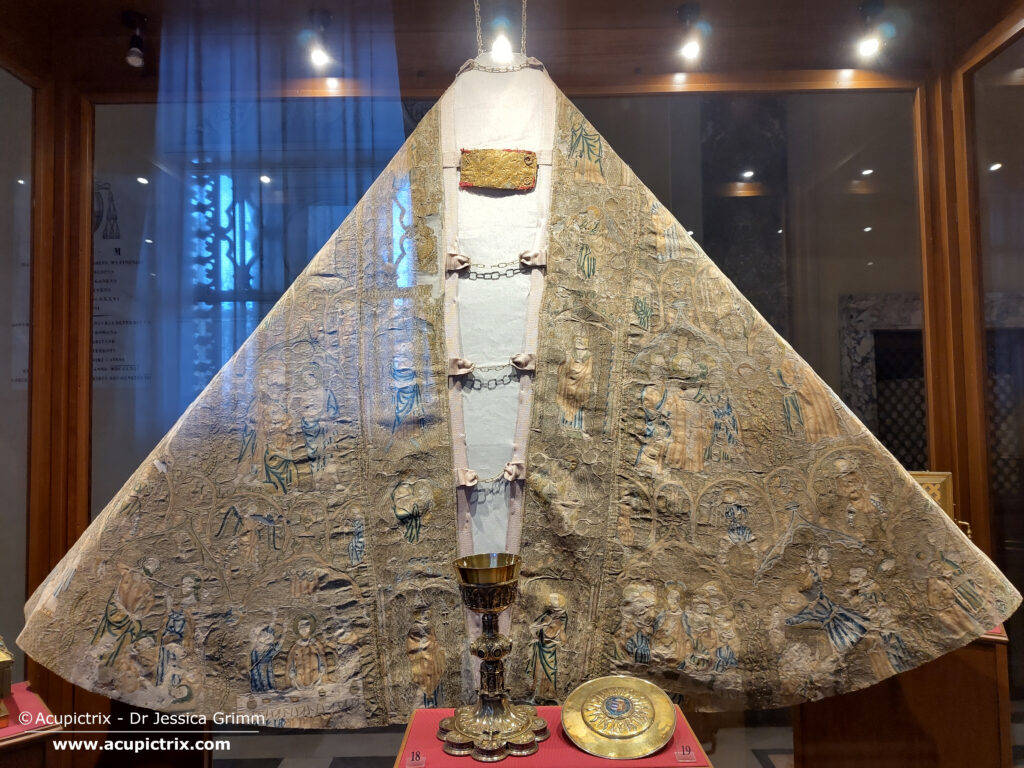
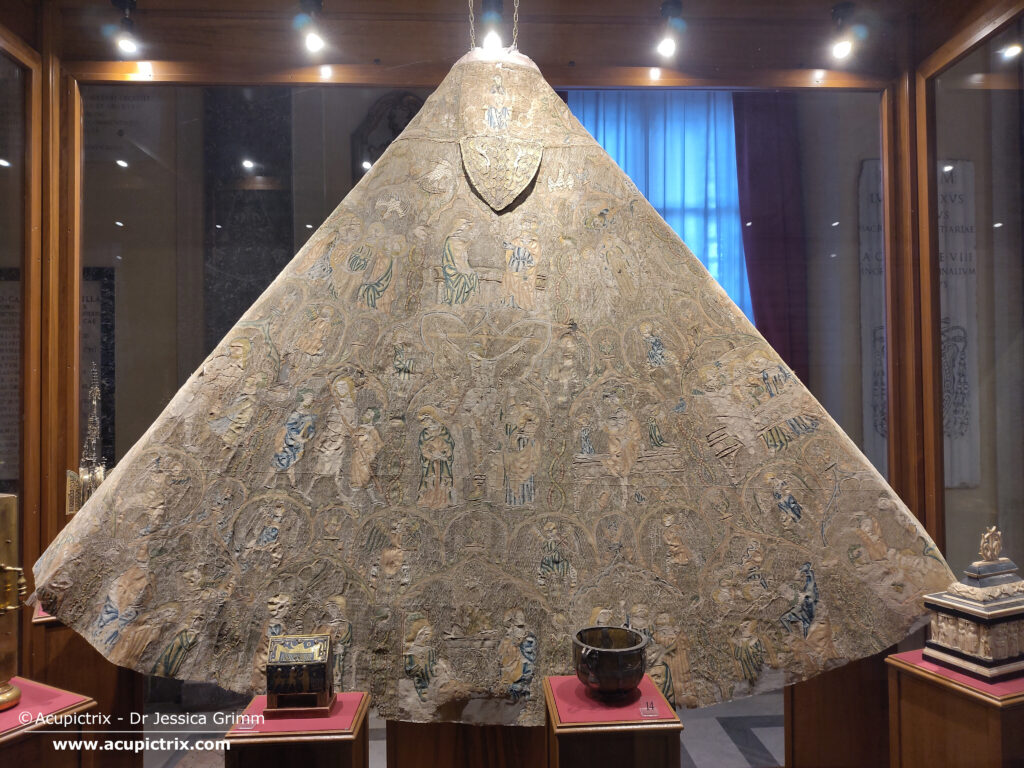
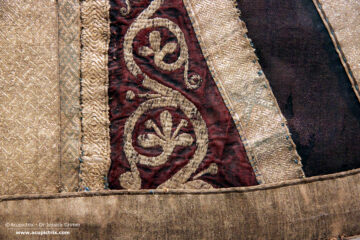
As you can see in the pictures above, although the Lateran cope is very worn, it is mostly intact. It still has its original orphrey and its original hood. Unfortunately, at some point, someone shortened the cope by cutting off a small strip along its semi-circular seam. This was likely done to make it fit a shorter clergyman. Can you imagine cutting through pristine embroidery like this? Shudder. The Lateran cope was not part of the 2016-2017 Opus anglicanum exhibition in the V&A in London. However, the cope is depicted on page 57 of the exhibition catalogue. The cope is also included in Christie’s opus magnum. As far as I know, those are the only “recent” publications of this magnificent cope. If you know of another reference, please comment below (for spam reduction, you need to be logged in).
The Lateran cope gets its name from the Roman church where it has been housed. However, I doubt this cope was always part of the church’s treasury. And this has to do with its revised date. Both the museum and Christie date this cope rather early – between AD 1250 and AD 1300. This is based on the belief that Pope Boniface VIII wore this cope when celebrating the Jubilee of AD 1300. However, the catalogue of 2016 (see below) dates the cope to c. AD 1340-1360. Far too young to be worn at said Jubilee. In addition, the popes resided in Avignon, France, from AD 1309-1376 and not in the Lateran Palace in Rome. Besides, the Lateran Basilica and Palace were in disrepair at this time and would not be restored until under Pope Sixtus V in the 16th century. As these splendid Opus anglicanum copes were often gifted by the English King to the Pope or another very high-ranking clergyman, it is unlikely that the Lateran cope was gifted to Rome when the Pope and his entourage resided in Avignon.
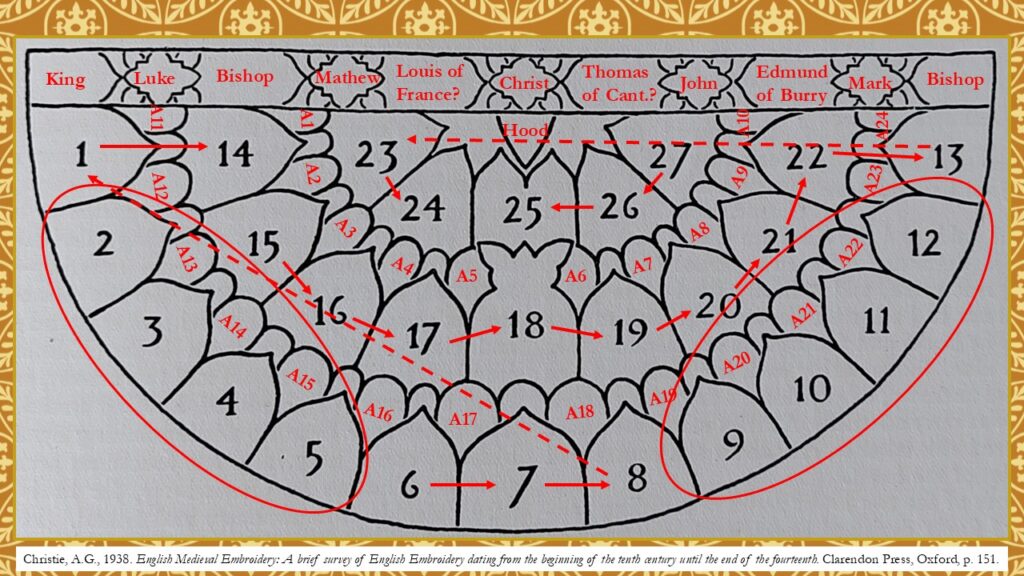
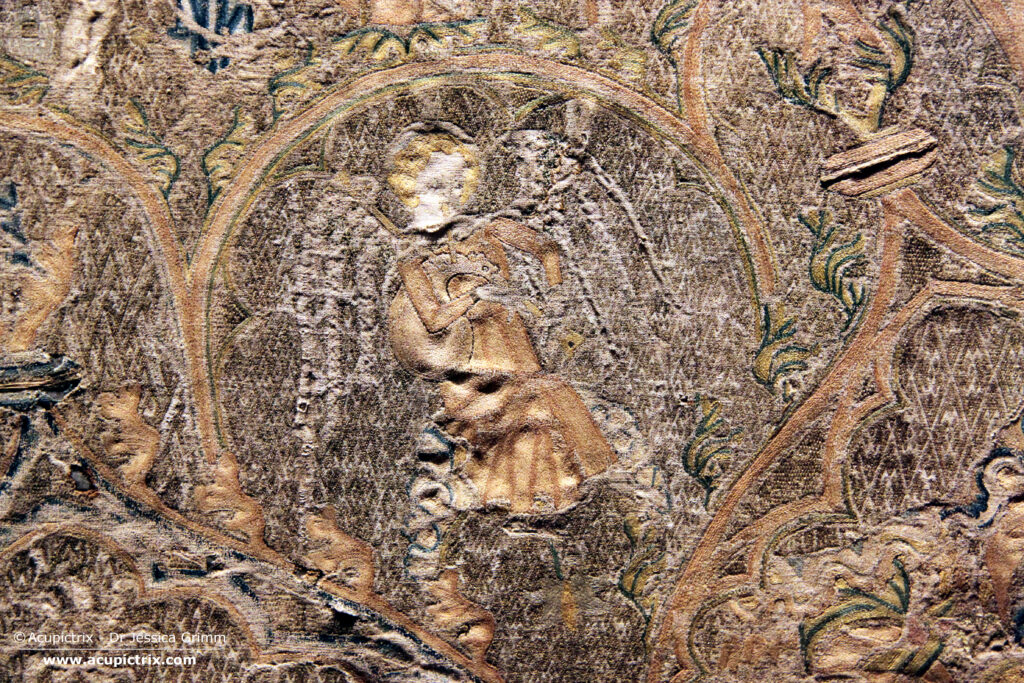
The embroidered scenes on the Lateran cope tell more than one story. The medieval designer or designers cleverly arranged the scenes across the semicircular canvas. The main story is that of the lives of Mary and Jesus. It starts at #6 with the Annunciation, followed by the Nativity and the Adoration of the Magi. There’s then a big jump in both space on the cope and time. The story continues at #1 with the Last Supper, culminating in the Crucifixion at #18 and continuing to Pentecost at #24. A somewhat separate story starts at #27 with the Annunciation of Mary’s death, followed by her Assumption and culminating in her Coronation at #25. As this is a somewhat separate story, the designer changed the reading direction. Also note that the three major scenes, Nativity, Crucifixion and Coronation sit prominently in the back of the wearer.
And then there are the minor stories. Scenes #2- #5 and #9- #12 depict scenes from the lives of important Saints. Of these, the apostles, Saint Lawrence, Saint Stephen, and the two holy Virgins were popular choices across Europe; Saint Edmund of Bury and Thomas of Canterbury were typically English. Both are also repeated on the Lateran cope’s orphrey. You could see them as a kind of provenance mark for the embroidery. Last but not least, 24 angels play musical instruments.
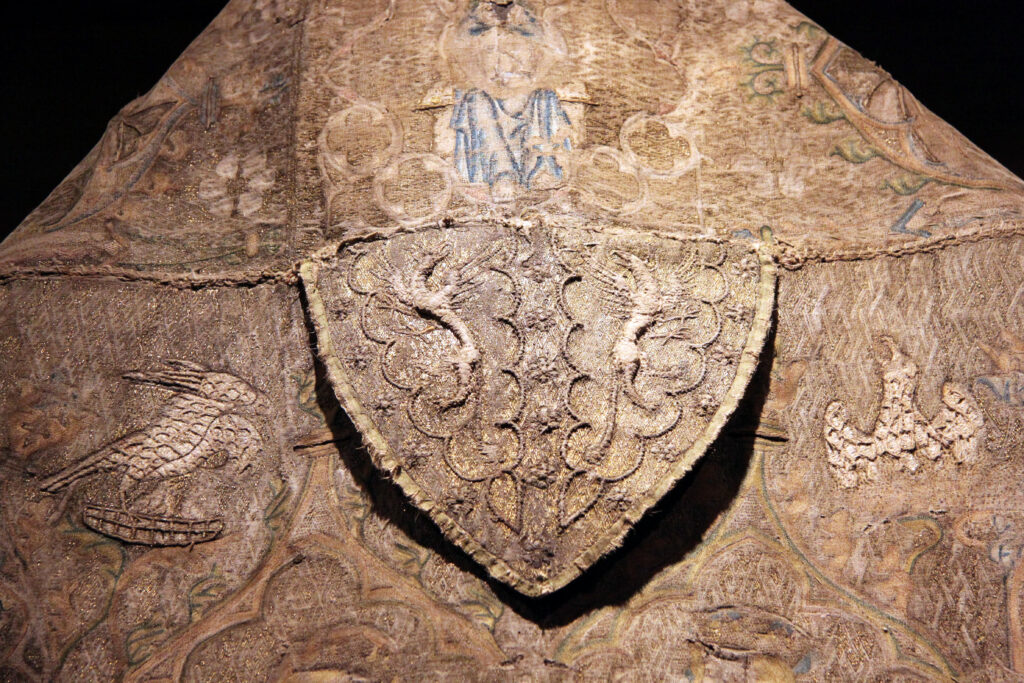
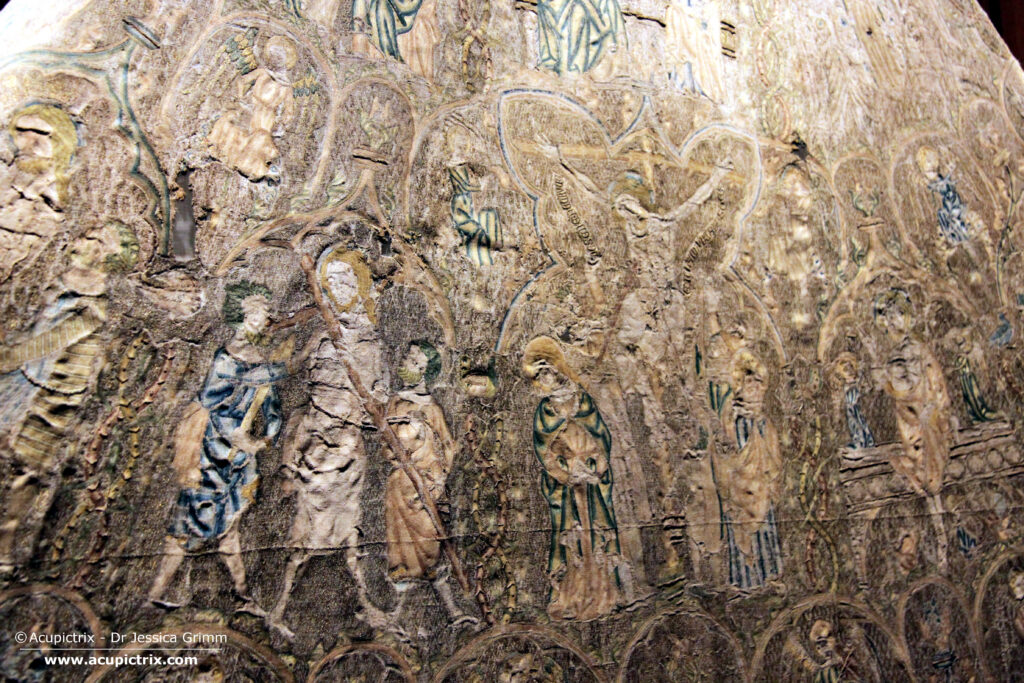
The many stories embroidered on the Lateran Cope already show that this is a complex, high-end piece of medieval embroidery. But what about the embroidery itself? For starters, it features beautiful shaded, directional split stitch on the silken parts. To add extra texture, some areas are stitched in counted-thread techniques like brick stitch and condensed Scotch stitch. But it is the underside couched golden backgrounds that really set this cope apart from, for instance, the vestments in Anagni or the Bologna cope. In the picture above, you can distinguish at least six different diaper patterns. Some are very complex. And then there’s the cope hood itself and the pelican and phoenix sitting on either side of it. The feathers of these birds have been accentuated with white padding string. The same white padding string is used throughout the cope. Some is covered with passing thread in guimped couching, and some has been trailed with coloured silks. Other parts are now completely blank and were probably once covered with freshwater pearls. A few pearls remain on the flower petals on the hood.
There’s far more to discover on the Lateran Cope. More than I can comfortably pack into a blog post. So I created the first in a new video series called “The Illuminated Stitch“. In these videos, we explore the history, iconography and embroidery techniques in great detail. Enjoy!
Literature
Browne, C., Davies, G., Michael, M.A. (Eds.), 2016. English Medieval Embroidery: Opus Anglicanum. Yale University Press, New Haven.
Christie, A.G., 1938. English Medieval Embroidery: A brief survey of English Embroidery dating from the beginning of the tenth century until the end of the fourteenth. Clarendon Press, Oxford.
0 Comments