In the past, I have written several blog posts on the amazing embroidered vestments dating to the 13th century in the Cathedral Treasury of Anagni. If you ever get a chance to visit this museum, you will not regret it. Today, I am going to introduce you to an Opus anglicanum cope with scenes from the Life of Mary and Jesus. It also belongs to the donations made by Pope Boniface VIII (c. 1230-1303) to his hometown cathedral in Anagni, Italy. In turn, Boniface VIII, or one of his predecessors, received several Opus anglicanum vestments from the English king. Or is the story perhaps a little different? Is this “counterfeit” Opus?
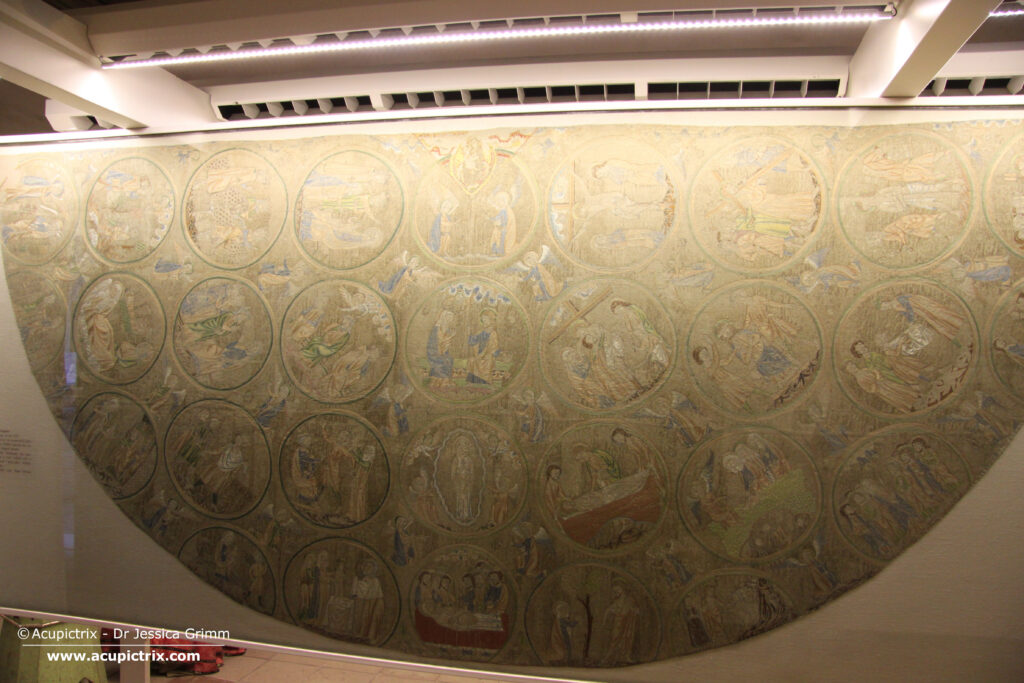
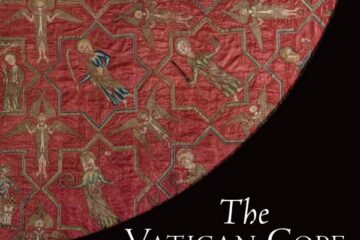
Although the 30 scenes on this Opus anglicanum cope tell the story of the lives of Mary AND Jesus, it really is all about Mary. Medieval girl power at its finest. You can tell by paying attention to where the scenes sit when the cope is worn. Naturally, the scenes on the back are best displayed. The rest of the vestment folds around the wearer. Now look at the picture above. Which scenes are prominently displayed on the central axis that would sit on the back of the wearer? It starts with the Dormition, or Mary’s deathbed, at the bottom. It is followed by her Assumption into heaven and her coronation as Queen of Heaven. The other 26 scenes are divided between Jesus’ birth and childhood on the left and his Passion and Resurrection on the right. But really, it is all about Mum!
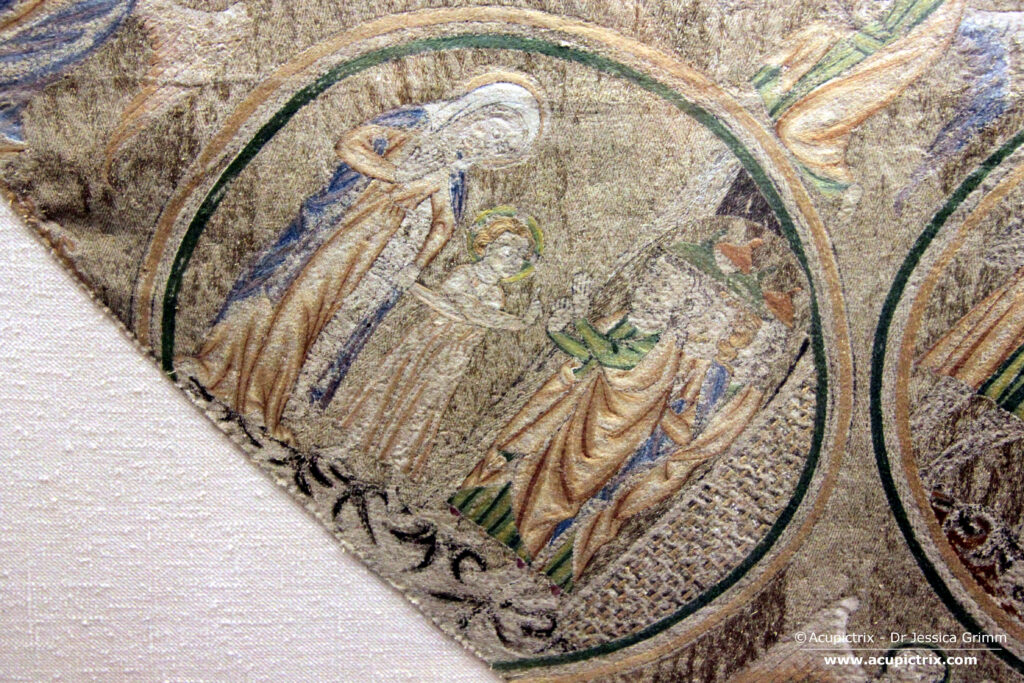
Personally, I love the above scene called “Christ amongst the doctors“. See those twisted arms? His annoyed mum is jerking away teenager Jesus. She has clearly no patience for his debating skills. Time to go home, young man! The designers of Opus anglicanum had a great sense of humour!
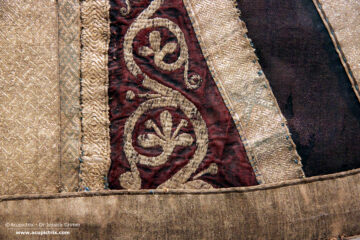
If you are familiar with Opus anglicanum copes, you have probably also noticed that this one isn’t complete. It is missing its orphrey at the top and its fringe or something similar at its semi-circular seam. The tiny triangular hood is also a later addition. It was made in the 14th century in Italy’s Lazio region.
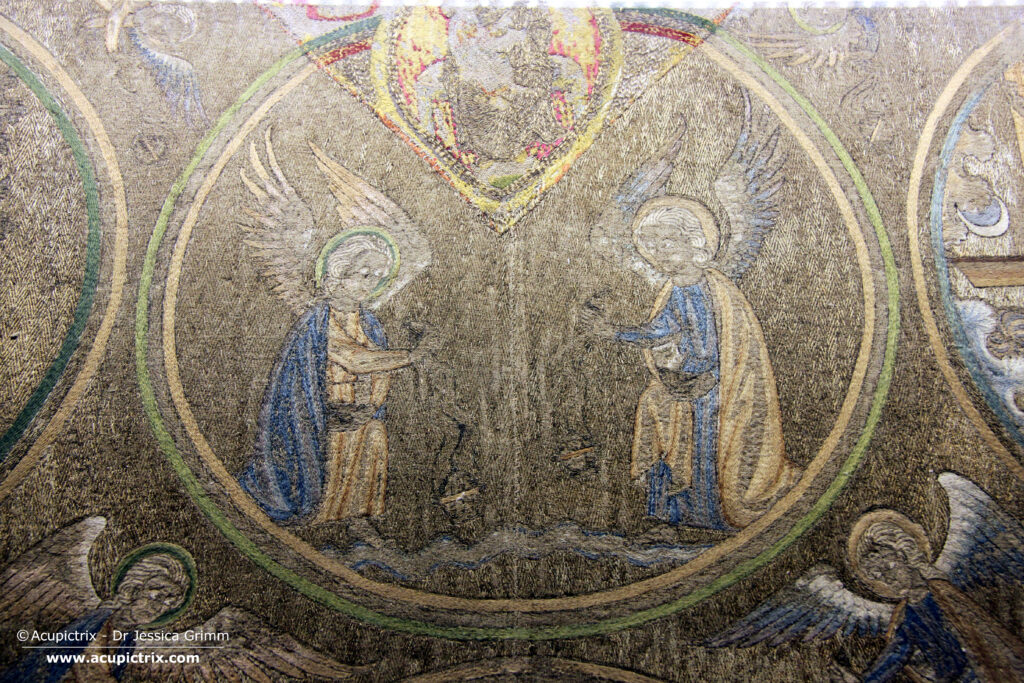
Why would someone remove the original Opus anglicanum hood and replace it with this 14th century one? Well, churches love to recycle vestments. And this cope was likely turned into a bell chasuble for a while. That’s easily done. Sew the straight edge together, but leave an opening for the head. The cope hood was in the way as it sat precisely where the priest’s head needed to come through. Probably sometime in the 14th century, the chasuble became a cope again, and a new hood was needed.
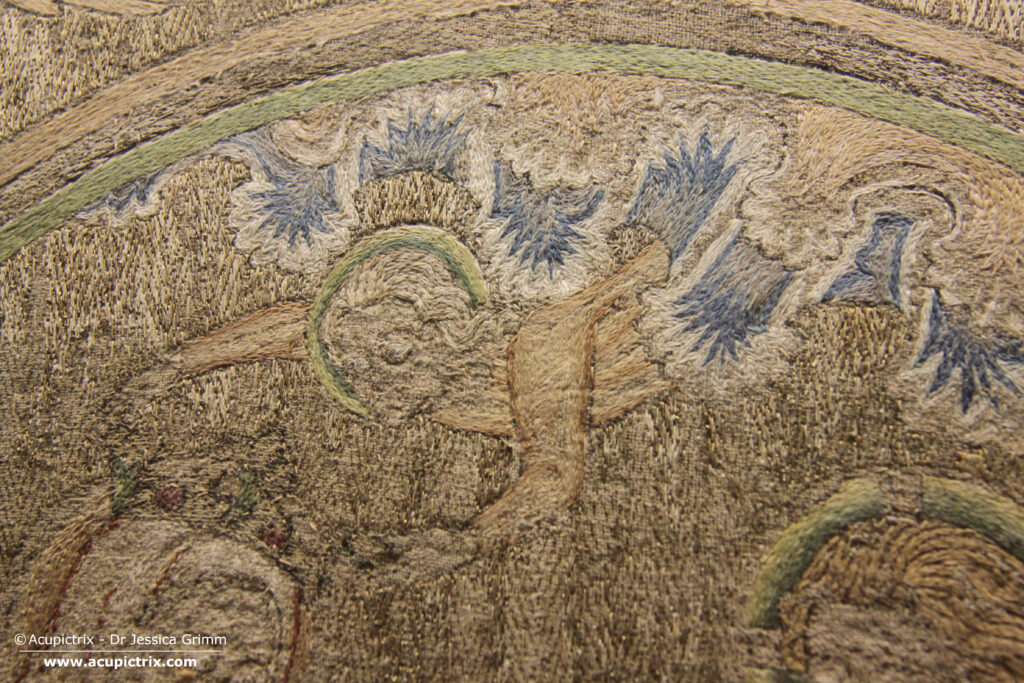
But is the Cope of the Virgin in Anagni true Opus anglicanum? No one knows for sure. It might have been made in France instead. Yes, it has beautiful underside couching in a simple chevron pattern with gold threads for the background. It also has beautifully worked split stitch for all the silk embroidery. The embroidery is worked on a double layer of linen – fine at the top and more coarse at the bottom. All typical of true Opus. But the scenes have a French flavour. There’s even a very similar cope in Saint-Maximin-la-Sainte-Baume (click the link for some splendid pictures) in France known as the cope of Saint Louis of Anjou. Seven of its scenes are duplicated on the cope in Anagni. The copes are so similar that some researchers think that they were made in the same French workshop. What do you think? True Opus anglicanum or a counterfeit product from France?
Literature
Elster, C., 2018. Die textilen Geschenke Papst Bonifaz’ VIII. (1294-1303) and die Kathedrale von Anagni: Päpstliche Paramente des späten Mittelalters als Medien der Repräsentation, Gaben und Erinnerungsträger. Michael Imhof Verlag, Petersberg.
Sur, F., 2013. La chape de Saint-Louis d’Anjou. Trésor du XIIIe siècle de l’opus anglicanum, Basilique Sainte-Marie-Madeleine, Saint-Maximin-la-Sainte-Baume. Somogy Éditions d’Art, Paris.
0 Comments