Historically, the study of Opus anglicanum embroidery mainly investigated the vestments from the Gothic era. Those large all-over embroidered copes with fine silk embroidery in directional split stitch and backgrounds in golden underside couching. The pieces from the High Middle Ages are far less known. Although Christie’s “English Medieval Embroidery” from 1938 did include pieces from the High Middle Ages. More recently, Alexandra Lester-Makin published her PhD thesis on “The lost art of the Anglo-Saxon world” with the Early Medieval embroideries made in England. But, so far, there was no study of the Opus anglicanum pieces from the High Middle Ages. Caroline Vogt’s “Hochmittelalterliche Bischofsgewänder mit Goldstickereien“, published by the Abegg Stiftung, fills this gap. Once I have read the whole book (435 pages!), I will write a proper review. For now, we will look at one of the pieces mentioned in the book: the Bernhard Chasuble kept at Dommuseum Hildesheim.


The bell chasuble with Opus anglicanum embroidery kept at the Dommuseum Hildesheim once was dark blue (now dark purple). The orphreys on the front and back are stitched on red silk. The chasuble is known as the Bernhard chasuble after bishop Bernhard I of Hildesheim (died AD 1153). It is part of the textile treasury of St. Godehard Benedictine Abbey. The chasuble measures 136 cm at the middle back and dates to around AD 1130-1160. Despite its 900 years, the chasuble has minimal damage – only the strip of embroidery on the back is missing. One wonders if one of the “embroidery hunters” of the 19th century paid a visit and brought a pair of scissors …

The embroidery fabric consists of a patterned samite backed with a high-count linen (43-51 x 46-51 ct). The chasuble was assembled before the Opus anglicanum embroidery of the powdered rosettes and crescents commenced. These small motifs are arranged radially so the crescents stay upright when the vestment is worn. The embroidery is executed in underside couching in a bricking pattern with a linen thread over a single or a pair of gold threads. The bricking stitches are placed every 2-4 mm with 33-35 threads per centimetre. Interestingly, the gold threads lay parallel to the warp threads of the samite regardless of their radial placement on the vestment. As you can see in the above picture, the empty space between the different parts of the rosette might have been filled with a silken contour stitch. If so, it has completely deteriorated.

The Opus anglicanum embroidery on the orphreys shows scroll motifs. The embroidery fabric consists of a red samite backed with linen (28-31 x 28-33 ct). Again, the pair of gold threads lay parallel to the warp threads of the samite. The only exception is the tendril on the right, where the threads fan out in a tight spiral. The larger parts of the scrolls are underside couched in a bricking pattern (3-5 mm between stitches, c. 36 threads per centimetre). Thinner design elements only have a couching stitch on the design line.
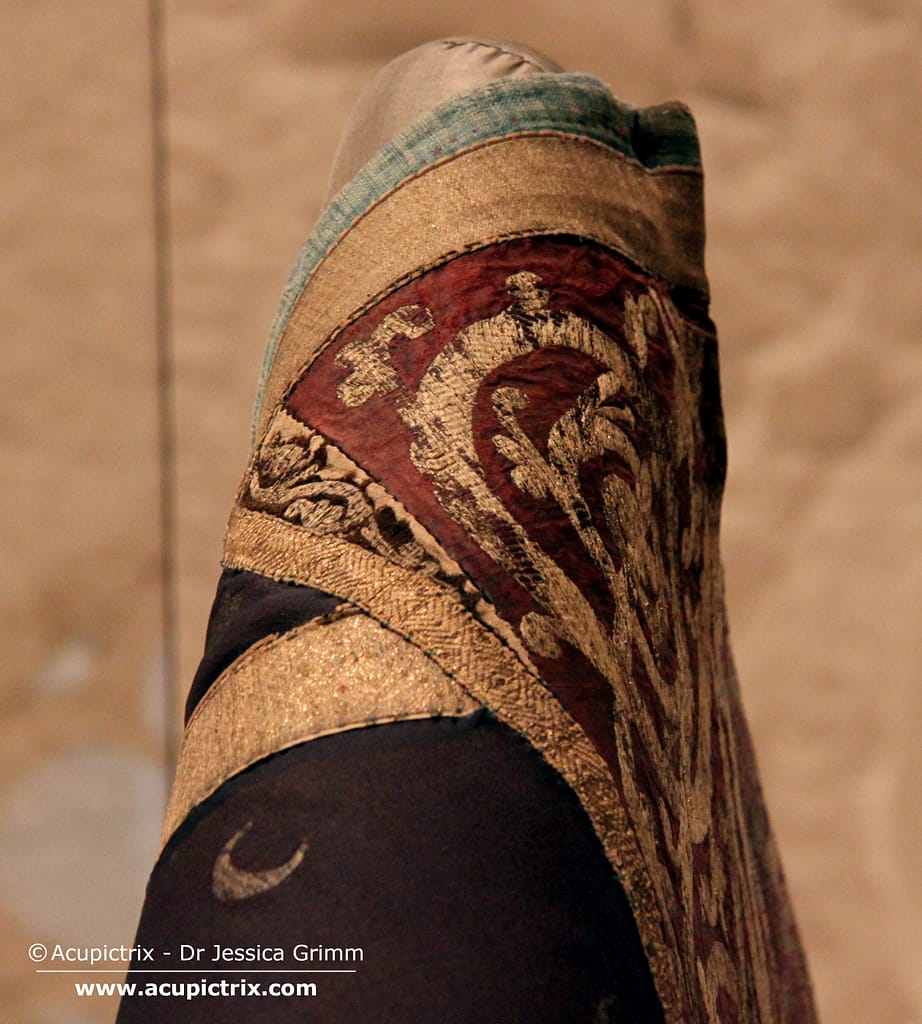
See that tiny triangular piece of Opus anglicanum embroidery on dark purple fabric? It was needed on one side only to fill a small gap. The orphrey on the back was simply a tiny bit too small. You wonder what the story is. Did someone not measure properly? Was there a slight panic during assembly? Or did the workshop simply have a box full of scraps for occasions like these?
Literature
Vogt, C., 2026. Hochmittelalterliche Bischofsgewänder mit Goldstickereien. Abegg Stiftung, Riggisberg.
0 Comments