In August 2017, my husband and I visited the Diocesan Museum in Brixen and the Stadtmuseum Klausen, both in Northern Italy. These museums have spectacular collections of historical embroidery with several pieces on display. You can read more on that specific road trip in this blog post. What caught my eye at the time was a linen chasuble embroidered with large silk flowers. The flowers had a folk feel, and the colours were very bold. It took me a while to find out more about them. It involved a misnomer and lovely help from the curator at Brixen. And when I started to recreate the flowers myself, I learned a new embroidery technique: a variation on the well-known Bayeux Stitch.
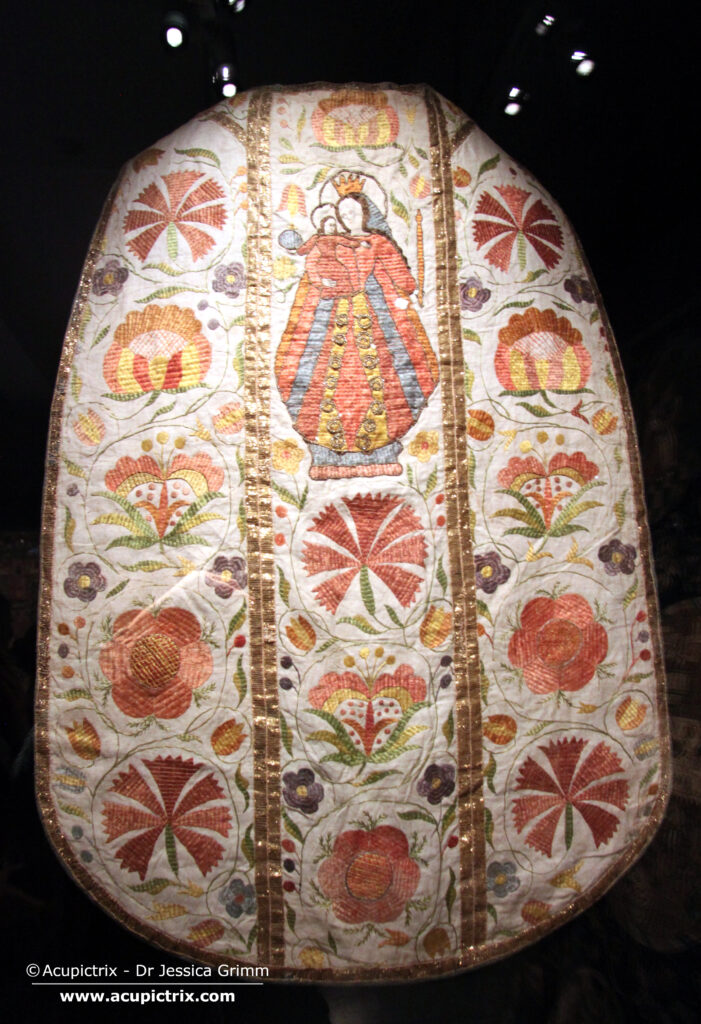
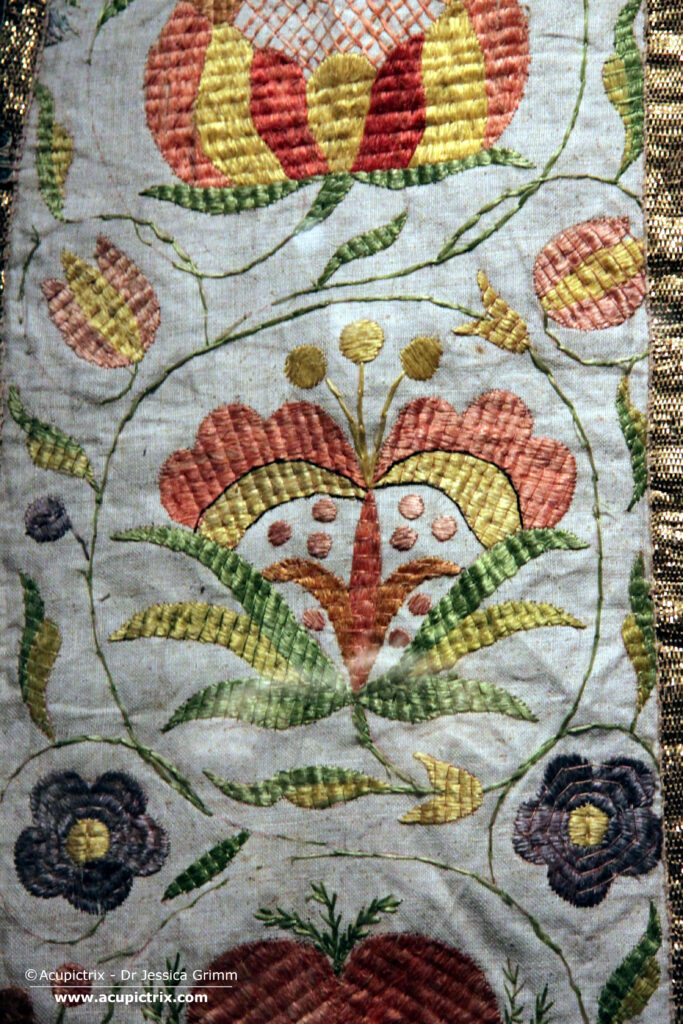
The designs on these linen vestments from Tyrol are not unlike what we see in Jacobean crewelwork. This is not surprising as both embroidery styles are roughly from the same period. The inspiration was likely for both the imported Indian printed cottons at the time. In England, these exotic flowers were combined with local fauna. The linen vestments from Tyrol have religious imagery besides these bold flowers. You can see the Virgin and Child centrally displayed on the back of the chasuble above. Interestingly, there are no alpine flowers stitched on the Tyrolian vestments. The national flowers of Austria are the Gentian and the Edelweiss (all of Tyrol belonged to Austria until 1919).
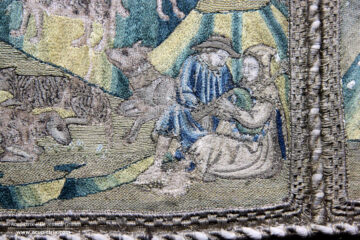
Since I compiled my original eBook in 2018, a lot has happened. As I continue to visit museums, I occasionally come across vestments belonging to this specific group of 17th-century linen vestments from Tyrol. I was able to handle a piece in the V&A collection back in November 2019. And in 2022, I came across a piece on display at the Schweizerisches Nationalmuseum (see pictures above). Besides me seeing pieces, many more museums now have an online database. I therefore decided to update my original eBook. It is available for download from the members’ section of my website. The eBook includes the detailed (video) instructions to work the eight flowers seen on the Brixen chasuble, historical background and a list of museums that have these pieces in their collection. Enjoy!
Literature
Bampi, J., 2011. Historische Paramente in Tirol: eine Einführung. In: Neue Stofflichkeit. Textilkunst durch die Jahrhunderte, Südtiroler Künstlerbund, pp. 11-19.
Hörmann-Weingartner, M., 2000. Seidenbestickte Leinenparamente des frühen 17. Jahrhunderts aus Tirol und ihre Vergleichsbeispiele, Der Schlern 74, pp. 407-438.
0 Comments