Last week, we looked at a piece of medieval embroidery from the Museo dell’Opera del Duomo di Pisa in Italy. The cope known as the Gelasius II cope exhibits embroidery from the first half of the 14th century and an orphrey from the first half of the 15th century. As the embroidery is very worn, we will examine the orphrey using a chasuble from the Victoria & Albert Museum in London. The orphrey on this chasuble has clearly been adapted to the current chasuble and originally likely came from a cope, too. And amongst the orphrey panels of the cope in Pisa sits an intruder. Let’s have a closer look!
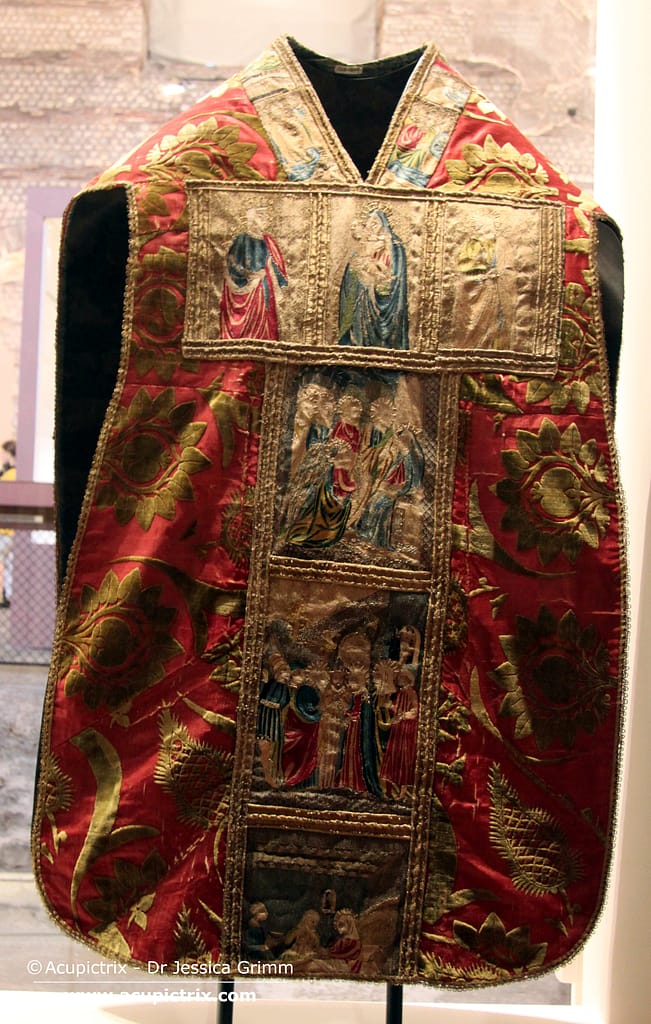
115.5 x 74 cm, inv.nr. 329-1908.

115.5 x 74 cm, inv.nr. 329-1908.
The above chasuble from the Victoria & Albert museum shows a probable cope orphrey that has been adapted (cut) to fit the current chasuble. The medieval embroidery on the front features two orphrey panels, each cut in half to line the neckline. These two panels show the Dormition and the Assumption. Below that are three panels showing St John, Mary with Child and Saint Catherine, followed by the Announcement of her Death to Mary, the Marriage of Mary and Joseph and the Nativity of Mary (cut). On the back of the chasuble, from top to bottom: Annunciation, Presentation of Mary at the Temple, Saints Joachim and Anne meet at the Golden Gate, Saint Joachim Expelled from the Temple and the Revelation of Saint Joachim (cut).
Together, the above scenes form the well-known cycle of the Life of Mary. This particular rendition has been linked to the embroidered orphrey of an antependium from Santa Maria Novella in Florence. The Florentine artist Paolo Schiavo (AD 1397-1478) was paid for the design in AD 1466. We will have a look at the medieval embroidery on this antependium next week. In turn, Schiavo’s designs go back to an older version by Giotto (c. AD 1267-1337).


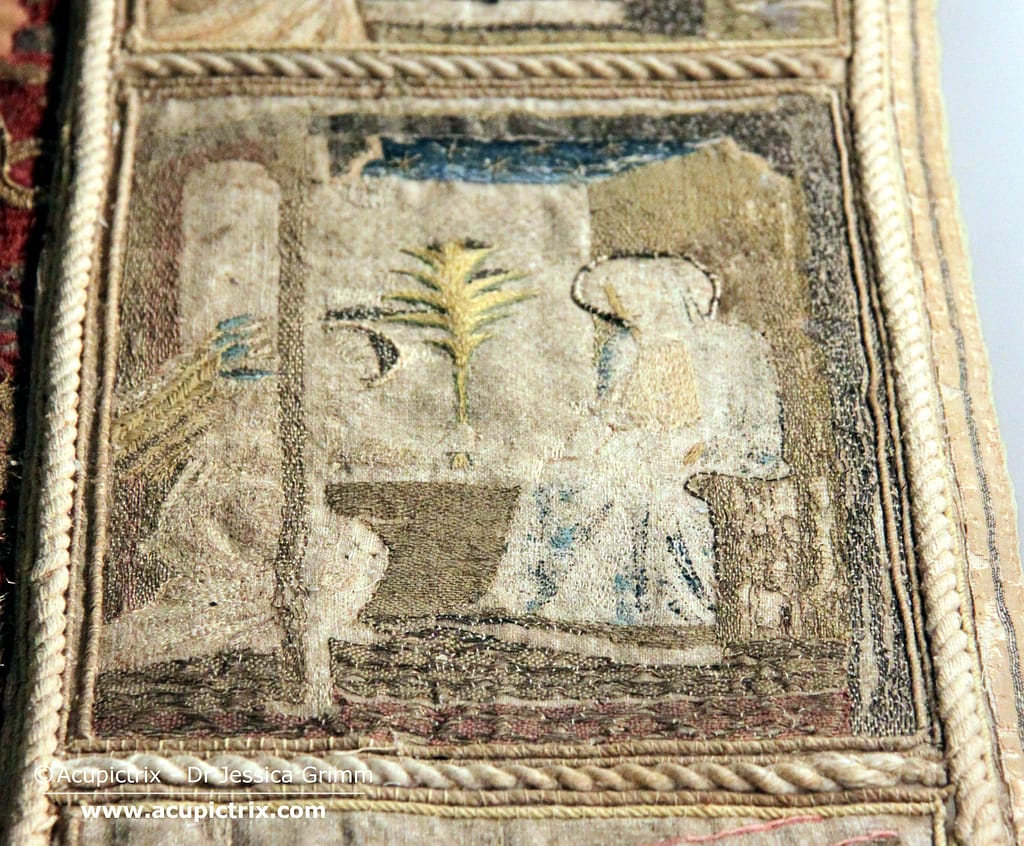
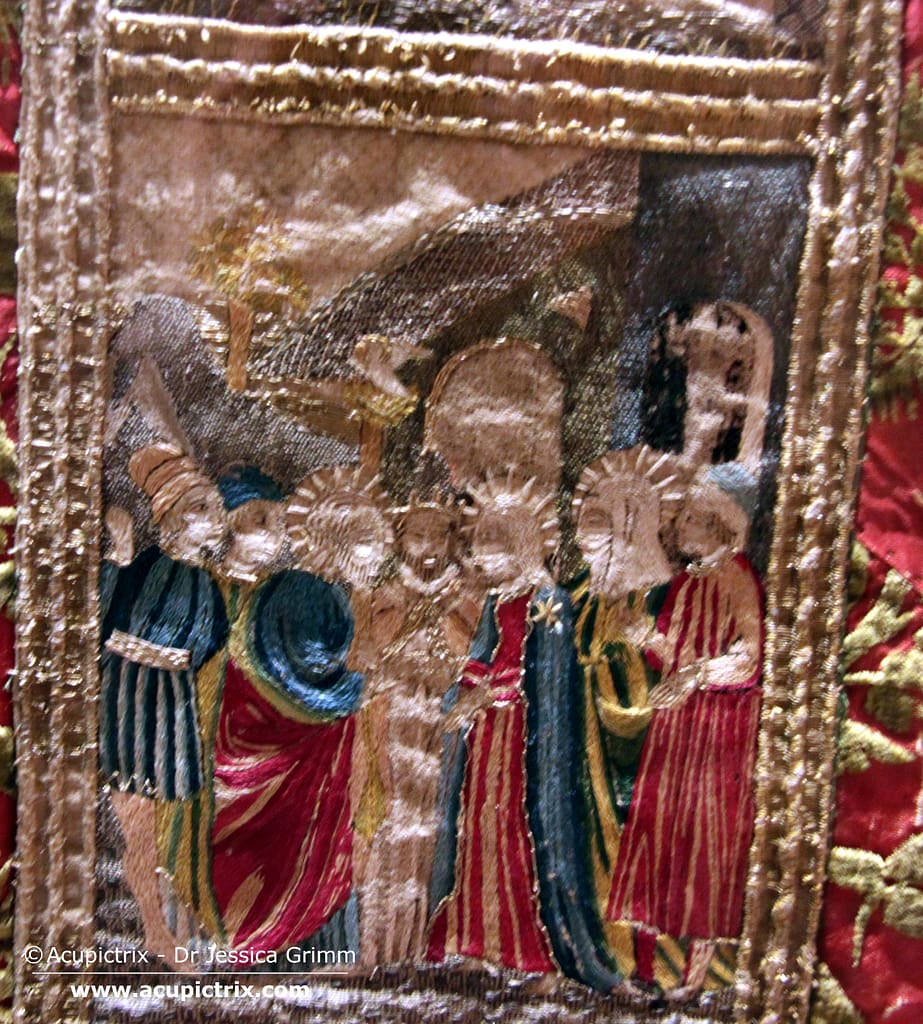
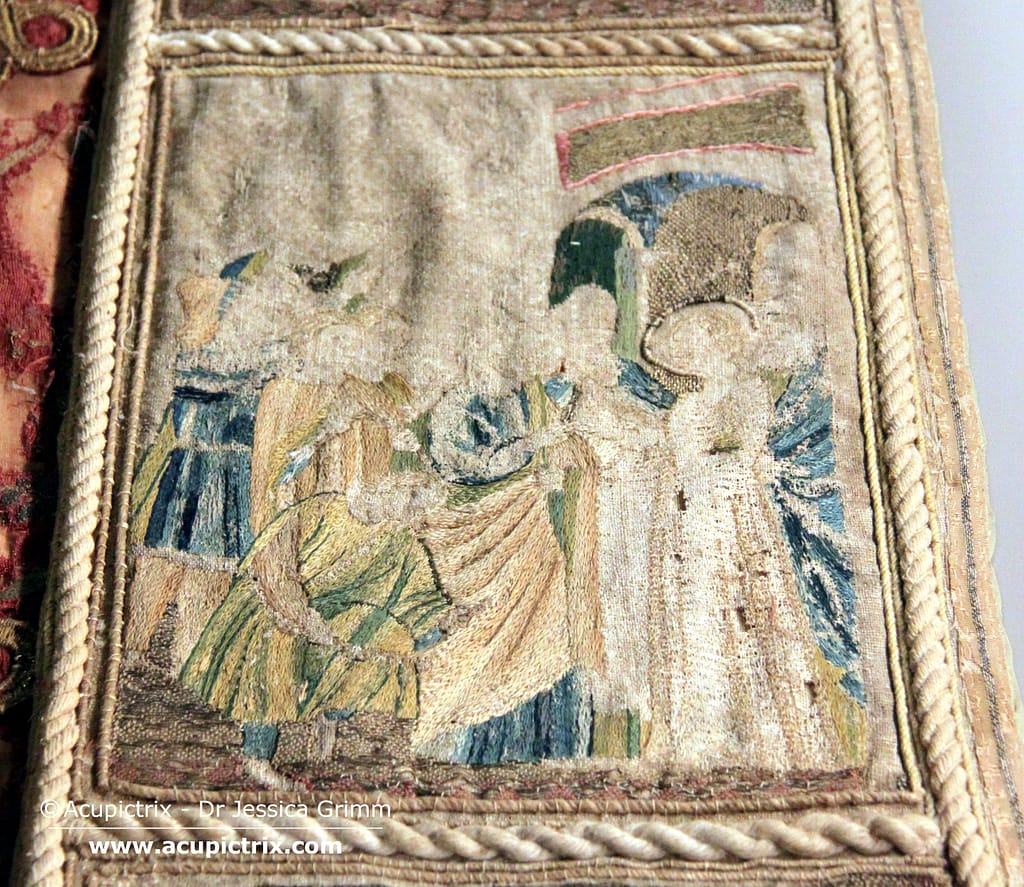
From the comparisons above, you can tell that these two pieces of medieval embroidery are clearly related. However, the design drawings used to create the two pieces were definitely not the same. Together with the fact that the embroidery techniques used for the different parts of the design also differ, makes it unlikely that both orphreys were made in the same Florentine embroidery workshop. Especially the differences in the orphrey panel frames, something I think was workshop branding, are obvious.
And there are differences in the orphrey panels present between the two pieces of medieval embroidery, too. The chasuble from the Victoria & Albert Museum shows Saints Joachim and Anne meet at the Golden Gate and the Annunciation of her death of the Blessed virgin Mary. Neither scene is present on the cope in Pisa. Contrary, the Visitation, Noli me tangere and the Coronation of the Virgin are present on the cope in Pisa. I think, depending on the size of the cope, the embroiderer could slightly vary the number of orphrey panels needed.
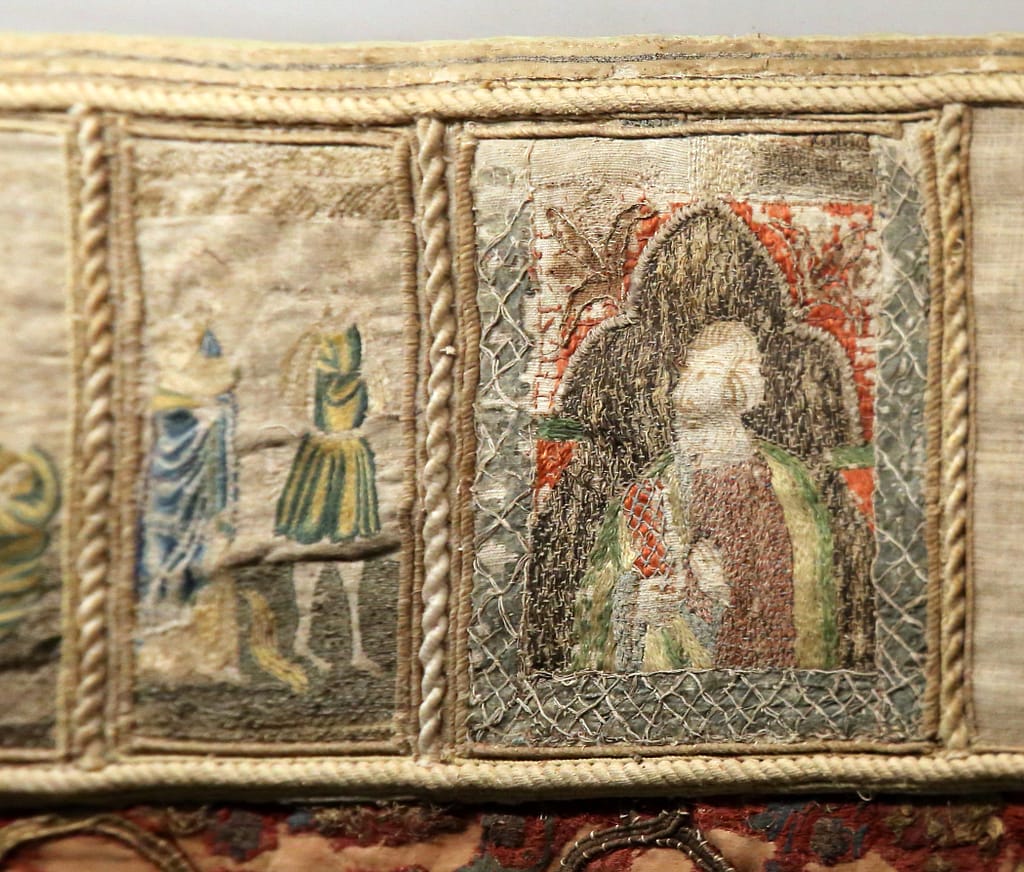
And then there are these additional, differently shaped, orphrey panels on the chasuble, showing Saint John, the Virgin Mary with Child, and Saint Catherine. Similar-shaped scenes are depicted in the “neck” area of the cope’s orphrey in Pisa. One scene seems to depict Noli me tangere, which is not normally part of the cycle of the Life of Mary. The other two scenes feature two people and are, unfortunately, indecipherable to me. And then there is the “intruder”. A very different piece of embroidery showing the bust of a male. Clearly not originally part of the orphrey with the panels showing episodes from the Life of Mary. Where does it come from? Was it also made in Florence in the second half of the 15th-century?
Literature
Coatsworth, E., Owen-Crocker, G.R., 2018. Clothing the past: Surviving garments from early medieval to early modern Western Europe. Brill, Leiden.
Descatoire, C. (Ed.), 2019. L’art en broderie au moyen âge: Autour des collections du musée de Cluny. Musée Cluny, Paris.
0 Comments