Here’s my latest book review! For most of you, it will come as no surprise: I am a book lover! And many of you regularly mention embroidery books to me, which would be worthy additions to my library. The Lost Art of the Anglo-Saxon World by Alexandra Lester-Makin is one of these latest additions. It isn’t a project book, but a properly published PhD thesis. Don’t let that scare you. As Alexandra is both an archaeologist and a Royal School of Needlework apprentice, this makes for an interesting read. Research into other art forms, such as painting and sculpture, never goes out of fashion. Researching embroidery and its makers seems to go through cycles. At the moment we clearly experience a renewed interest in this often under-appreciated art form.
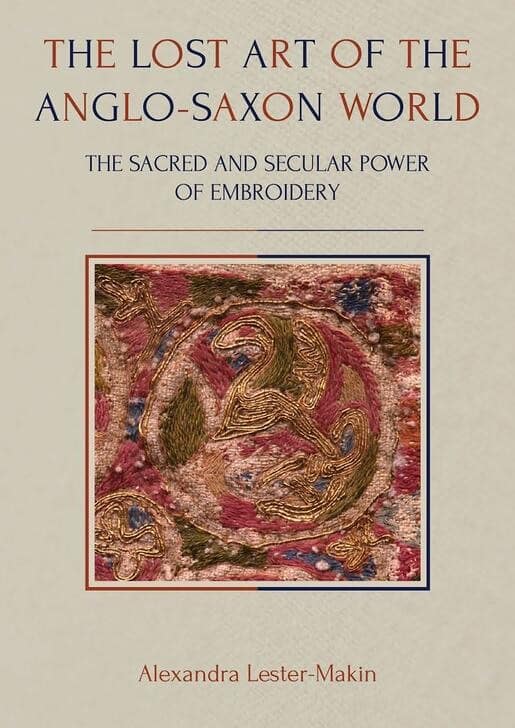
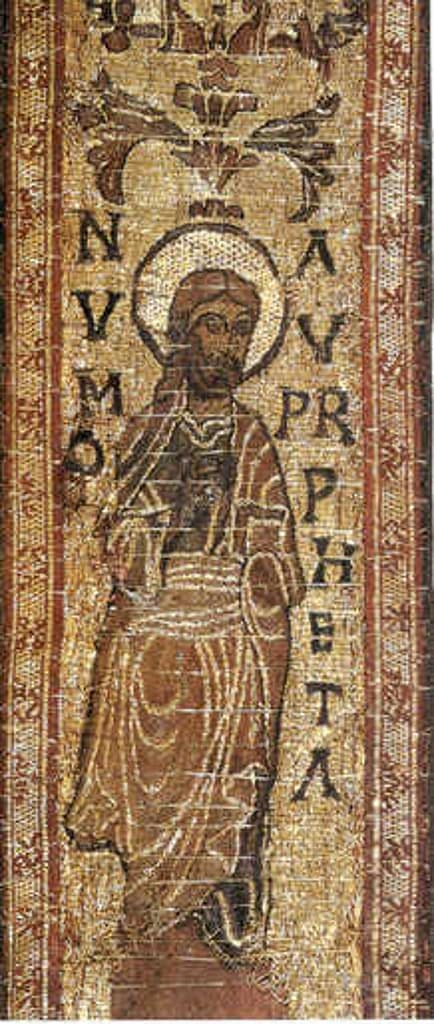
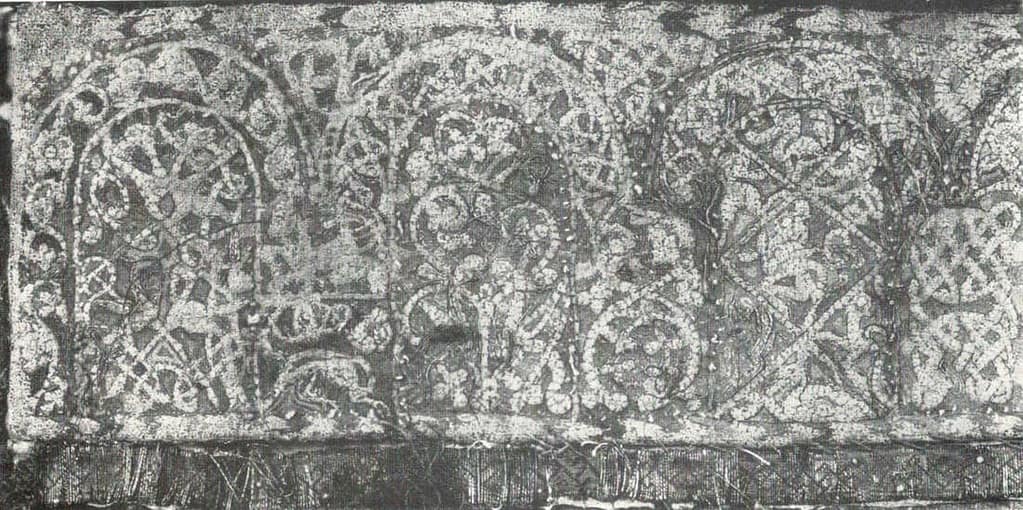
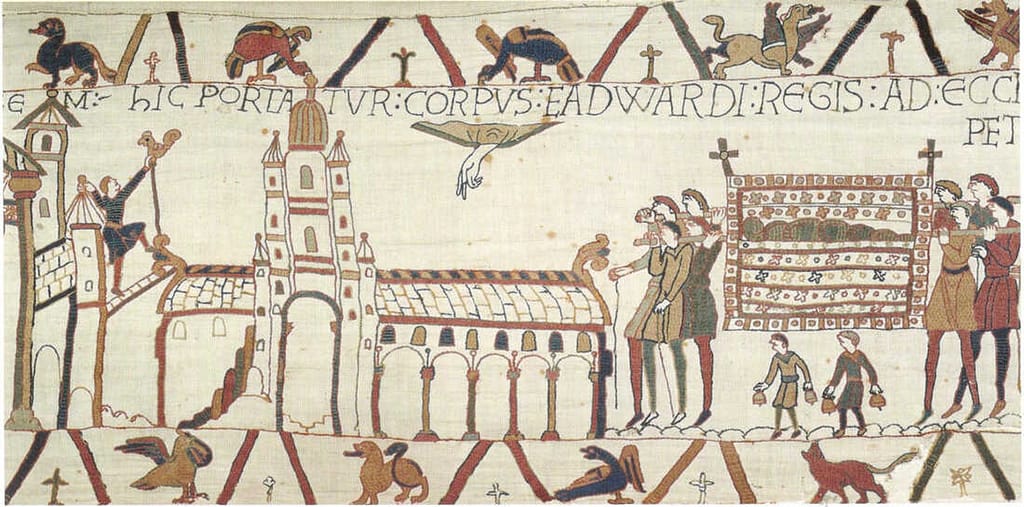
The book is divided into six chapters and comes with an elaborate catalogue. After a chapter on the introduction of Anglo-Saxon embroidery comes a chapter on the data and its difficulties. As you probably already knew, there isn’t much embroidery left from the Early Medieval period (c. AD 410-1066 for the British Isles). For the more than 600 years under scrutiny, only 41 embroideries remain. Of these, only three are more or less complete: the Cuthbert embroideries from Durham, the Maaseik embroideries in Belgium and the Bayeux tapestry. All other embroideries are fragments. In some cases, only the holes have survived and not the embroidery thread. In other cases, no original material remains, as we deal with an imprint on a metal object (mineralisation) or complete carbonisation due to fire. Oh, and then there are fragments unavailable for inspection because they are too fragile, mounted in a way that makes them inaccessible, or have simply vanished… Precisely dating them is often a problem too.
As a fellow archaeologist who worked with animal bones instead of embroideries, I was rather sceptical when I realised the dataset the research is based on is so small and fraught with difficulties. Would I have written my PhD thesis on 41 samples of animal bone, of which were three more or less complete skeletons, the rest fragments: either burnt, inaccessible or lost? Often only broadly dated. And then come up with a coherent story about husbandry, hunting, fishing, trade, and bone working over more than 600 years across all of Germany? Nope. Instead, I had thousands of bones in very good condition, many well dated, and almost all available for my inspection. Still, I couldn’t do more than draw tentative conclusions and hypothesise about animal keeping and the use of animal products in medieval Emden.
Does this mean that I think Alexandra did a bad job? No, not at all! But comparing her archaeological data set to mine hopefully shows you how little it is we really know. And that Alexandra had to develop a theoretical archaeological framework to extract as much information as she could from each data set entry. That she did rather brilliantly!
In chapter 3, Alexandra shows us in great detail how she extracts as much information as possible from an embroidery fragment by writing its object biography. In this object biography, she includes detailed technical analysis, careful study of related attributes and context, and related documentary evidence. This covers the fragment’s entire lifespan up to the present day. Being both an archaeologist and a professional embroiderer, Alexandra is very well equipped to undertake this kind of research.
With this theoretical research framework in place, she then analyses all the embroideries at her disposal. The results form the basis of chapter 4 (Embroidery in Anglo-Saxon society) and chapter 5 (Early medieval embroidery production in the British Isles). And I am quite impressed with the ideas she comes up with. For instance, although there are few written sources on the training of professional embroiderers in the early medieval period, her careful analysis of stitch length and execution leads her to conclude that embroiderers must have had extensive training to achieve the level of perfection they did. Or giving us archaeologists something to think about when we excavate a dwelling site. Could a certain building have housed an embroiderer? Is there enough natural light coming in? Can it be kept clean? Not necessarily lines of thought an archaeologist or an art historian would have come up with.
I find it harder to justify her conclusions about certain stitches going in and out of fashion, given the patchy nature of the dataset. Although they seem to correlate with the pagan versus Christian nature of society, we should not forget that this might be pure coincidence and could change when further embroidery fragments are unearthed. That said, I like the idea of looped stitch being viewed as the mythological serpent that both protected the pagan wearer and the seam from coming apart.
Personally, I have learned a lot from reading this book. Too often I am reluctant to publish my own embroidery research as I feel that my database is too patchy. Alexandra’s research approach has given me an opening on how to extract more information from my database. And she has given me the guts to put my findings out there despite the patchy nature of the database. After all: if you don’t put your hypotheses out there for contesting, you are not helping to advance the research of historical embroidery. Alexandra did and does.
Literature
Browne, C., G. Davies & M.A. Michael (eds.) (2016) English medieval embroidery: Opus Anglicanum. London: Victoria & Albert Museum.
Grimm, J.M. (2010) Animal keeping and the use of animal products in medieval Emden (Lower Saxony, Germany), self-published.
Lester-Makin, A. (2019) The lost art of the Anglo-Saxon world: the sacred and secular power of embroidery. Oxford: Oxbow Books.
Schuette, M. & S. Müller-Christensen (1963) Das Stickereiwerk. Tübingen: Wasmuth.

0 Comments