Although my library of books on medieval (goldwork) embroidery is filling more and more IVAR shelves, I still don’t have everything :). Hunting publications down is a slow process. There’s no central institution or website shouting new releases from the rooftop. Finding older publications often happens by reading through the footnotes and literature lists of publications already on my shelves. Chapters in books in which the subject is compared to other examples are especially helpful. In the book on the Emperor’s last clothes I showed you last week, I found some new-to-me information on the embroidery on the Imperial Regalia in Vienna, Austria. I’ve seen those. They are in a room very close to the spectacular or nué embroideries of the Order of the Golden Fleece. As the embroidered regalia are very old, they are not exactly in the limelight. The room is very dark. So the intriguing goldwork embroidery eludes probably most visitors. Let me introduce you to a very rare goldwork embroidery technique that I had never seen before.
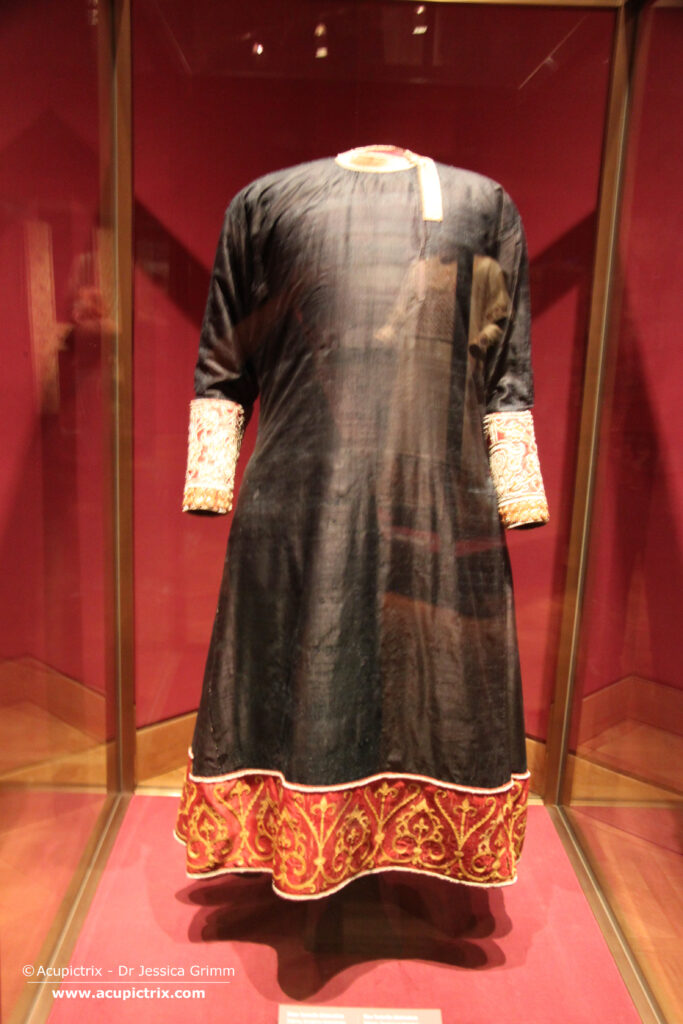
From the picture above, you can already tell that seeing details of the embroidery on the blue tunic is difficult due to the reduced lighting levels. The tunic was made in the first half of the 12th century in the Royal workshops of Palermo, Sicily. The red bottom seam contains embroidery in underside couching. This is seen in more pieces made in Palermo. The really intriguing embroidery is on the cuffs.
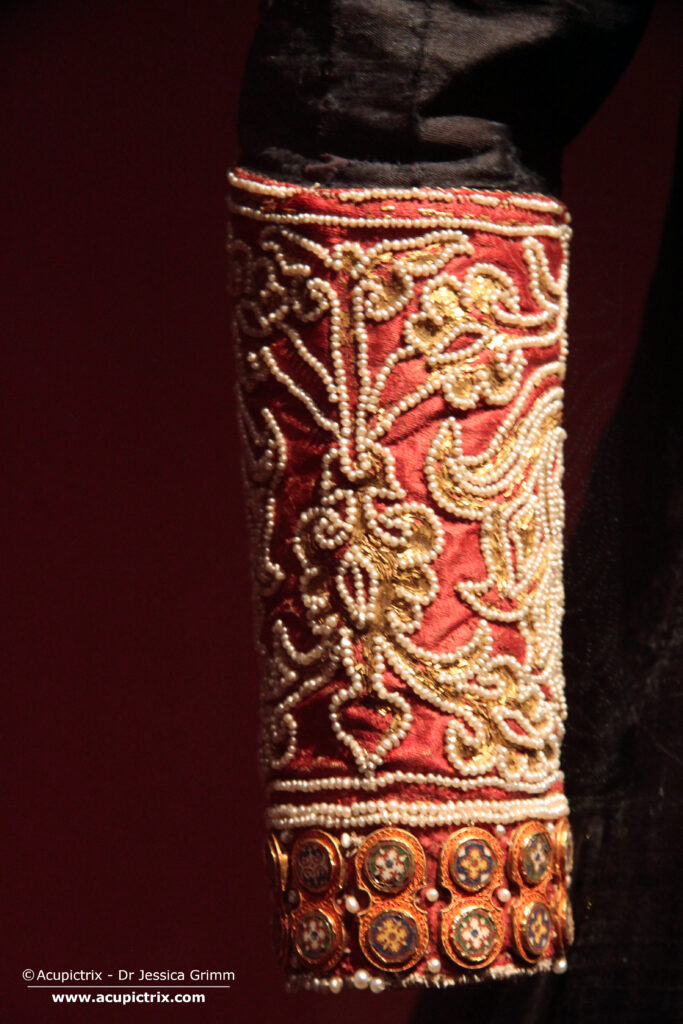
From this picture, you probably cannot instantly see what is so special about the goldwork embroidery technique used on part of the Imperial Regalia. If you look really closely, you might see that the embroidery is made of gold-foil tubes sewn down like elongated beads and then flattened. The museum’s website states that this is probably the only surviving piece in this technique. The museum’s caption mentions ‘gold tubes’ in the material list. But when you are not told where to look for them, it isn’t easy to spot them in the dimly lit room.
I am most intrigued by this embroidery technique as I feel that these golden tubes were quite fragile and easily deformed. Why did the embroiderer choose this technique for the blue tunic of the Imperial Regalia and not (underside) couching, also in use at the same time in the Imperial workshops? Is the effect achieved so different? Is it quicker to stitch? Or is it easier to make gold tubes compared to gold thread? Any ideas?
2 Comments
Chris Berry · September 27, 2026 at 11:50 am
The gold foil tubes remind me of an image you showed in your July 30 post “Gold threads from archaeological excavations”
The foil of a gold thread (textile core gone) from an early medieval tablet woven band in Grave 95, excavation Frankfurt am Main (taken from Nowak-Böck 2013).
Could they have been a variation of what is now called plate and the textile core / method of attaching gone?
Acupictrix - Dr Jessica Grimm · September 27, 2026 at 6:28 pm
Thanks for your comment, Chris. The golden tubes are like bugle beads that have been individually attached. They are made from near-pure gold foil. The tubes were flattened after the embroidery was completed. Excavated gold threads that once resembled our modern passing thread or Japanese thread look very different. As the textile core is gone you are left with a long spiral of very thin metal foil. Far thinner than modern plate. You can test this by removing the core from either passing thread or Japanese thread and compare it with the pictures in my blog posts. You can also try to form bugle beads from plate or wrap a longer piece of plate around a thin rod and see what that looks like.