This book review has been long overdue. I’ve literally been waiting to review this book for years. Its publication date was moved so many times. And, as is often the case with academic papers, the authors teased me with “forthcoming” in their reference lists for years. This collection of papers comes from a conference that accompanied the excellent exhibition at Musée de Cluny in 2019-2020. So, is the book worth the wait? Should it be on your shelves? Let’s dive in!
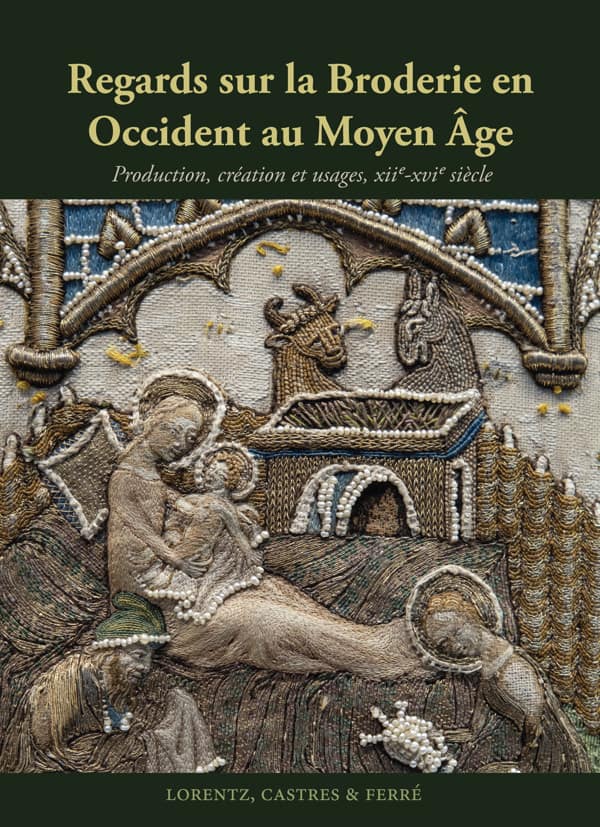
One reason for this book review is that ten of the twelve published papers are written in French (with unhelpful short, one-paragraph summaries in English). A language most of us are not fluent in. That makes it hard to tell whether the book is worth your money. To me, this is the book’s main drawback. Why write an academic publication in French? Why can’t we agree on using English for all academic publications? Our medieval peers used Latin whether they lived in France or Germany. Using English doesn’t mean you don’t value your mother tongue. Or that your mother tongue will die out. On the other hand, publishing academic texts in French or German or any of the other 21 official non-English languages used in the EU does result in your book not reaching its full potential. And this book will be one of them!
The book opens with a paper on prior research on medieval embroidery in France. These papers are always handy for finding older literature. Some may be available for free online. This initial paper is followed by three papers focussing on the makers of medieval embroidery. The first is by Lisa Monnas and provides a list of names from the English court between 1300 and 1461. Guadaira Macías and Cèsar Favà do the same for Catalonia in the 14th and 15th centuries. This piece is very well written and a joy to read. Especially since this is an extensive “trailer” for a series of books on embroideries produced in Catalonia in the 14th and 15th centuries, it will combine historical sources (exceptional complete archives for this period!), surviving embroideries, and paintings. Professor Rafael Cornudella oversees this research project. I can’t wait for the books to come out! The third one is by Astrid Castres on the late medieval embroiderers of Paris and is very preliminary. This was one of those “forthcoming” papers I was especially looking forward to, but it is a bit disappointing.

The book also contains a few papers on particular pieces of medieval embroidery. These kinds of papers are usually the most valuable to us embroiderers. But not in this case. Isabelle Bédat writes on the mitre from Sainte-Chapelle. She compares it with the badly preserved remains of a mitre from Orléans. She notes that these embroideries share an unusual stitch in metal thread that forms chevrons: no detailed pictures or further explanations, let alone a stitch diagram. Fear not – I wrote a blog post about it! A similar disappointment is Maxence Hermant’s piece on a rediscovered 13th-century vestment in the Cathedral of Reims. Since 13th-century vestments tend to be rare, a detailed description of the embroidery materials and techniques used would have been nice. Or a comparison with other 13th-century vestments, perhaps?
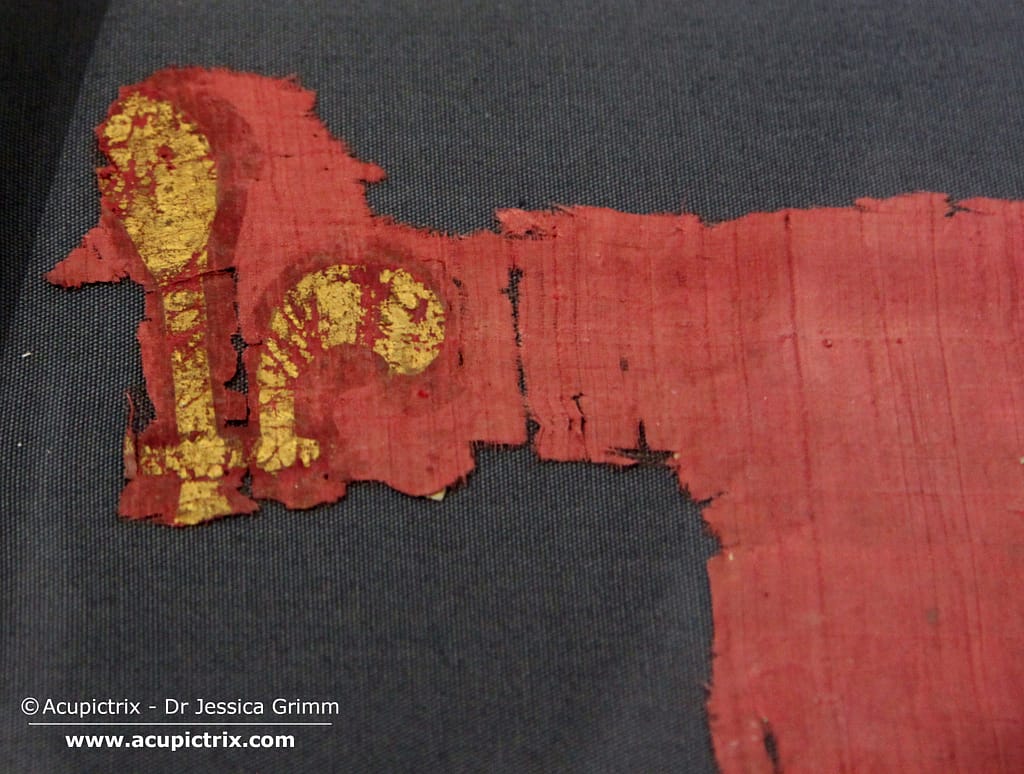
Julie Glodt’s paper on embroidery on altar linens is more theological in nature. Rafael Cornudella’s paper examines whether antependia and similar items were made locally or imported, as well as their exact use. Nadège Gauffre Fayolle writes about the technique of gilding fabric. This was a cost-effective and speedy technique to apply golden decorations to light-weight fabrics. Due to their fragility, hardly any examples have survived. However, the technique is described in a couple of treatises and the products can be identified in accounts.
Christine Descatoire examines the pictorial inspiration for the models used in Opus Florentinum embroidery. Like Opus anglicanum, embroidery made in Florence in the 14th and 15th centuries was highly valued and traded across Europe. Descatoire also briefly examines the embroidery techniques used. I wish she had explored it some more. In my talks on the origins of or nué, I point out that the embroidery technique used for the figure of the woman at the well on an Opus Florentinum orphrey kept at the Abegg Stiftung (used as a comparison piece by Descatoire) is important. It carries meaning. The woman is embroidered in an early form of or nué. Jesus, normally the most important figure in the composition and worthy of the “high-end” or nué technique, is embroidered only in silk. The woman at the well is traditionally called Photini meaning the “luminous one”. No wonder she gets the or nué treatment!
And then two papers have lost all relevance because monographs on their topics have since been published. The first is Martha Wolff’s paper on the altarpiece of Pedro de Montoya in the Art Institute of Chicago. The Abegg Stiftung published an excellent monograph on the piece in 2022, with detailed descriptions of the embroidery technique. You can read my book review here. The other one is a paper on the embroidered cap, possibly belonging to Hildegard of Bingen. Again, the Abegg Stiftung has publish a monograph in the meantime.
I hope this detailed book review has helped you decide whether to buy a copy for your shelves. It mainly comes down to two things: 1) how well can you read French? and 2) what is your particular area of interest when it comes to medieval embroidery? Because the book is written in French, it may be difficult to find in your library. But it is worth a try. After all, at €125 + VAT + postage, the book is on the expensive side. However, if you want to go that route, you can order the book directly from the publisher.

0 Comments