As a result of exploring the Cappa leonis, I was pointed to MS.8932, an embroidered, folded almanac. This extraordinary piece has been studied, recreated and published by Jacqui Carey. On the Wellcome Collection website, you can find spectacular images of the piece. Although I was vaguely aware of Jacqui’s book, I hadn’t paid it much attention. After all, there’s no goldwork embroidery involved. However, I am glad that I now own a copy! Jacqui’s work on the piece is thorough and exemplary. Let me show you why you should consider getting a copy too.
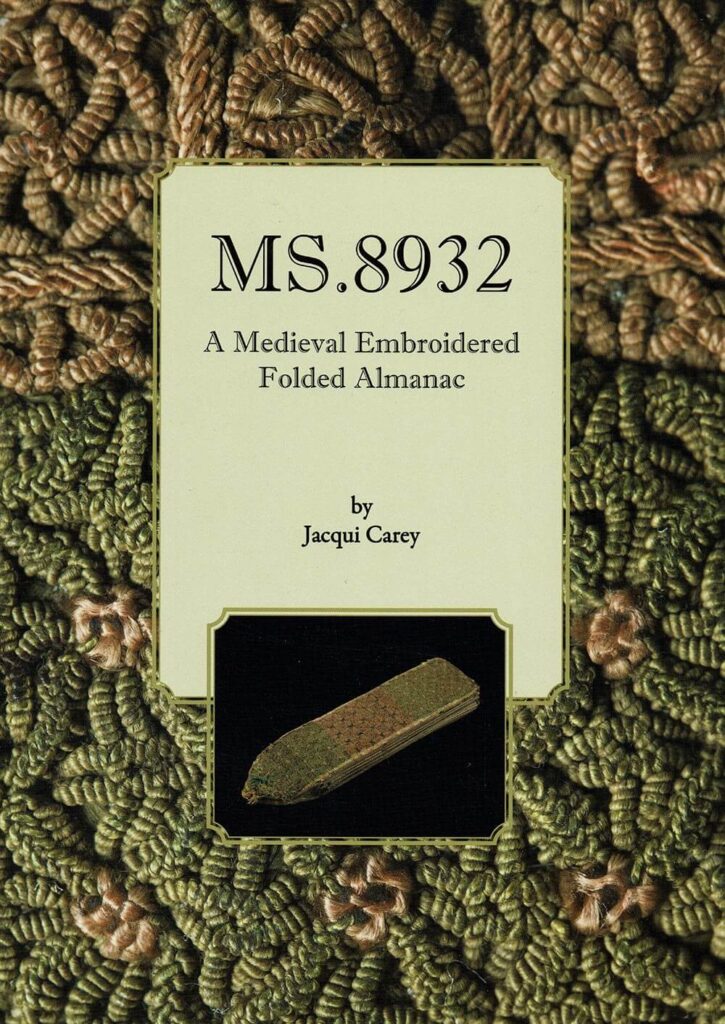
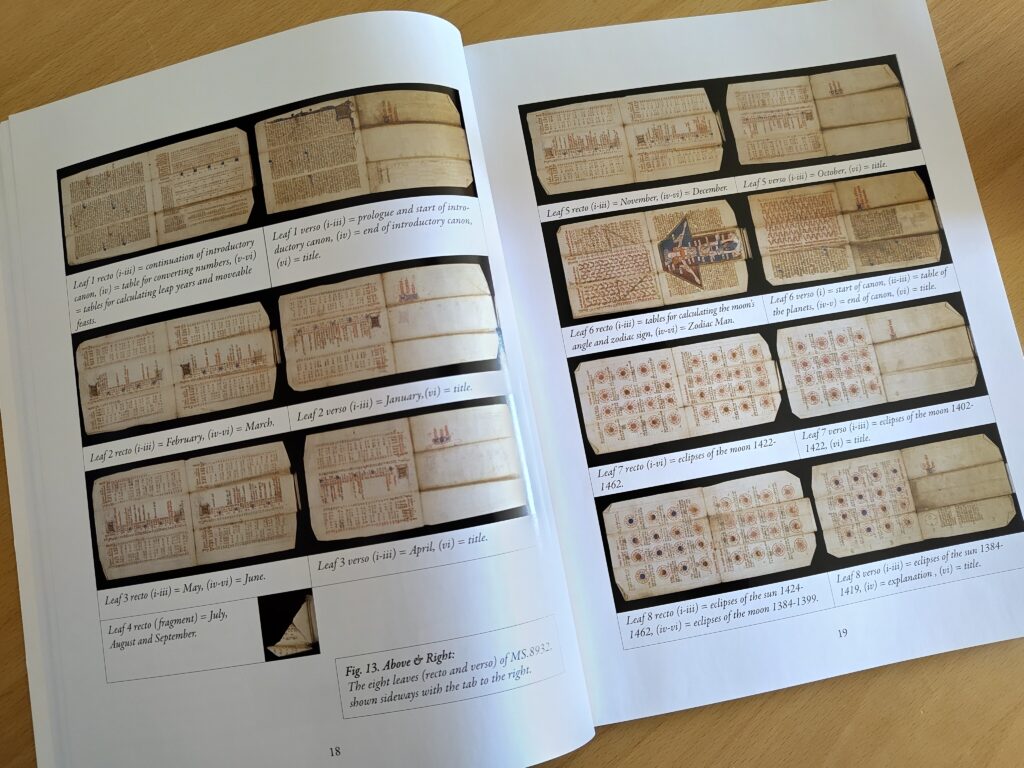
The book on MS.8932 is well-structured with chapters on the current collection it is in and its assumed provenance. It then goes on with a chapter on the contents of the handwritten manuscript inside the sumptuously embroidered cover. The manuscript is a copy of John Somer’s Kalendarium, which contains tables for accurately predicting movable religious feast days such as Easter. It also contains some medical information. The dating on the website of the Wellcome Collection is given as c. 1415-1420. However, the manuscript actually contains eclipse details for the period 1384 to 1387, suggesting an earlier date.
The chapter on the manuscript’s construction is thoroughly enjoyable. Folded books were not uncommon in the medieval period. By the way, more modern books are folded too, but their folds are hidden in the spine. Most of us are probably familiar with children’s books folded in the concertina way. MS.8932 is not like that. The folding is very sophisticated, and only about 60 similar objects have survived to the present day. The term proposed for the folding style of MS.8932 is a bat book – they rest upside down and their leaves open like wings. Opening the leaves reveals the manuscript’s contents bit by bit. To ensure the unfolding worked, the placement of the written elements on the vellum sheets required careful planning.
The next chapter discusses the unusual embroidered binding of MS.8932. Its properties are discussed, and other textile bindings are examined to put MS.8932 in context. Together with the next chapter on the embroidery, it becomes clear that the binding of MS.8932 is unique. However, the fact that the stitches are worked with great skill suggests this is due to a lack of survival rather than the object being unique in the era in which it was made. Absence of evidence is not evidence of absence, as archaeologists like to say.
The next chapters are probably of the greatest interest to us embroiderers. In the chapter on the stitches, Jacqui explains that what she describes in the step-by-step instructions with images and diagrams is only one way of how the stitches on MS.8932 could have been made. Access to the back is limited, and even today, there is often more than one way to execute the more complex stitches. Besides known stitches, such as a variation on long-armed cross-stitch and Hansen stitch, known from Nålebinding, Jacqui identified many more highly dimensional stitches that aren’t quite needlelace yet. They still require anchoring into the embroidery fabric.
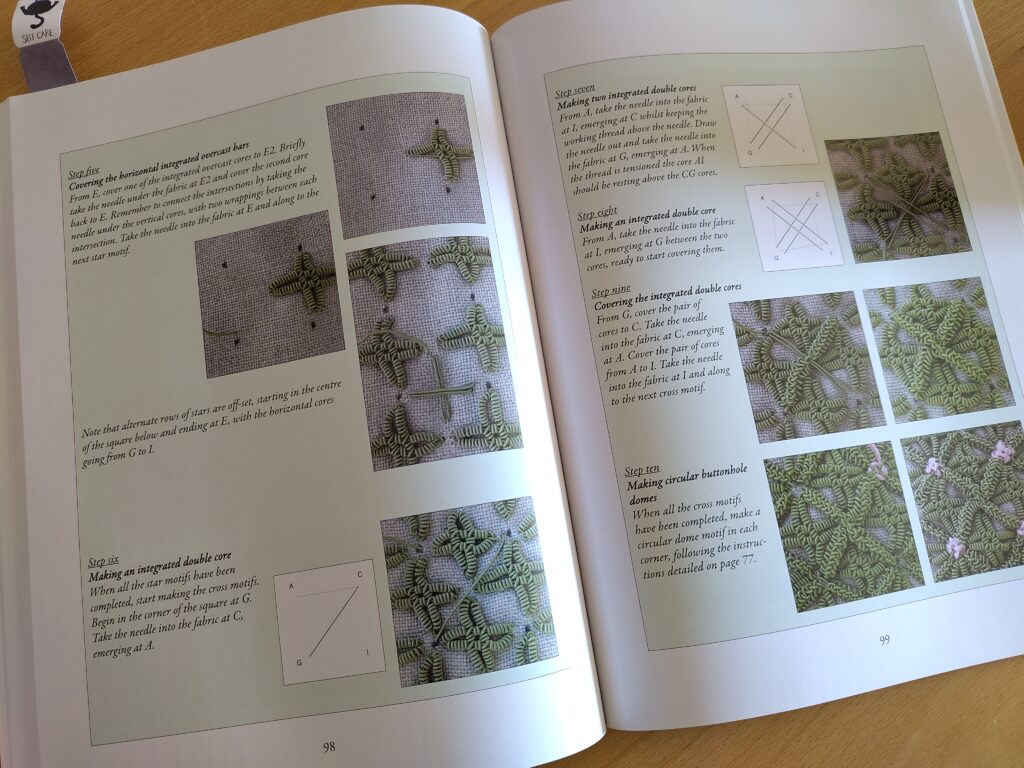
Following the chapter on the stitches is a chapter that details the making of each of the six areas comprising the embroidered binding of MS.8932. Jacqui discusses the stitches used and proposes an order of work. Each stitch and subsequent step is beautifully illustrated with detailed images. What really transpires is that the embroidered binding is layered and, consequently, highly textured. The use of a base layer of silk floss and a top layer of silk gimp made the embroidery very durable on an object intended for practical use.
Personally, I enjoyed reading the last two chapters. One listing all the steps involved in making both the original and Jacqui’s replica. It becomes clear that the making of MS.8932 involved many skilled hands and is not the work of a single person. In the last chapter, Jacqui writes down all those impressions that you gain when you make a replica of a historical piece. You can often not scientifically prove what you are experiencing and how you think this relates to the original makers and owners of the object. Nevertheless, these observations add another layer of depth to the information extracted from the object. It is my personal opinion that we can only ever fully understand these objects when we make a faithful copy.
You can order your copy of the book directly from Jacqui’s website or through your local bookshop. Please avoid Amazon and the like to keep small businesses operating, people fairly employed, and our high streets varied!
0 Comments