Maybe this book review should come with a warning that you’ll likely spend money after reading it… The Abegg-Stiftung has published a new book. In English this time! Some years ago, they conserved the altarpiece from El Burgo de Osma, and the new book describes in incredible detail what they have found out about the embroidery, from the materials used to the order of work. It is so detailed that a skilled embroiderer or group of embroiderers could make a copy. Now that’s a book worth having on your shelves. Even if it means you will have to eat dry bread for a while to afford it. We are still in Lent so that you will fit right in :). Let’s explore!
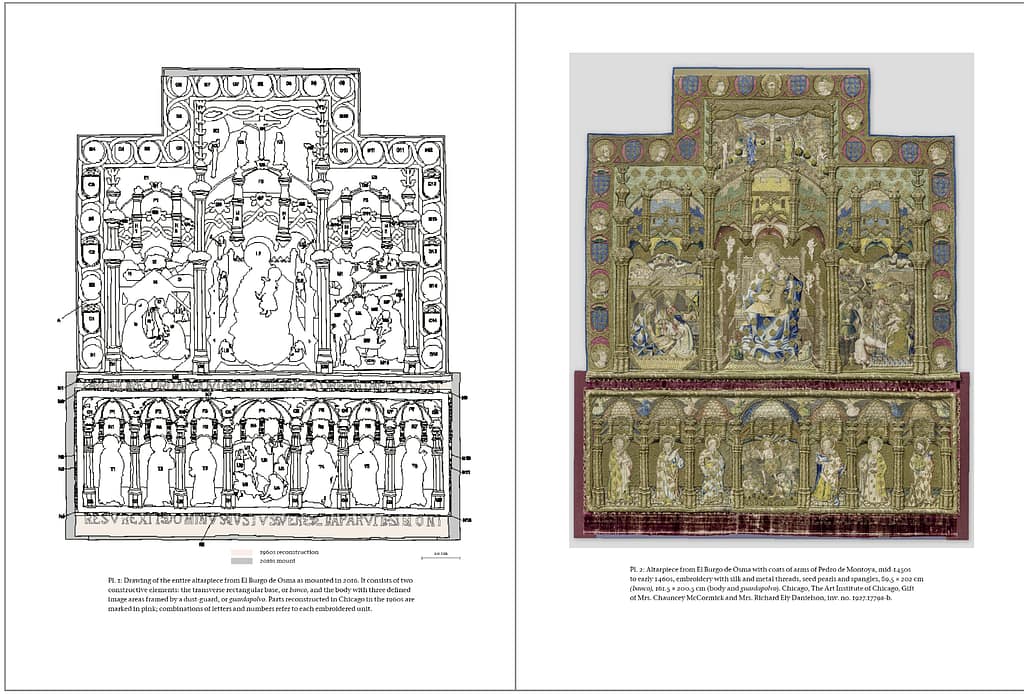
The embroidered altarpiece from El Burgo de Osma is the only one of its kind to survive to the present day. It was made around AD 1460-1470 in Castile (Spain) for bishop Pedro de Montoya. The altarpiece is currently housed in the Art Institute of Chicago (Inv. no. 1927.1779a-b) and consists of two pieces. The top part shows four scenes: the Nativity on the left, Mary with baby Jesus in the middle, the Crucifixion above and the Adoration of the Magi on the right. The bottom piece shows the Resurrection in the middle, flanked by three Apostles on each side. The top part measures 161,5 x 200,5 cm, and the bottom part measures 89,5 x 202 cm. Both parts are all-over embroidered with gold and silver threads, coloured silks, spangles and seed pearls.
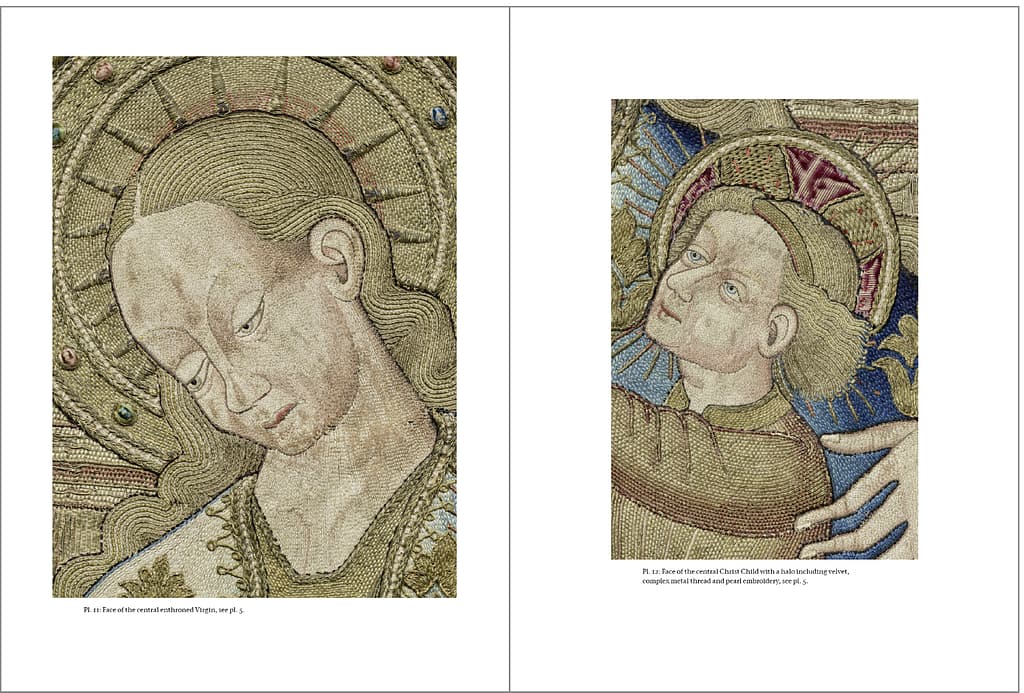
The main part of the book consists of a 100-page chapter on embroidery materials and techniques written by Bettina Niekamp. She has identified over 200 different combinations of threads and stitches/techniques on the altarpiece. She describes them in great detail. With the many detailed pictures in the book, you can identify them all. It will take some time, but it can be done.
Among the embroidery techniques is the over-twisted silk technique for rendering realistic treetops, grassy areas, and dirt. This technique is well known from 17th-century English stumpwork. The many padding techniques are also intriguing. They make tubes of linen fabric and stuff them with wool to form the base layer of columns. String is then added for extra texture before the actual goldwork embroidery commences.
The embroidery is mainly executed in very skilfully shaded split stitch. But there is a form of or nué too. And for a more realistic depiction of certain details, multi-coloured threads were used. They were made by blending different silk filaments in the needle. The embroidery is also embellished with twists made of different numbers and combinations of passing threads.
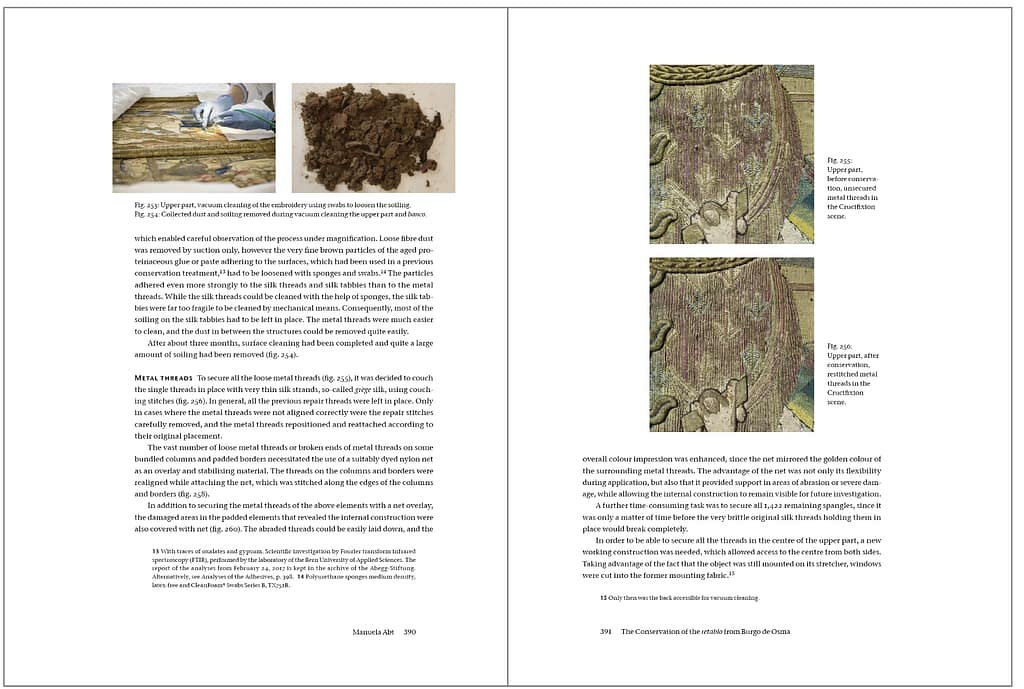
The book also has a whole section with full-page plates of the different parts of the embroidery. You can spend hours looking at the amazing detail. Later chapters describe the life and times of Bishop Montoya, its art-historical context, the iconography in relation to the materials and embroidery techniques used, late medieval embroidery in Aragon, and a case study on vestments from Barcelona. With 427 pages, there is a lot to explore!
You can order the book directly from the Abegg-Stiftung in Switzerland. It costs CHF 85 + shipping. It does not seem to be available from the Art Institute of Chicago. The fact that this book was published in English instead of German is a real plus. Please let the Abegg-Stiftung know that we like more of that when you are ordering. They might end up translating some of their equally stunning older publications. You can find more book reviews here.
0 Comments