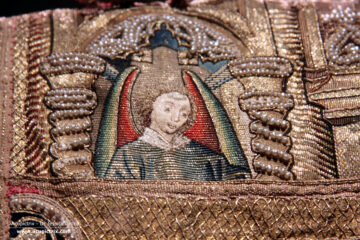
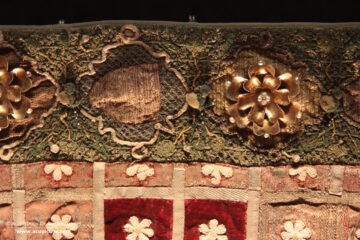
At the start of August, I anticipated a month of embroidery research. I aimed to study the embroidery on the vestments of the Golden Fleece and turn it into a goldwork course. But you know what they say: “The universe laughs when you make plans”. For the first three weeks I was ill. And in the last two weeks I helped a friend who hit rock bottom. In between, I had just enough time left to dig out a project that I never properly finished: the Gothic Pansy orphrey panel. I was originally going to teach this at a retreat. Then, the pandemic hit, and the project never saw the light of day. Until now, that is! Starting on the 4th of October, we’ll have eight Zoom lessons in which we’ll tackle stitching a medieval orphrey panel together.
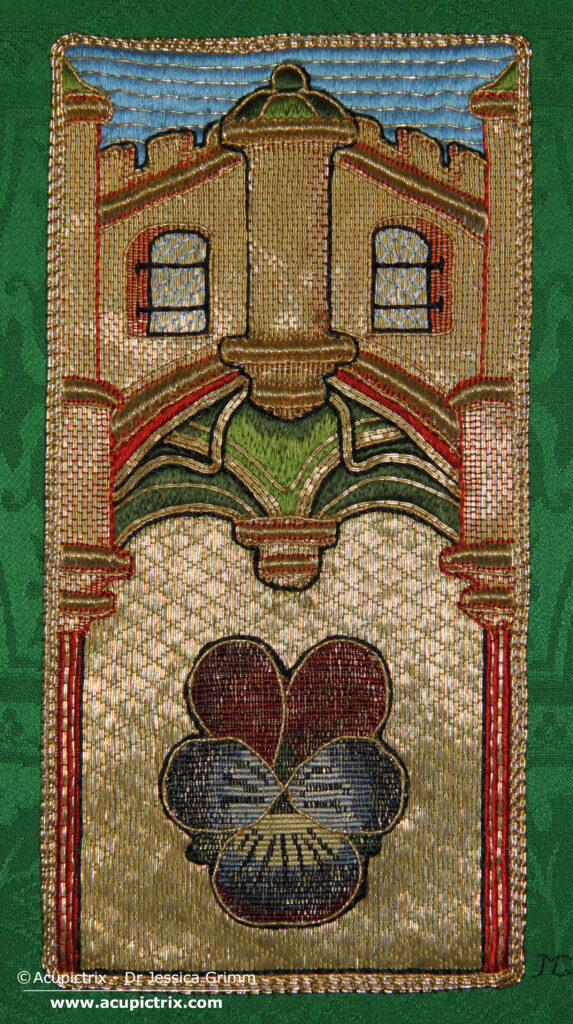
Tackling stitching an orphrey panel on your own, even with ample instructions, is hard. Joining me for this live Zoom goldwork course is the perfect alternative. The lessons are held on Sunday with plenty of time in between to finish your homework. We also avoid the time when the clocks turn back and the major holidays towards the end of the year. Don’t worry if you cannot make the Zoom sessions; these are recorded. Lessons drop a week before the Zoom so that you already get an idea of what we will tackle. When you stick to the plan, you will have a finished orphrey panel before the end of January 2027!
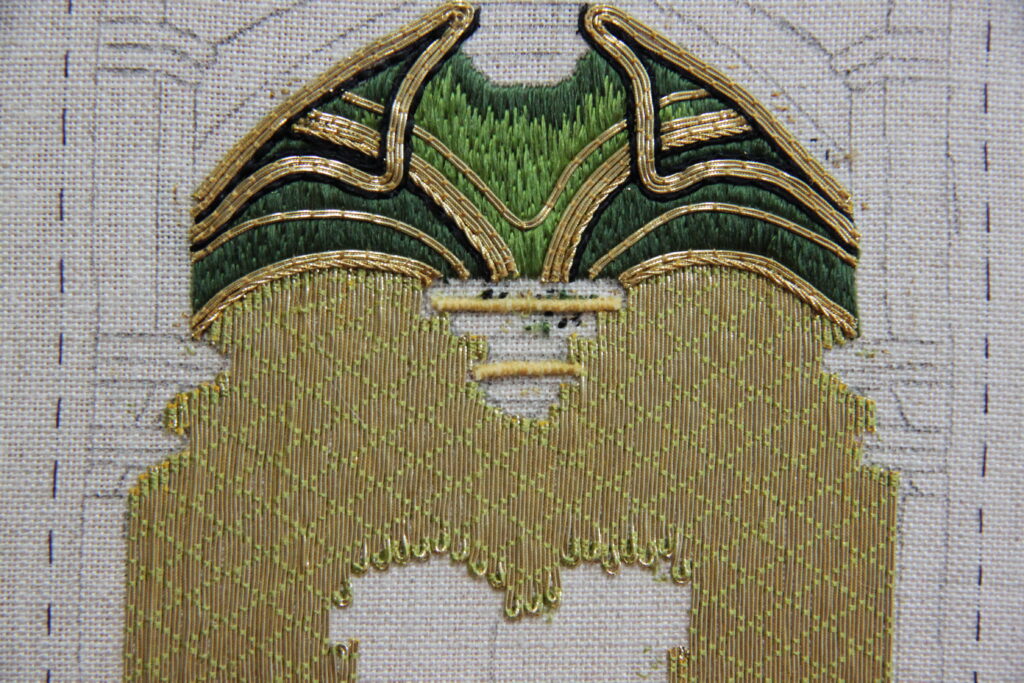
In this goldwork course, what will you learn? Which techniques will we tackle? The orphrey panel features classic elements of a typical late-medieval goldwork embroidery. However, the completed design is 20 x 10 cm, a bit smaller than the originals. This course will teach you how to read diaper pattern diagrams, apply string padding, layer goldwork, stitch or nué and apply slips. The course starts with setting up your slate frame and transferring the design. It will end with applique the slips and mounting the orphrey panel onto chasuble fabric.
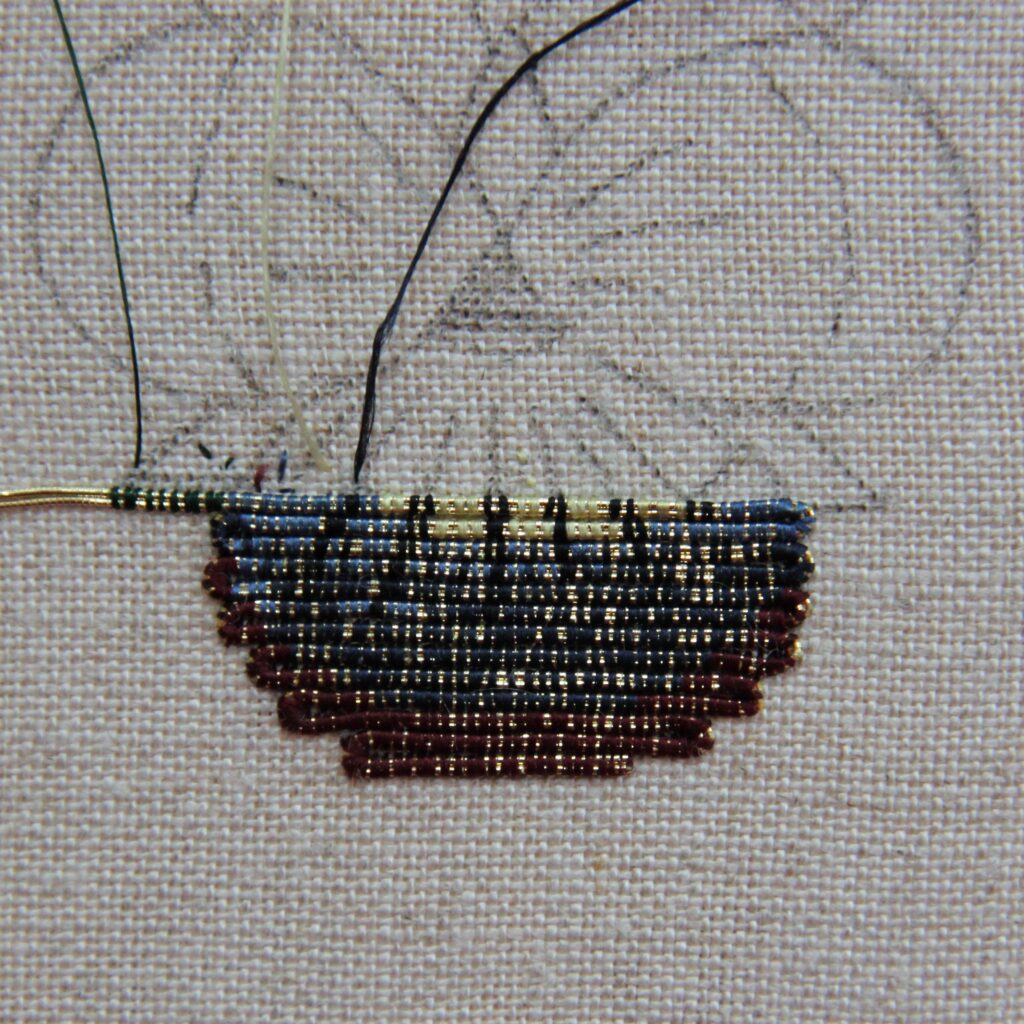
It was great fun to finish writing up the instructions for this goldwork course. Since I stitched the original nearly 10 years ago, I have learned so much more and would stitch things differently now. So, re-stitching the piece during the Zoom sessions will also turn this project into a proper online embroidery course that will stand the test of time on the membership part of my website.
Have I whetted your appetite, and would you like to stitch the Gothic Pansy orphrey panel with me? Great! You can already see the materials you will need, along with all the important dates and times on the course page. The course is open to all my Monthly and Yearly Members. Free Members will need to upgrade to either a Monthly or a Yearly Plan. Please leave any questions you may have in the comments below (due to spam control, you will need to sign up for a Free Membership and be logged in to do that). Looking forward to seeing you in class!
13 Comments
Dagmar Thiel · September 8, 2026 at 7:13 am
Dear Jessica, I left a comment with a question yesterday, but maybe something went wrong, so I try again 🙂
First of all, glad you are back and thanks for the exciting news about the course. I have a question please regarding the design: in the course description you say that this is what an early 16th century SECULAR orphrey panel could have looked like. I am confused because I thought that an orphrey (panel) always belongs to an ecclesiastical vestment? Can you help to clarify what kind of secular vestment this was and what/when it was used? Also, is my understanding right that anything beside the pansy design was inspired by orphrey panels of ecclesiastical vestments? Thanks for helping to clarify!
Acupictrix - Dr Jessica Grimm · September 8, 2026 at 8:37 am
As I say in the course description: This is what a secular orphrey panel COULD have looked like. We know from the medieval accounts of for instance the King of France that he ordered orphreys for his clothing and that of his inner circle. Orphrey comes from the Latin auriphrygium which contains aurum for gold. It basically translates as a golden patch. It does not specify that it needs to be on a church vestment. This design was inspired by the beautiful goldwork orphreys found on vestments in the Low Countries dating to the late 15th and early 16th centuries. The pansy comes from a contemporary source. As none of these secular orphreys have survived, it is thus entirely possible that a secular early 16th-century orphrey panel would have looked something like the Gothic Pansy.
Dagmar Thiel · September 8, 2026 at 9:27 am
Thank you! I wasn‘t aware of secular orphreys at all. Great learning.
Agnė Zemkajutė · September 8, 2026 at 8:12 am
Hello, Jessica, I am glad that you are fine and you are organizing such a great goldwork course.
I only have one question: have you ever seen pelican or Agnus Dei in or nue small enough to be added into this panel? I was thinking about Agnus Dei (of course, I would need to make the whole work a little bit taller and to add some floor for the lamb), but I am afraid of four legs 😀 Maybe pelican would be easier to stitch and to attach. But I was not able to find any example online.
Acupictrix - Dr Jessica Grimm · September 8, 2026 at 8:46 am
Excellent idea! There are agnus dei orphrey panel figures in the collection of the Catharijneconvent https://adlib.catharijneconvent.nl/Details/collect/8904 and https://adlib.catharijneconvent.nl/Details/collect/8905 And there’s a pelican on a chasuble from Bergamo https://www.beweb.chiesacattolica.it/heritage/work/5773037/Manifattura+italiana+sec.+XVI%2C+Pianeta+rossa
Agnė Zemkajutė · September 8, 2026 at 10:27 am
Jessica, thank you for the links. I’ll have to think, what to stitch on my panel. I have to go through my pictures too. After I saw a chasuble from Bergamo I think, that I also have some with pelican somewhere deep in my computer 😀 Oh, sometimes I feel that I have too many pictures 😀
Margaret Morgan · September 12, 2026 at 4:55 am
I embroidered an or nue Agnus Dei that is now mounted on silk on a friend’s missal.
@margiem5044 on Instagram. This may give ideas. In hindsight I would have used stronger colours.
Jessica I have just signed up for your Gothic Pansy gold work course. I have been checking the requirements for the course and wondered if Dark Gold 371 Couching thread would be suitable for the background.
Acupictrix - Dr Jessica Grimm · September 12, 2026 at 8:32 am
I have never seen or used the Dark Gold 371 Couching thread. From what I could find on the Golden Hinde website, it is a fake metal thread comparable to a #4 passing thread. This is quite a bit thinner than the #6 passing thread the course calls for. However, technically speaking, it should not be a problem.
Dagmar Thiel · September 8, 2026 at 9:27 am
I like your idea very much!
Victoria Wood · September 8, 2026 at 10:57 pm
Hi Jessica,
What great news! I have the Gothic Poppy kit but have not started it. Would all those materials be suitable for this project? The Zweigart linen is the same as you described, also the gold and silk threads that came in the kit. Please let me know what would not work — for example, the Gothic Poppy kit has chinese flat silk.
I think I might also chose to do a different motif in or nue instead of the pansy. Hope that is OK with you.
I’m very excited to start studying technique with you again!
Best, Victoria
Acupictrix - Dr Jessica Grimm · September 9, 2026 at 12:20 pm
Hi Victoria! You could just work on the poppy kit alongside us. It uses very similar techniques. Using your poppy kit supplies to work on the pansy is a bit difficult – the colours are very different. Yes, by all means, do change the design to your liking. It has caused quite a bit of amusement for my husband and me. Customers and retreat organisers have always told us not to offer religious imagery. And guess what? My non-religious designs get changed into religious ones – never the other way around :).
Margaret Morgan · September 23, 2026 at 4:12 am
Hi Jessica, I have been able to source the gilt passing #6 fromAll Threads in Brisbane. It is becoming more difficult to source metal threads. One supplier that I used almost exclusively said that the volatility in pricing and tariffs is the main problem.
Acupictrix - Dr Jessica Grimm · September 23, 2026 at 8:58 am
Oh, I am so glad you managed to find it, Margaret! It has turned out that goldwork supplies for European goldwork are really only still available where they are produced: Austria, England and Spain. Very worrying. I wonder what this means for people like Allison Cole? Every goldwork designer outside of Europe must have a problem thanks to those tariffs.