Last week, I promised you a more detailed blog post on the gold threads that are regularly found in archaeological excavations. In Germany, Dr. Ina Schneebauer-Meißner wrote her 2010 diploma thesis titled “Untersuchungen an Goldtextilien des frühen Mittelalters” (= Investigations of gold textiles from the early Middle Ages). You can download the thesis for free from the University website. As many gold threads are being found in rich graves in Bavaria, there’s also a volume (#53) of the periodical “Bericht der Bayerischen Bodendenkmalpflege” from 2012 dedicated to these finds. Dr. Ina Schneebauer-Meißner went on to write her PhD thesis in 2022 titled “Textilien und andere organische Materialien ausgewählter Männergräber des baiuvarischen Reihengräberfelds von Petting (Lkr. Traunstein)” (= Textiles and other organic materials from selected male graves from the Baiuvarian linear cemetery at Petting (county of Traunstein)). This one can also be downloaded for free. As all of these excellent references are written in German, they are, unfortunately, not very accessible. This blog post tries to remedy that. If you want to dive in deeper, please join me at the next Zoom meeting of the Medieval Embroidery Study Group. The recording will be available to my paying members.
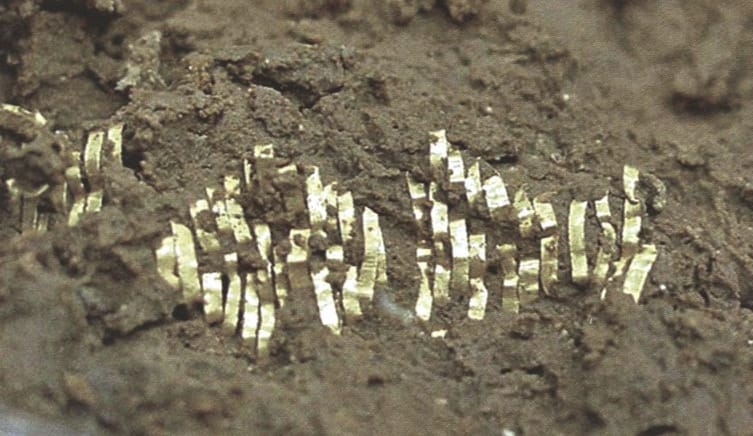
Organic materials like textiles only survive in exceptional circumstances. Very dry conditions, like the Egyptian desert, are good. Or completely waterlogged, like the finds from the Dutch terpen (artificial dwelling mounds), are also good. In contrast, most soils are generally well-aired and subject to alternating dry and wet conditions. Unless the salts from corroding metal objects have permeated parts of the textiles, they are completely gone. Not so the gold threads and strips that once decorated these textiles. Gold is a noble metal that doesn’t corrode. When it is (near) pure, it comes out of the ground shiny – a pretty surreal experience! Recording the precise location during excavation, or even block-lifting, can potentially tell us a lot about the textiles that are no longer there.
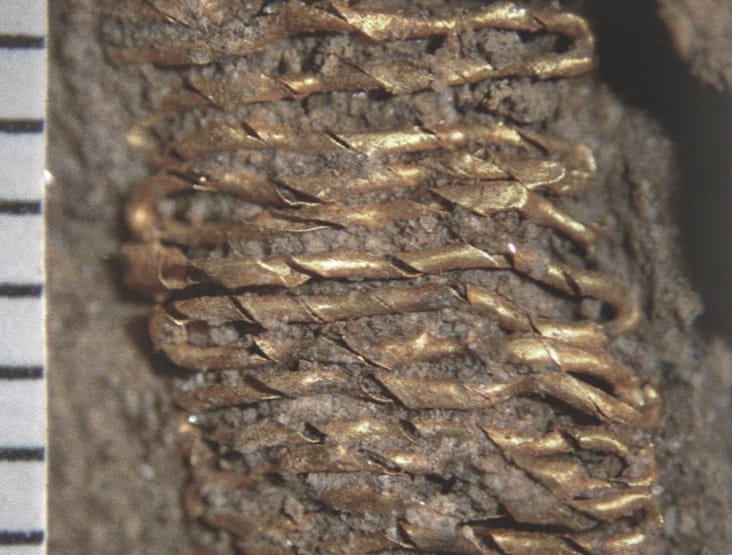
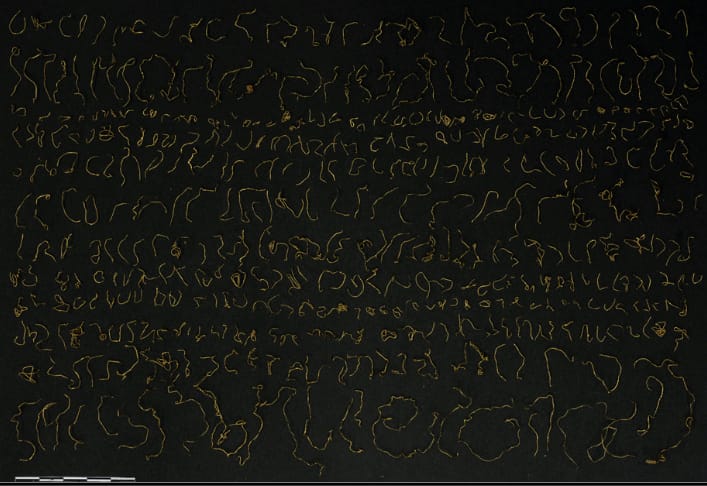
From what I have seen in the literature so far, most gold threads and strips were not used in embroidery. Practical tests and reconstructions have shown that the kinks in the golden remains resemble those happening in tablet weaving. Prior to these practical tests around 2010-2012, gold threads that looked like the ones in the above picture were often identified as remnants of embroidery. It does not help that the archaeological literature mostly does not use the same nomenclature that needleworkers would use. Equally, most of these graves have been looted in antiquity. Gold threads are often no longer in their original location.
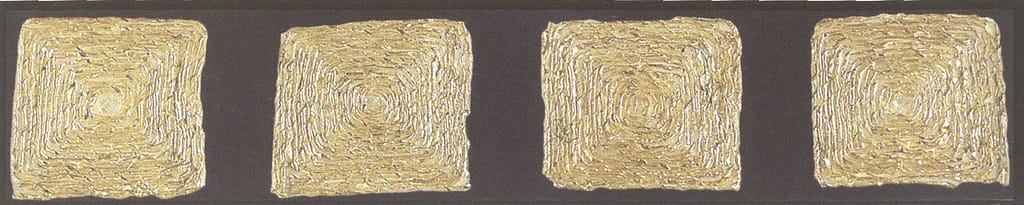
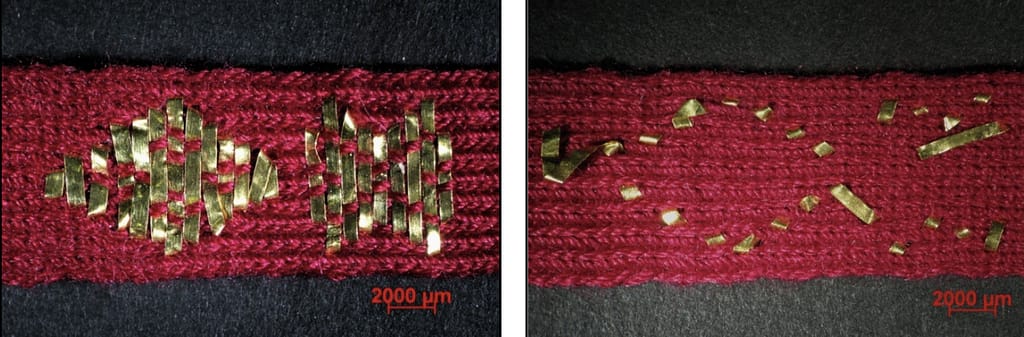
Luckily, there are the finds from grave 10 from the Peterskirche excavation in Lahr-Burgheim. The grave belonged to a wealthy woman who was between 40 and 60 years old when she died. The above golden squares were found around her skull. It is thought that they were once embroidered onto a headband that held her veil in place. The gold thread is comparable to our modern passing thread. Each square is about 1.45 cm.
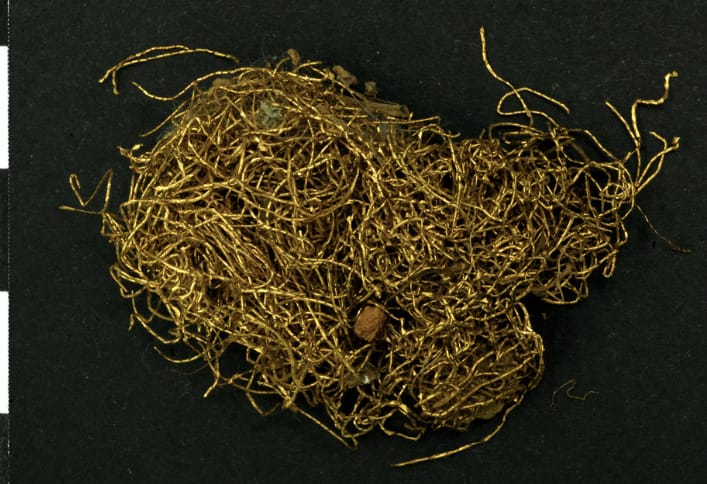
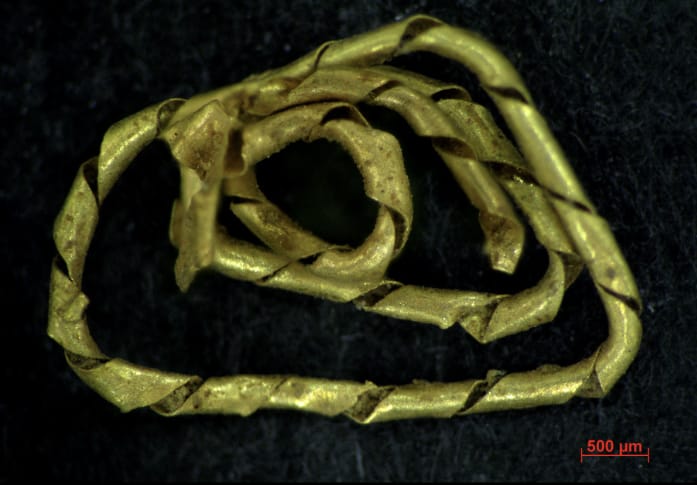
Gold threads formerly couched in triangles (only metal foil remaining) from an early medieval grave, excavation “Peterskirche, Lahr-Burgheim”Löwenbückel”, Gerolfing (taken from Meissner 2010).
When gold threads are not properly excavated, they often look like the example above. Careful sorting and studying the fragments showed that the gold threads were once couched into triangles onto the fabric. Only careful study and proficiency in several needlework techniques (or having such people in your team) can identify these remains correctly.
As said, most of these remains are identified as being from tablet-woven bands with geometric patterns. Only a small proportion of the threads were once part of an embroidery. However, the reasons that both Dr. Schneebauer-Meissner and Dr. Nowak-Böck present for the identification of woven bands versus embroidered bands might not always hold. One argument is that the turns in table-woven bands produce kinks in the gold threads that lie “lower” than the rest of the gold threads. However, some early pieces of goldwork embroidery that are surface couched have turns in underside couching. In my opinion, this would produce a similar result.
Another reason why tablet weaving was possibly preferred over embroidery was that weaving is quicker as the “frame” (width of the band) is a given. However, any countable fabric would provide the same “guard rails” for the embroidered band. What do you think?
Literature
Eger, C., 2013. Goldtextilien spätantiker Zeit aus Nordafrika. Bericht der Bayerischen Bodendenkmalpflege 53, pp. 341–354.
Krohn, N., 2013. Goldlahn in der Alamannia: Beispiele aus Dürbheim “Häuslesrain” (Kreis Tuttlingen) und Lahr-Burgheim, St. Peter (Ortenaukreis). Bericht der Bayerischen Bodendenkmalpflege 53, pp. 355–360.
Meissner, I., 2010. Untersuchungen an Goldtextilien des frühen Mittelalters. Diplomarbeit, Technische Universität München.
Nowak-Böck, B., 2013. Goldtextilien aus dem frühen Mittelalter – Anmerkungen zum praktischen Umgang und zur wissenschaftlichen Auswertbarkeit. Bericht der Bayerischen Bodendenkmalpflege 53, pp. 261–269.
Stiefel-Ludwig, C., 2013. Merowingerzeitliche Goldtextilien in Süd- und Westdeutschland im sozialen Kontext. Bericht der Bayerischen Bodendenkmalpflege 53, pp. 337–340.

0 Comments