When I visited the Diözesanmuseum Brixen in Italy last year, I was captivated by linen vestments embroidered with brightly coloured silks. They weren’t particularly old or made with extraordinary skill. But to me, it just screamed: FUN to embroider. And I had seen this technique before on an unfinished sampler in the collection of the Wemyss School of Needlework in Scotland. The particular pieces were made with vibrant coloured silks using a simple couching technique (Bayeux Stitch) and seem to date to the 17th century. Then my internet search began.
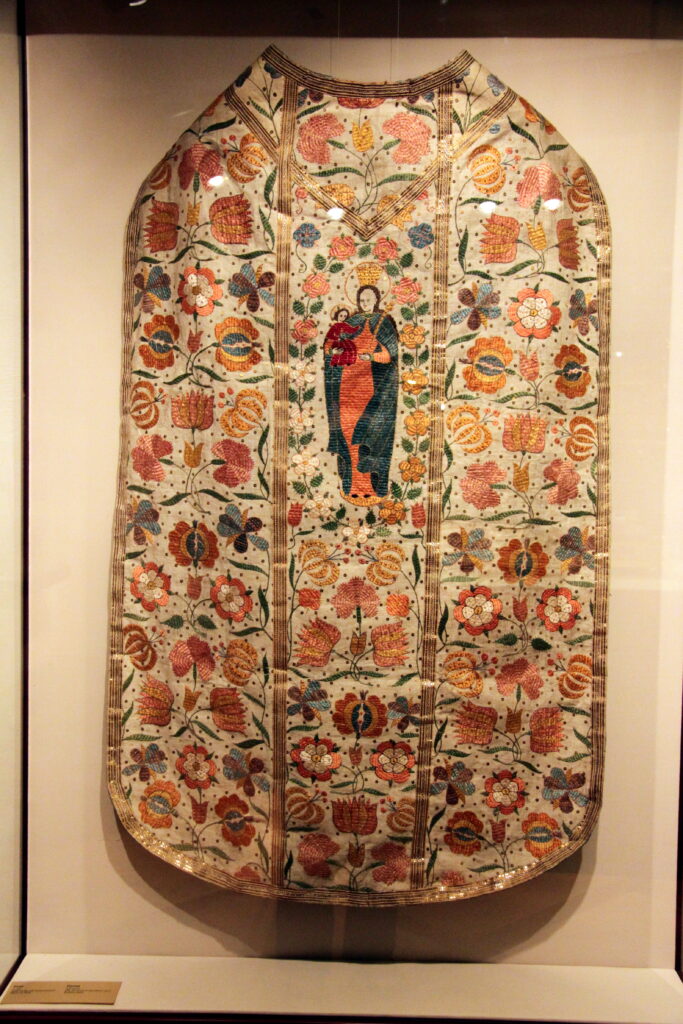
I proved not to be the first to write about ‘Italian couching’, in lieu of a better term for the technique seen on these linen vestments. In 2007, Mary Corbet wrote an article about ‘Italian Stitching’ on her blog Needle ‘n Thread. Through the related articles, I found the book Mary had originally consulted: Church Embroidery and Church Vestments by Lucy MacKrille, written in 1939. You can download it for free here. If you like goldwork embroidery and embroidery with silk, you’ll love it! And what does it say on ‘Italian Stitch’?:
Italian stitch in which stout floss is used for a foundation is the most beautiful of stitches. The floss is stretched across the surface from end to end of the design, care being taken not to twist a fibre, so that when the surface is covered it will be as smooth as satin. The finest gold thread is then laid across the silk in lines one-eighth of an inch apart and couched evenly. The beauty of this stitch depends on the glossy smoothness of the floss, the straightness of the lines of gold, and the evenness of the bricking or couching stitches (MacKrille, 1939 p. 27-28).
Hmm, not my ‘Italian Couching’ after all. The examples I saw in the Museums in Northern Italy on the linen vestments were all couched with matching silks, not with gold thread. Could it be that ‘Italian Stitch’ was actually an Anglo-American invention and not of true Italian origin? Let’s check with Pauline Johnstone, writing on Italian Embroidery in ‘Needlework: an illustrated history’, edited by Harriet Bridgeman and Elizabeth Drury, from 1978. There it says:
An alternative technique was laid and couched work in colored silks, crossed and held down by spaced lines of gold thread. … Many vestments of this type are attributed to Naples, where the Kings of Naples and the Two Sicilies held a wealthy and luxurious court (Plate 45). (Johnstone, 1978, p. 143).
So, what does Plate 45 show? Not much in a book from 1978. It is in colour, but a whole chasuble at only 10.2 x 9.3 cm doesn’t tell a whole lot. Luckily, this particular chasuble is held at the Victoria & Albert Museum in London. And they have a digital archive! You can find the entry for the chasuble featured in the 1978 book here.
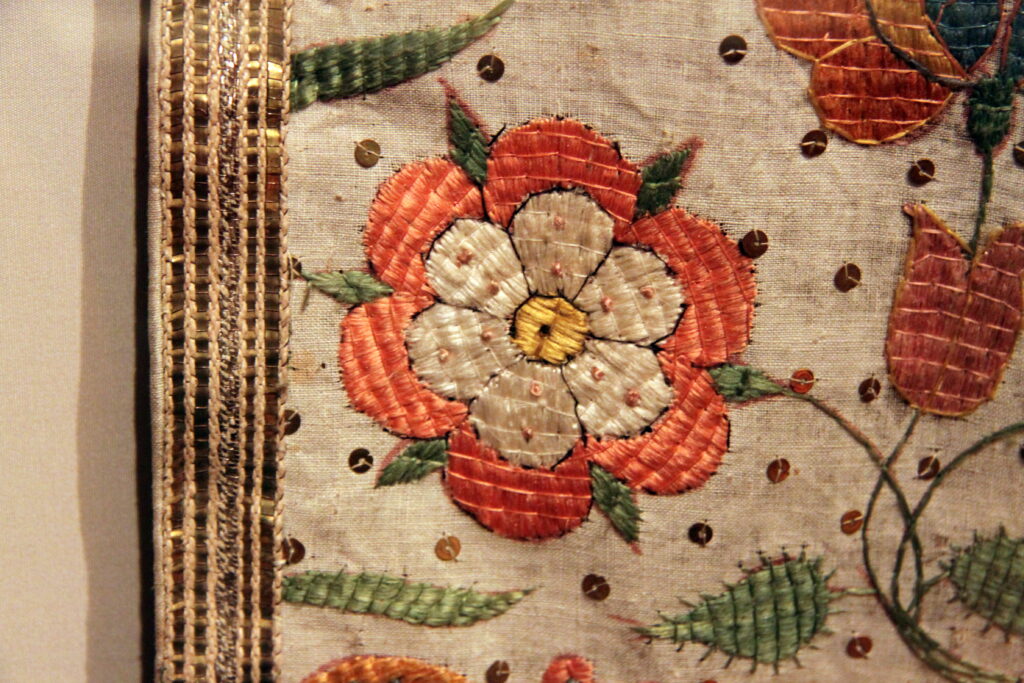
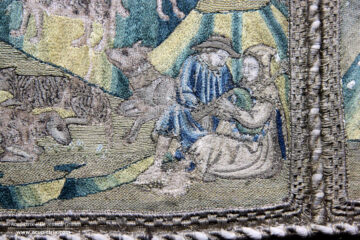
Lo and behold! This is indeed the needlework technique I have seen in a few pieces in Northern Italy and the unfinished sampler in Scotland. And as you can see, the laid silk is couched with a matching silk thread. Not with a gold thread.
So, can you see what happened here? An authority on ‘modern-day’ church embroidery from America, but who studied embroidery in England, wrote on a couching technique with silks and gold thread she had learned and used in 1939. Later researchers on Italian needlework presumed this was a historical technique used in 17th-century Italy. They had a poor-quality photograph from the V&A collection and a brief description that mentioned floss silks and silver-gilt thread. Combining the two into a Bayeux stitch with silks and gold thread.
Now, don’t get me wrong. The Italian Stitch embroidery executed by both Lucy MacKrille and Mary Corbet looks absolutely stunning. But it does not seem to have been a historical needlework technique in use in 17th-century Italy. However, if you have come across a historical piece made in Italy that uses gold thread as the couching, please do let me know! In the meantime, I’ll keep my eyes peeled for more pieces in this fascinating technique.
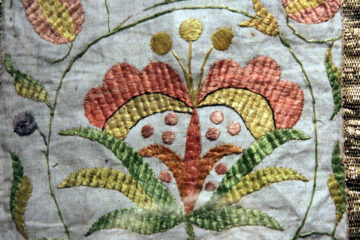
You can find an eBook with detailed (video) instructions for the eight flowers found on the Brixen chasuble in the members’ section of this website. The 24-page eBook includes the historical background of these linen vestments, as well as a list of museums that hold them in their collections. You can read more on the special variation of Bayeux stitch used in these pieces in this blog post.
0 Comments