Last week, we looked at an embroidered maniple from the Stiftsmuseum Xanten dating to the 14th-century. This week, we will study a beautifully embroidered alms pouch from the same era and kept at the same museum. Non-religious embroidery from the Middle Ages has rarely survived. This particular secular alms pouch is an exception because it was gifted to the church and repurposed as a reliquary container. It was hidden in plain sight in Saint Viktor church (Xanten), where it was spotted by Alexander Schnütgen in 1891. Schnütgen describes the piece in some detail and publishes a picture in 1902. Although the piece has been restored, the 1902 photograph shows it was in remarkable condition when Schnütgen found it.
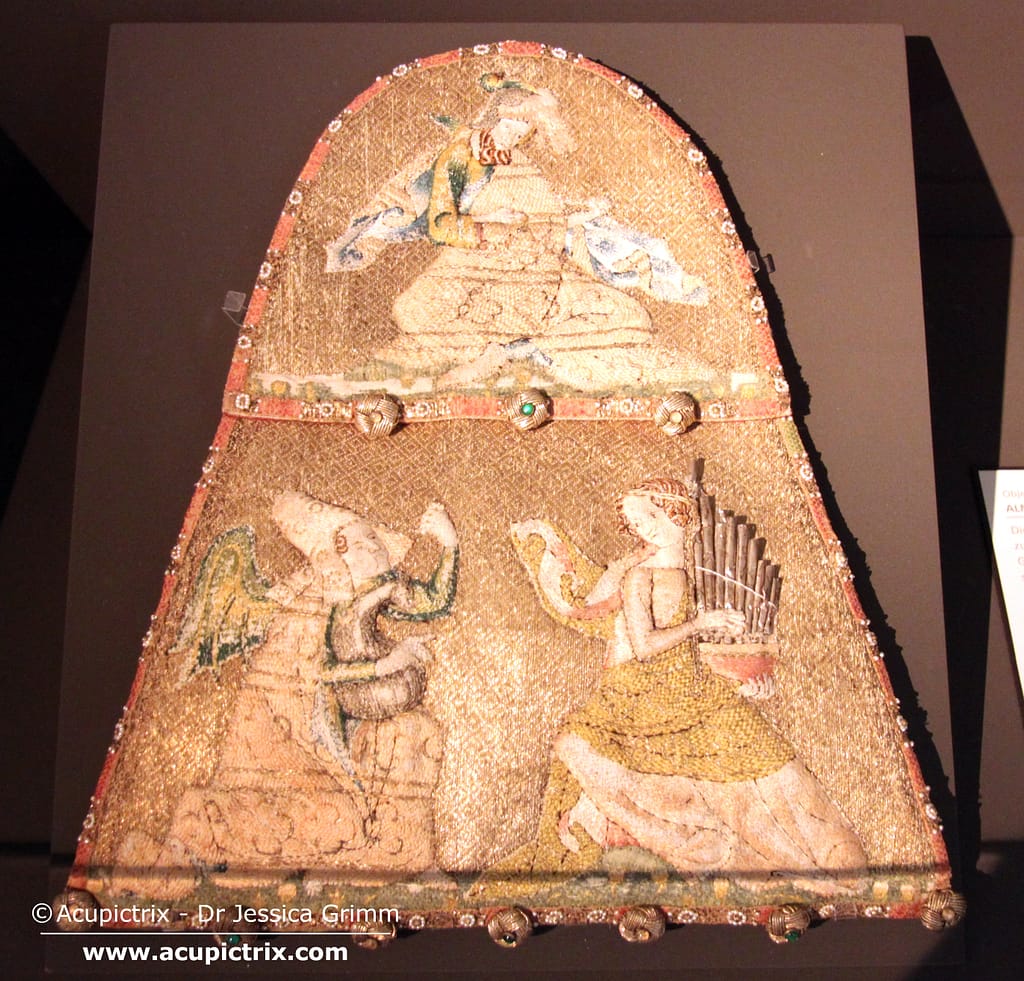
The alms pouch at the Stiftsmuseum Xanten shows three embroidered musicians. The male figure at the top sits cross-legged and may once have held a lute. Below him sits an older, winged woman with a bag on her lap and puffed cheeks. The pipes of her bagpipes are now sadly lost. To her right stands a younger woman who holds a portable organ. The metal pipes of her organ give an indication of what the instruments of her two companions once looked like.

The embroidery on the alms pouch of the Stiftsmuseum Xanten might have been the result of two different embroiderers. One worked the golden background in a beautifully regular diaper couching pattern with gold thread on linen. This counted-thread technique was achieved by laying two passing threads vertically and couching them with a once, red silken thread. To save money and time, the area below the figures is bare. The other embroiderer worked the figures in padded silk embroidery. The padding has been achieved with raw cotton fibres (seed caps still on). And there’s a timesaver here too.
When you look at the above picture, the red dress of the organ player is executed in beautifully shaded, tiny split stitches. This is very time-consuming. A speedier technique was used for her yellow (formerly green?) cloak: thick bundles of silk thread were couched in a bricking pattern. Additional embellishment in gold thread was couched on top.

Apart from the embroiderers, there may have been a third person involved: the passementier. This person made the intricate golden buttons and the red trim with pearl embroidery. Although it is technically possible for one person to make the entire bag, quality and efficiency improve when the labour is divided. And whilst we mainly find the names of male embroiderers associated with ecclesiastical and court embroidery, these bags were made by women in 14th-century Paris.
The bags were known in the Middle Ages as Aumonières Sarrazzinoises (Saracene alms pouches). The term “Saracene” was used to refer to people and products from the East. In other words, luxury bags produced in Paris with a catchy marketing phrase. The people who produced them were known as Faiseuses d’Aumonières Sarrazzinoises, or female makers of Saracene alms pouches. And amazingly, we have their guild regulations from March AD 1299! About 125 women promise to adhere to the rules of their trade.
The rules themselves are familiar to anyone who has studied medieval embroidery guild regulations. It specifies how long you need to learn (a year and a day), that you cannot steal apprentices away from another master, apprentices must be at least 6 years old, you cannot use base materials, etc. The fact that some names are accompanied by “and her daughter” or “and her niece” shows that the trade of Saracene alms pouch maker was passed on within the female line. Some surnames are also interesting. We have a weaver, a tablet maker (tablet weaver?) and a Saracene. And women who are short, stiff, lame or perhaps look like a candlestick. There are also two women from Lombardy, Italy.
And when we dream a little, the maker(s), or close relatives, of the alms pouch kept at the Stiftsmuseum Xanten might be on that list from March AD 1299. That’s pretty cool!
Literature
Boileau, É., 1837. Réglemens sur les arts et métiers de Paris, Rédigés au XIIIe siècle, et connus sous le nom du Livre de Métiers d’étienne Boileau; publiés, pour la première fois en entier, d’après les Manuscrits de la Bibliothéque du Rois et des Archives du Royaume, Paris, pp. 382–386, https://gallica.bnf.fr/ark:/12148/bpt6k65349759.texteImage#
Luthmer, F., 1891. Kirchenschätze und ihre Benutzung, Zeitschrift für christliche Kunst 4 (11), pp. 345-352.
Schnütgen, A., 1902. Gestickte Aumonière des XIV. Jahrh. in Xanten, Zeitschrift für christliche Kunst 15 (7), pp. 219-224.
Schwabauer, A., 2022. Vom modischen Accessoire zum vermittelnden Reliquiar. Die Almosentasche im Stiftsmuseum Xanten. In: Tina Asmussen, Eva Brugger, Maike Christadler, Anja Rathmann-Lutz, Anna Reimann, Carla Roth, Sarah-Maria Schober, Ina Serif (Hg.): Materialized Histories. Materielle Kultur und digitale Forschung, https://mhistories.hypotheses.org/?p=7230.
3 Comments
Gina · January 26, 2026 at 4:20 pm
8 years old, or 8 years of experience perhaps?
What a gorgeous piece.
I don’t suppose you know if these are functioning buttons, or simply decorative knops? They are lovely knots either way, and the addition of the gemstones is very pretty.
I hope you are keeping well!
Acupictrix - Dr Jessica Grimm · January 26, 2026 at 5:11 pm
Thanks for pointing that out, Gina! I completely mistranslated that part. The apprentices must be at least six years old. And they pay a certain amount when taken on. These amounts change when the child is eight or ten years old. Oh, how I wish for a good English translation of this important French book!
The German blog article calls the buttons “Zierknöpfe”, which likely means that they are decorative only.
Lesley Fudge · January 27, 2026 at 1:03 pm
A lovely piece, thank you for sharing