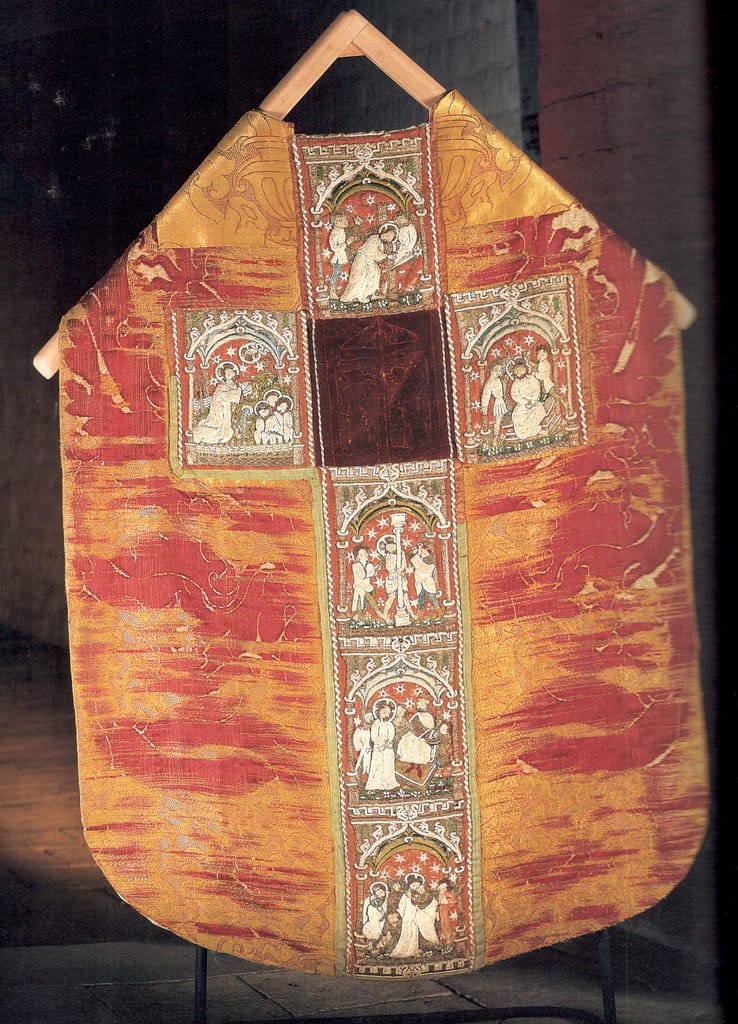
Today, I am going to introduce you to a body of medieval goldwork spread across several museums. Two pieces are still housed in the cathedrals where they were used. The third piece is, or was, part of the Keir collection. Its current whereabouts are unknown. I first came across this body of medieval goldwork when I saw a chasuble in the Diocesan Museum in Bamberg. The chasuble may be the result of recombining embroidery from older, worn vestments into a wearable piece. Let’s examine the lovely embroidery on the chasuble from Bamberg and compare it with the other two known pieces of the same body of work.

As you can see in the above picture, the embroidered chasuble cross is made up of two different pieces of medieval goldwork. The horizontal part was made around AD 1400, whilst the vertical strip was embroidered about 50 years later. The width of this vertical strip, combined with its complex scenes, suggests it was originally used as a cope orphrey. Both pieces of medieval goldwork were likely produced locally in Franconia.


The embroidery of the horizontal strip consists of two groups of three saints. On the left, we see Bartholomew the Apostle, Saint Barbara, and Emperor Henry II, and on the right, we see Empress Kunigunde, Saint George, and Saint Walburga. The embroidery is executed on linen and then applied to red velvet. Black silk covers the seams for added depth. All the white padding we see was once covered with freshwater pearls. Part of the clothing and the inside of the halos are couched with a pair of gold threads in a bricking pattern with a yellow thread. The gold threads follow the garment’s flow. Folds are accentuated with silk embroidery. The inside of the mantles also shows some silk embroidery. Some clothing edges have been accentuated with a braid made of two pairs of gold threads. The faces are particularly beautiful with directional split stitch and some padding underneath, for instance at the tip of the nose.
The vaults above the figures are stitched in silks covered by a trellis of padding thread. This padding thread was once also covered with freshwater pearls. The tiny stars dotted all over the background are made from parchment. They too would have been covered in pearls. And then there’s the lovely border at the top and bottom. It consists of a strip of parchment (painted red on the back?) twisted together with a silk gimp. The silk gimp has alternating bands of bright and very dark green. The strip of parchment was once covered with pearls.
Overall, this piece of goldwork embroidery was once highly valuable because of its pearls. Some of the other techniques also appear in 17th-century stumpwork from England.

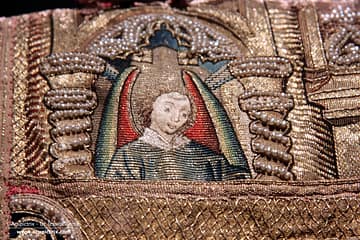
The vertical strip of embroidery uses similar materials and techniques. The embroidery is also executed on linen and then applied to the red velvet. We see the familiar white padding for the freshwater pearls. However, there are subtle differences. The golden areas consist of pairs of gold thread couched down with different colours of silk (mainly red) instead of just yellow. The vaults are treated differently as well – gone is the trellis made of padding thread.
The embroidery also has those parchment stars in the background. However, these seem to have a metal bead or sequin in their centre. And the border is different too. Instead of twisting the strip of parchment around the gimp, it is more of a zig-zag around two green silken gimps.
The picture above of the Resurrection scene also shows how the original cope orphrey was cut to a new length to accommodate the current chasuble.
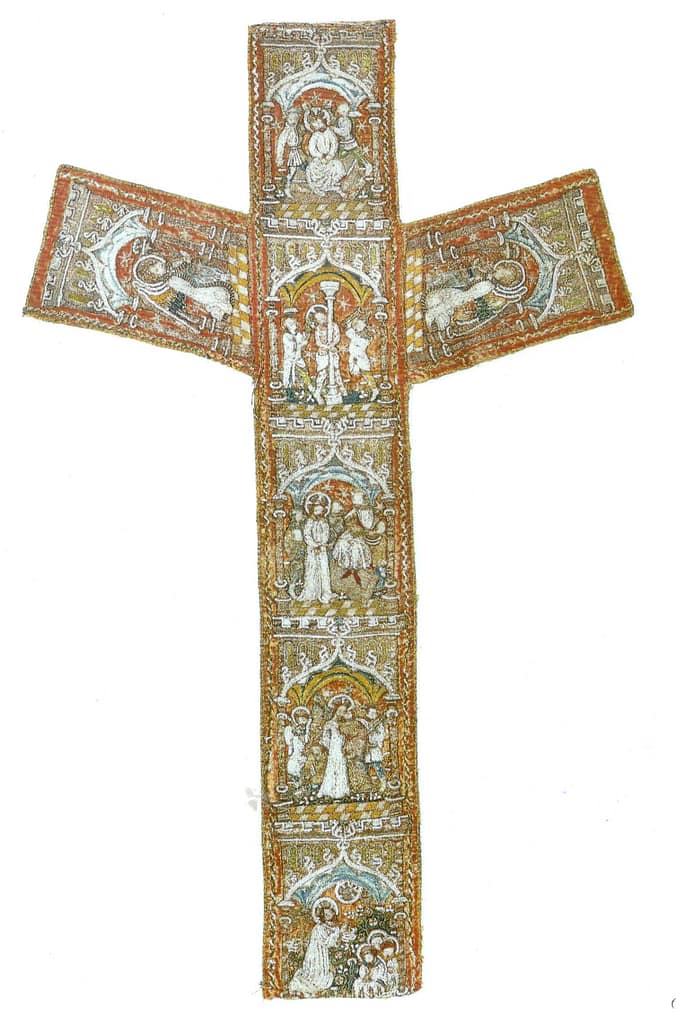
Two other known pieces of medieval goldwork embroidery show the same embroidered scenes as the vertical strip from Bamberg. Chasuble C6 is in the Cathedral Treasury of Brandenburg, and the chasuble cross is in the Keir collection. The Brandenburg publication mentions a further two pieces: an orphrey in Museum Kunstpalast (Düsseldorf), Inv. Nr. 8107 and three orphrey panels attached to an antependium of St Petri Church (Lübeck). The latter is now in the Sankt Annenmuseum under Inv. Nr. 7505 (and not A 6304 as mentioned in the publication). Unfortunately, the publication shows these two pieces only as small black-and-white pictures. I am working together with the people of the Kunstpalast and the Sankt Annenmuseum to study these pieces properly. These embroideries do not show the same Passion scenes as the pieces from Bamberg, Brandenburg, and the Keir Collection.
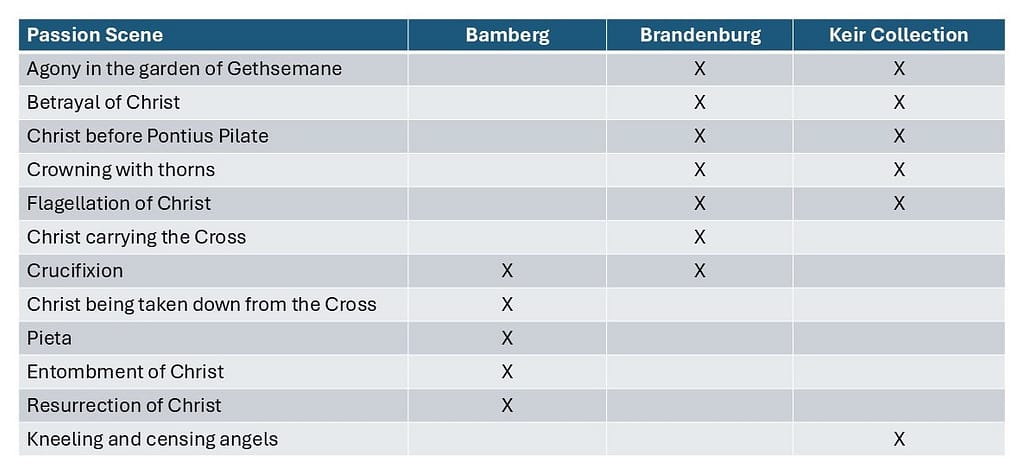
The above table shows you which Passion scene is depicted for each vestment. If we follow the idea that the scenes were once part of a cope orphrey, the fact that we have “twins” means we have at least two copes. Each scene is about 24 cm tall. There are 11 different scenes plus the two orphrey panels with the angels. To accommodate all 13 scenes, you would need a cope with a width of 312 cm. That’s a perfectly normal size for a cope. It is therefore possible that the embroideries on the chasuble from Bamberg and those forming the cross in the Keir Collection were once part of the same cope from Bamberg Cathedral. The scene with Christ carrying the Cross was lost in the remodelling.
Brandenburg Cathedral once had a cope with the same beautiful stumpwork and pearl embroidery as seen in Bamberg Cathedral. Differences in the treatment of the backgrounds between Brandenburg on the one hand (grassy areas) and Bamberg and Keir Collection on the other hand (tiled floor) further support this idea. As the embroidery materials and techniques are so similar, both copes were ordered from the same Franconian workshop.
The older strip of embroidery on the chasuble from Bamberg may have received additional embellishment when it was combined with the vertical strip. Maybe the stars were added to the background? And what about the twisted strip of parchment borders? Unfortunately, it is unknown when this remodelling took place. The chasuble fabric is also from the middle of the 15th century, when the embroidery on the vertical strip was made, and thus does not help date the remodelling.
Literature
Jehle, M., Wetter, E. (Eds.), 2005. Liturgische Gewänder und andere Paramente im Dom zu Brandenburg. Abegg-Stiftung, Riggisberg.
King, M., King, D., 1990. European Textiles in the Keir Collection 400 BC to 1800 AD. Faber and Faber, London.
Wilckens, L. von, 1996. Kunst in Nürnberg um 1400: eine Bilanz neuer Einblicke. Anzeiger des Germanischen Nationalmuseums, 53–75.
0 Comments