Today, I am sharing a free medieval embroidery pattern with you. Late last year, I visited the Treasury of the basilica of St Servatius in Maastricht, the Netherlands. Among the display cases with medieval textiles sat this very damaged alms purse. Colours faded and threads fallen out. When I studied the pictures I had taken on my computer, I saw traces of gold thread. The embroidery consists of brick stitch executed in gold thread and silk on linen. And since I have never tried brick stitch with gold thread, reconstructing the pattern would certainly teach me a thing or two! You can follow along as I share the pattern and my process with you in this blog. You can also find a downloadable PDF in the membership section of my website.
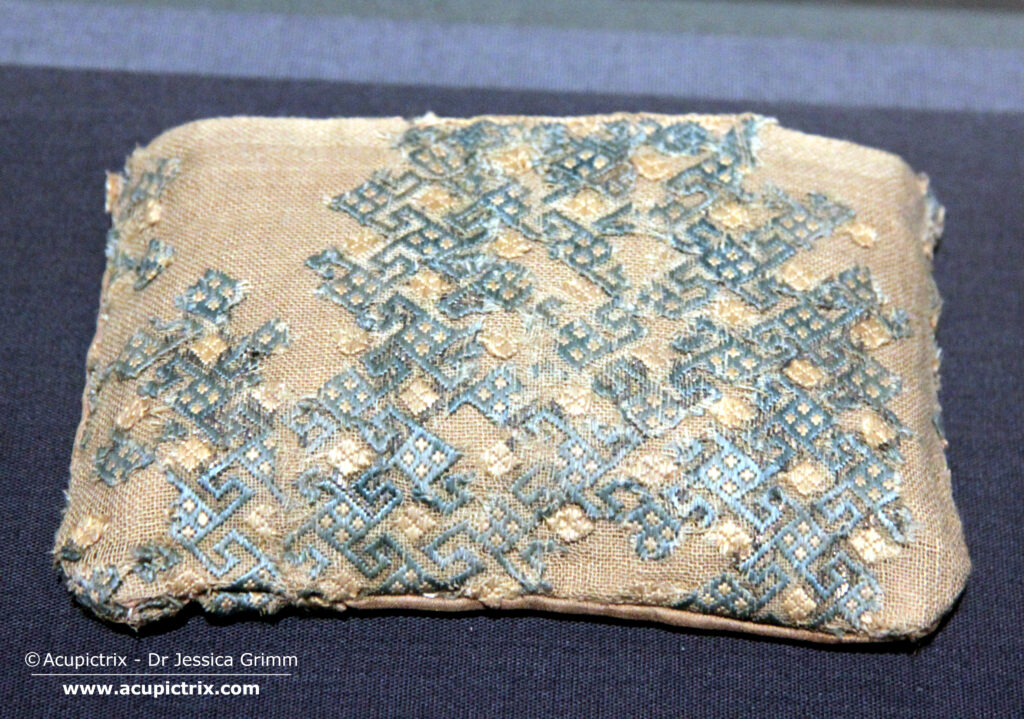
Unfortunately, the museum’s caption was VERY short: 105, Liège/Maastricht c. 1300. The embroidery uses two colours of untwisted filament silk: red (now blush) and blue (pretty faded as well). Often, a dark stain surrounds these silken brick stitches. And some of that stain still contains traces of a metal thread. The embroidery fabric is a coarser linen or wool, probably evenweave. Unfortunately, I don’t have exact counts. For similar counted thread embroidery, the counts can range from 28 to 72.
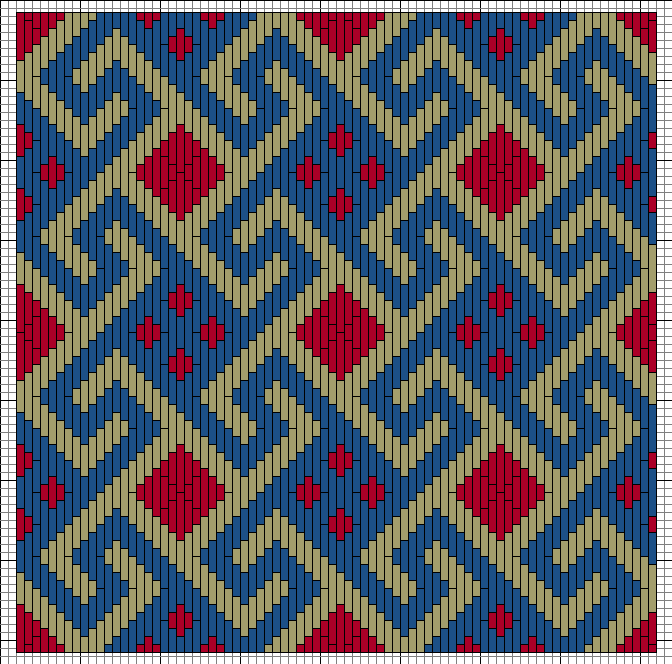
As noted, this medieval embroidery pattern employs only one stitch: Brick Stitch. The smallest stitch in the above pattern runs over two fabric threads. Most stitches run over four, and a small number run over six. That’s it. You will need an untwisted filament silk, such as Au Ver à Soie Soie Ovale, if you want a true medieval look. However, it will also work with normal stranded cotton or perlé. For my metal thread, I chose Stech 120/130 made by M.Maurer. This is comparable to passing thread #5.
When you look at the original, the linen or woollen fabric has a very open weave. Today’s embroidery linens don’t. As part of the embroidery is worked in a metal thread, this open weave is likely important. The bigger holes make the metal thread go through more easily. I have therefore opted to use 32 ct Congress cloth instead of linen. The size of the embroidery fabric means that I needed a double thread (or go over your stitch twice) of the Au Ver à Soie Soie Ovale.
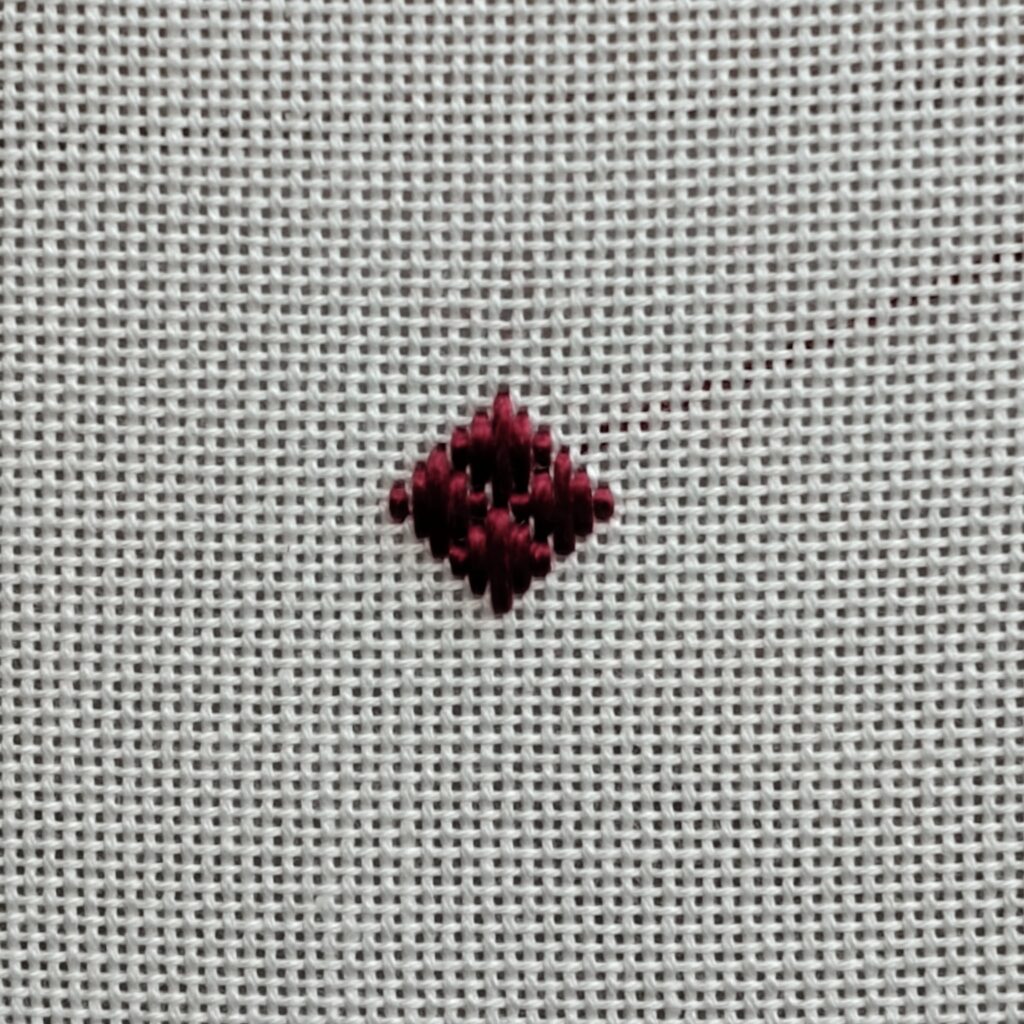
When recreating this medieval embroidery pattern, I started in the middle, stitching the red diamond first. How you start and anchor your threads is up to you. Knots are fine by me :).
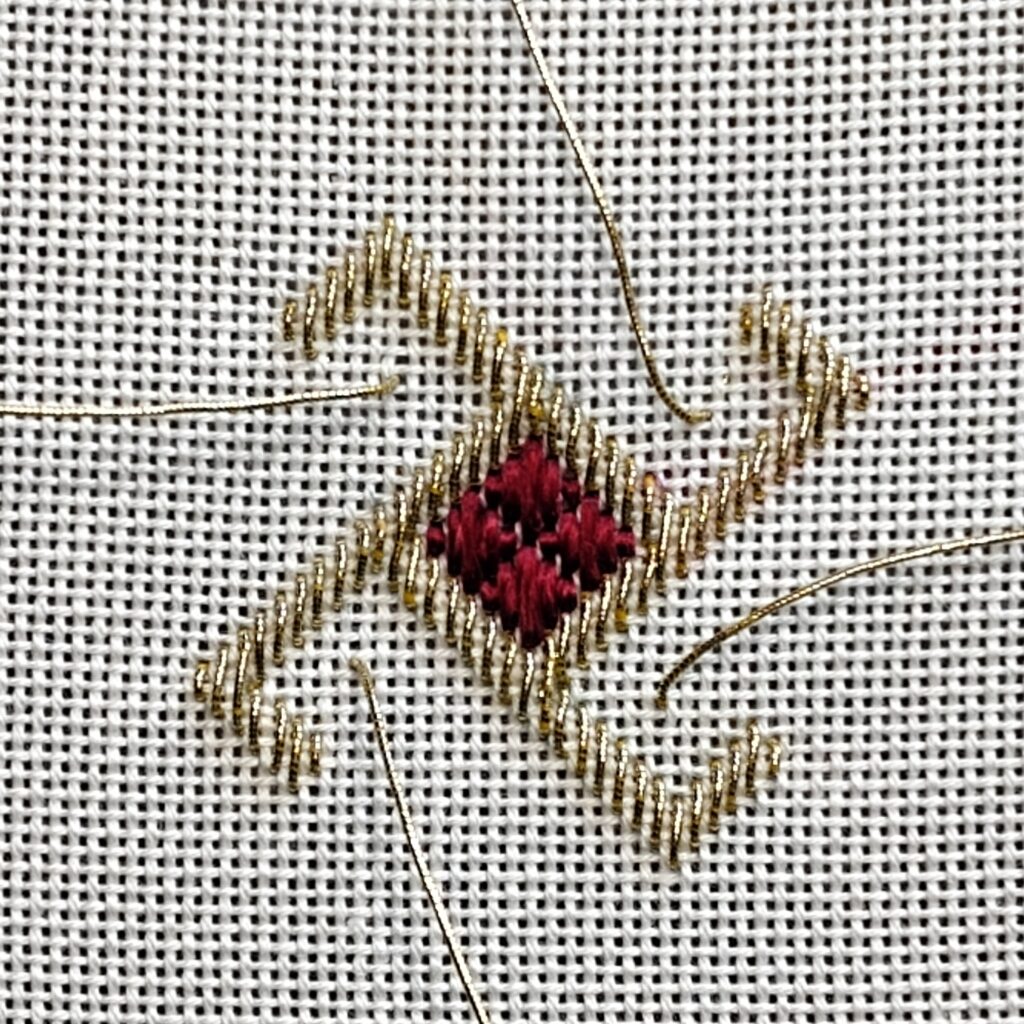
For the next step, I added the metal thread stitches around the central red diamond. As you can see, metal thread doesn’t spread like silken threads do. It is completely normal to see the background fabric between the stitches. Especially enlarged like this. In real life, this isn’t very noticeable as the sheen of the gold overpowers the dull cream of my fabric. To get the same effect, avoid stark white fabrics. By the way, you can also use metallic threads. They behave more like textile threads, and you will get better coverage. Not period-appropriate, though.
I treated my metal thread just as I treated my silk embroidery thread. However, I did work a little more slowly to give my metal thread time to adjust to all the abrupt movements I made.
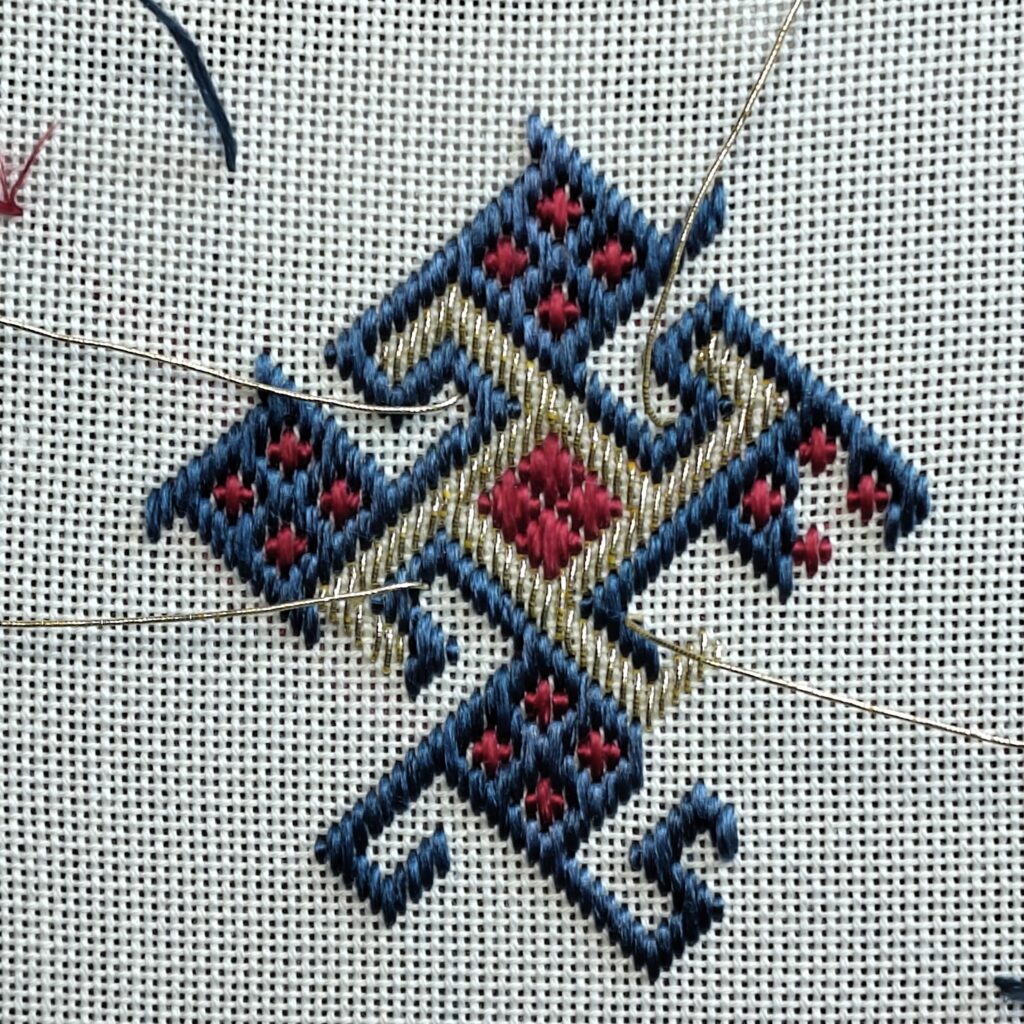
Keep adding stitches, working from the middle outwards. The metal thread will tend to drag up silken fibres from the threads running along the back. You can minimise this by being mindful of your stitching path.
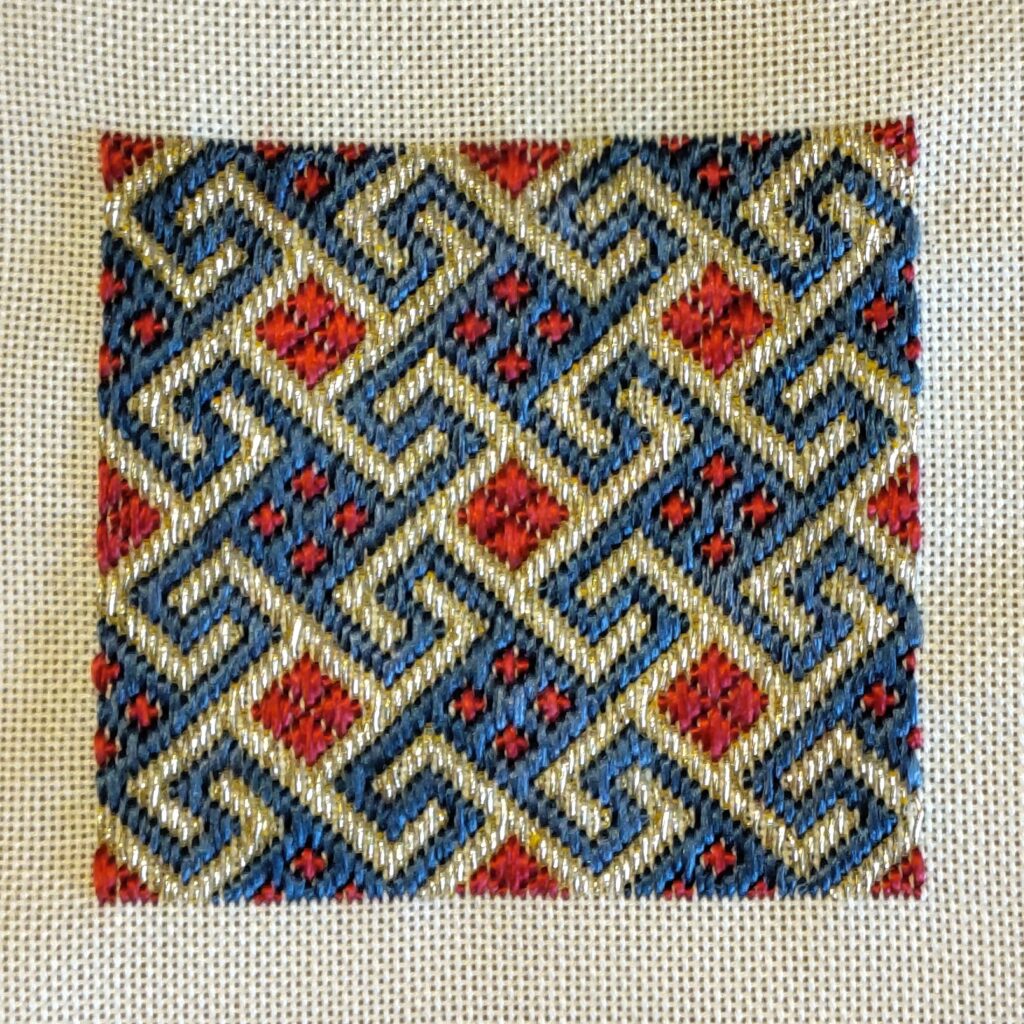
And this is the finished medieval embroidery pattern based on the fragments of an alms purse in the Treasury of St Servaas in Maastricht. Would you have guessed that the alms purse was once probably this bright? And are you surprised by how the complete pattern reads?
Embroidered bags like these would have been valuable possessions. Unlike other forms of goldwork embroidery, the metal thread runs on the invisible back. And as the embroidery is full-cover, the labour costs would have been considerable too!
10 Comments
Melinda · May 27, 2026 at 9:00 pm
Beautiful recreation, bringing to life what has only survived in shreds. I see that the overall size is different (based on the number of 4-spot designs), but likely similar to other surviving bags, and it gives us such a stunning example of its colorful effect. Love the result!
Acupictrix - Dr Jessica Grimm · May 27, 2026 at 9:04 pm
I’ve only worked a sample :).
Rebecca · May 27, 2026 at 9:59 pm
Wow, how lovely. It is wonderful to see the medieval patterns in something like their original glory. Do you have the dimensions of the medieval purse? I’m curious to know how big such purses are.
You’re such a great treasure hunter! Thanks for every single photo you share with us.
Acupictrix - Dr Jessica Grimm · May 28, 2026 at 7:53 am
Unfortunately, not! But from memory, I would say it is about 15 cm wide.
Raven · May 27, 2026 at 10:29 pm
Very cool. Thank you for sharing this pattern.
Amy Ropple · May 28, 2026 at 1:35 am
Lovely! Really wonderful article and work. Thank you!
Denise Duda · May 28, 2026 at 1:49 pm
This is so beautiful! Thanks so much! But I have never heard of 32ct congress cloth, only 24ct. Where did you find this?
Acupictrix - Dr Jessica Grimm · May 28, 2026 at 4:24 pm
Hi Denise! I bought it during my recent visit to the Eugen Übelhör factory: https://acupictrix.com/eugen-ubelhor-high-quality-embroidery-linen-made-in-austria/ The tag reads “Monika 12” 32 ct with product number 20044. You can order directly from them by sending them an email (in English). For my 100 x 183 cm piece, I paid €29,80.
Sandy P · May 29, 2026 at 3:45 am
I’ve never worked with metal thread or even metallics; I’m just beginning to venture into those. I’ve also never worked with Soie Oval and have wondered for some time what using it would like compared to spun silk thread like Soie d’Alger or NPI. Doing a sample like this would be a great thread adventure.
I also managed to run amok with my time this afternoon looking up information on alms purses. There’s not a lot outside of museums but I found a couple of websites with some details on them. That was a fun rabbit hole to chase down.
Thanks for the reminder about where to get 32 count Congress cloth. I did an online search and it seems like it cannot be found in America; 24 count is easily found. Berlin Woolwork in Alberta, Canada, has loads of options for the metal or metallic threads. Hmm, I think I’ve talked myself into giving this a try once I’ve sourced materials from all kinds of places.
Acupictrix - Dr Jessica Grimm · May 29, 2026 at 11:05 am
Yes, they are fascinating masterpieces of embroidery, Sandy! By the way, on the Forum, under General, there are two recordings of the Medieval Embroidery Study Group dedicated to alms purses. Tomorrow evening, we will have another meeting (which will also be recorded), again on alms purses.