Nearly a year ago, I visited the small museum of Kloster Kamp and spent a delightful afternoon with a beautifully embroidered antependium. As the embroidery dates to the first half of the 14th century and was probably made in Cologne (the Abbey had property there), it is well-suited for comparison with the embroideries from Burtscheid Abbey. We will explore other pieces of 14th-century embroidery in the coming weeks as well. This is perfect preparation for my planned reconstruction of one of the Burtscheid embroideries.
Kloster Kamp is a former Cistercian monastery established in AD 1123; the first of its kind in Germany. Most of the Abbey has been demolished, and what remains dates to much later. As the town of Kamp-Lintfort is in the middle of nowhere, the magnificent 14th-century antependium is little known. However, I urge you to make the detour as the lighting is decent and you are allowed to take pictures.
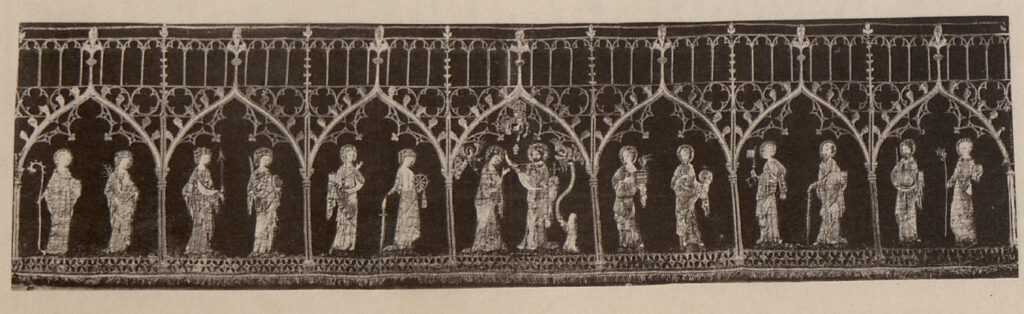
The above overview of the Kamper Antependium is from Schnütgen’s 1888 publication. At 260 x 85 cm, the piece is simply too large to photograph in one piece, as it is displayed at Kloster Kamp. But you do need that overview to understand what is depicted. In the middle, you see the Coronation of Mary. The tiny kneeling person to the right of Jesus holds a scroll that once contained a dedication. This person is probably the Cistercian monk who donated the Antependium.
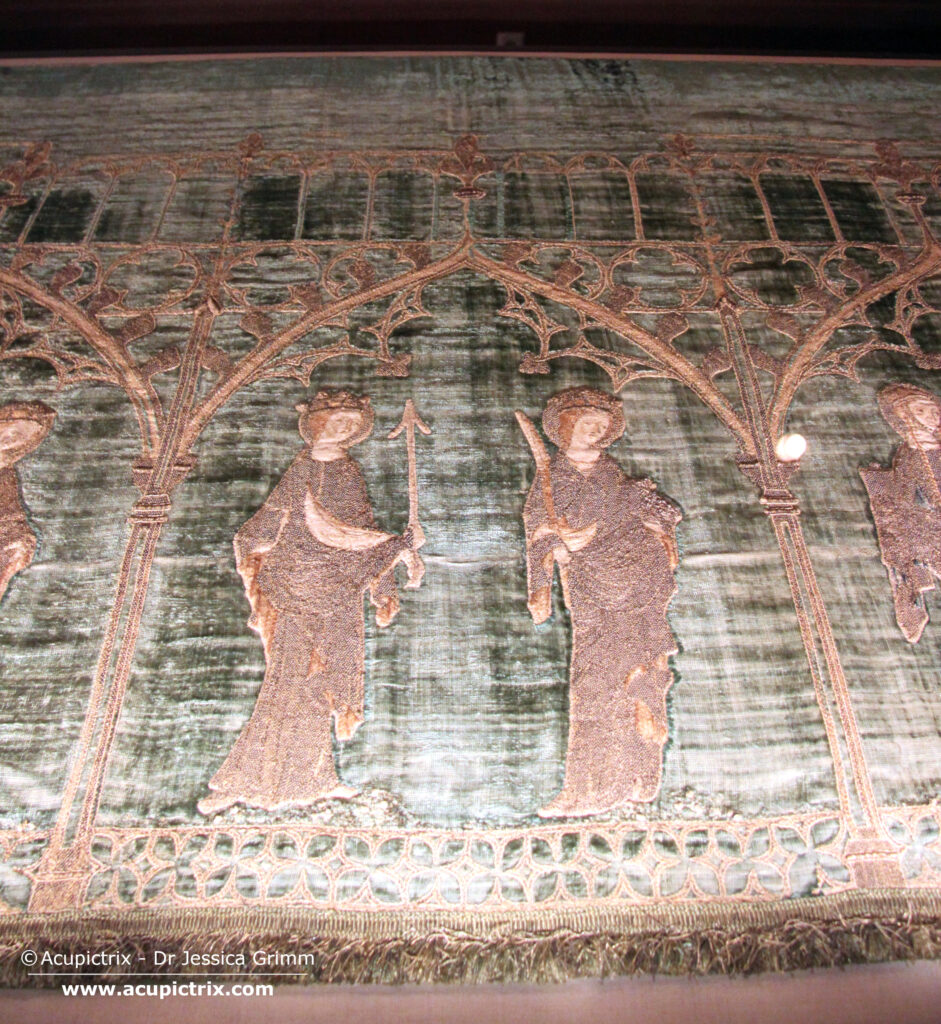
Surrounding the central Coronation scene, we see, from the left, an Abbot, either Benedict of Nursia or Bernhard of Clairvaux, followed by Saints Dorothy, Ursula, Agnes, Mary Magdalene, Catherine, John, John the Baptist, Peter, Paul, James the Great and an Abbess, either Scholastica or Hildegard of Bingen. The figures are paired under these elaborate Gothic arches.
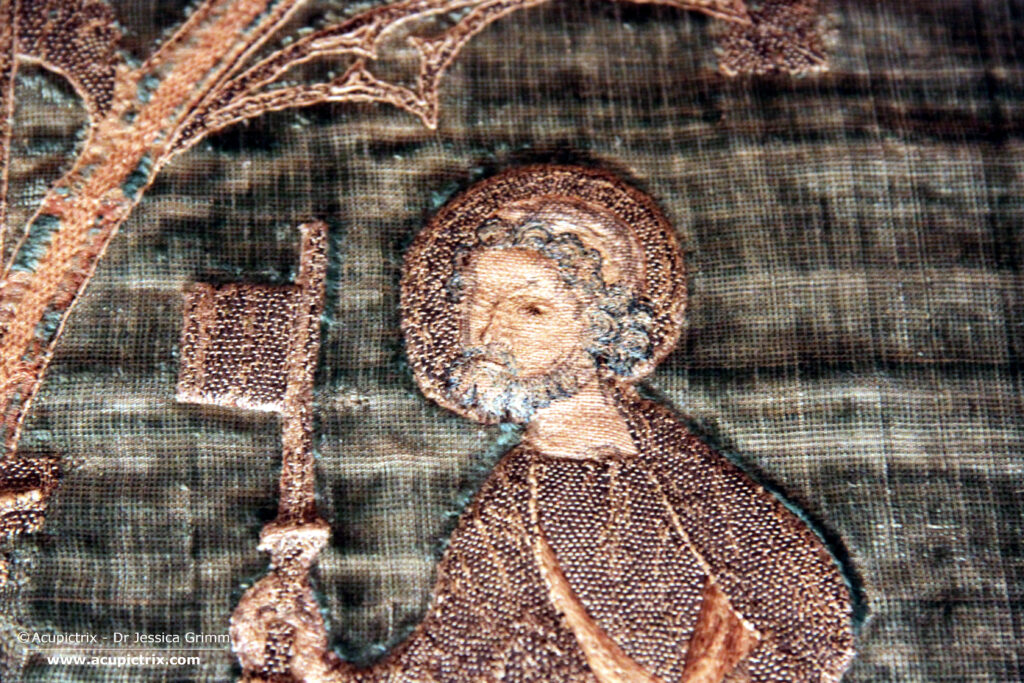
As you can see from this detailed picture of Saint Peter, the embroidery on the antependium kept at Kloster Kamp is of a familiar kind. The figures (about 27-28 cm high) and the architecture were embroidered onto fine linen and then appliqued onto the green velvet. There’s a detailed drawing, probably made with black ink, below the embroidery. The faces were executed in very fine directional split stitch. Much as they would have been in traditional Opus anglicanum. Parts of the clothing are also worked in a slightly larger split stitch. The shading is very delicate.
Most of the remaining design on the antependium at Kloster Kamp is executed in goldwork embroidery. Pairs of gold threads have been couched down with a, by now suspiciously blush coloured, silken thread in a simple bricking pattern. I suspect that these stitches were probably originally red, a favourite of medieval embroiderers. The gold threads follow the flow of the garments. Additional folds are added on top of the goldwork with simple stitches in a thicker silken thread. Design outlines were once contoured with black silk (remains clearly visible on the back during restoration in the 1950s). The attributes of the saints are stitched in silver threads.
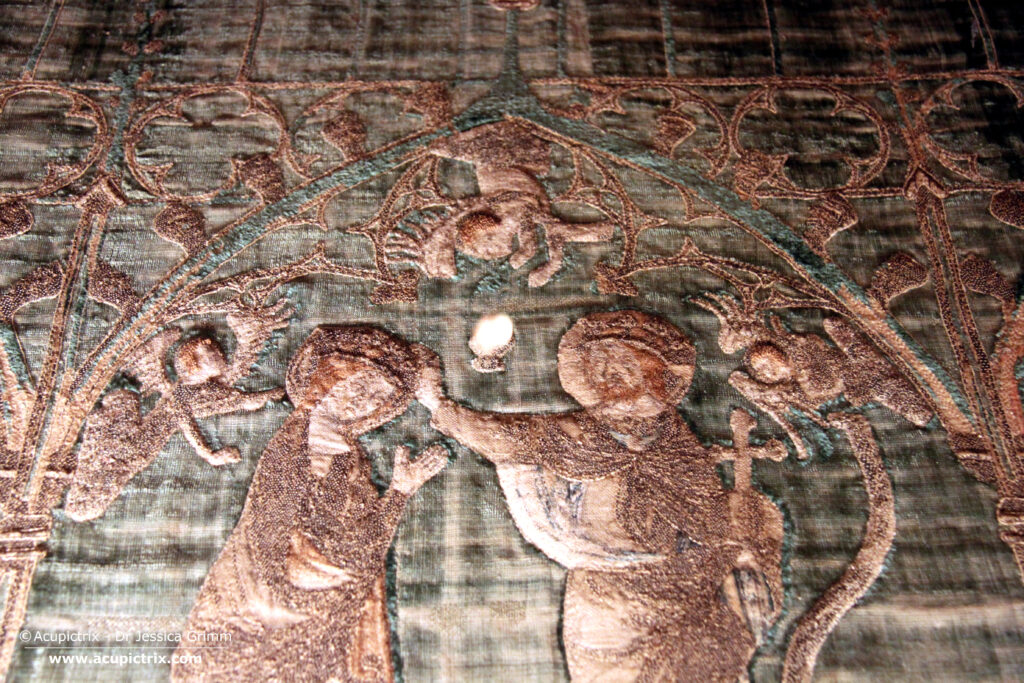
Some parts of the design, such as the base of the crowns and the wheel of Saint Catherine, have been padded with simple string padding. There might also be some softer padding under the angel’s faces in the Coronation scene. Their hair consists of a knotted stitch. This was a popular choice in the medieval period.
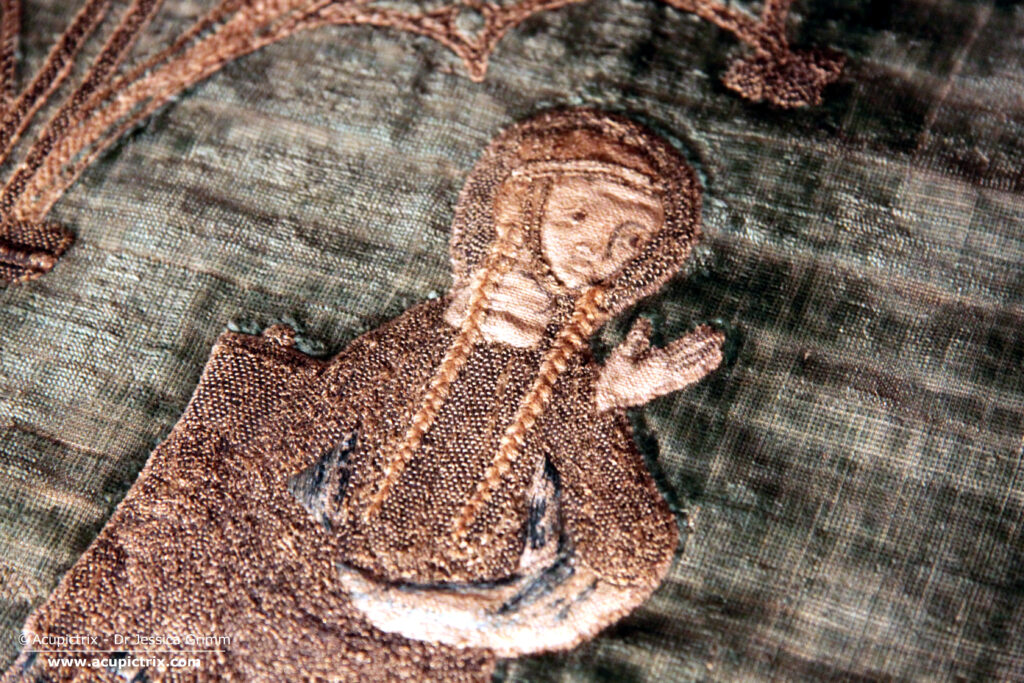
But my absolute favourite embroidery hack on the antependium at Kloster Kamp is Mary Magdalene’s braids! Aren’t they cute? When you zoom in, you’ll see that they are shaded groups of short, slanted satin stitches slightly worked on top of each other to achieve the chevron pattern of the braid.
Literatur
Jaques, R., 1956. Die Wiederherstellung des gestickten Antependiums der ehemaligen Abteikirche Kamp (Kreis Moers). Jahrbuch der rheinischen Denkmalpflege in Nord-Rheinland 20, 321–325.
Schnütgen, A., 1888. Besticktes Antependium, rheinisch erste Hälfte XIV. Jahrhunderts. Zeitschrift für christliche Kunst 1 (4), 123–132. This can be downloaded for free!

2 Comments
Kimberly McCoy · January 13, 2026 at 10:57 pm
I love these sacred figures. The detail is lovely and fine especially on the faces. Thank you for these!
Acupictrix - Dr Jessica Grimm · January 14, 2026 at 7:02 am
You are very welcome!