Last week, we looked at a chasuble dating to AD 1130-1160 and featuring Opus anglicanum embroidery. To place it in a wider context, this week we will look at a mid-12th-century chasuble from the Museo Arcivescovile di Ravenna in Italy. Although the piece is called the chasuble of bishop Giovanni Angeloptes, this cannot be. Angeloptes was bishop of Ravenna in the first half of the 5th century when the Roman Empire in the West was on its last legs. Some have speculated that the chasuble was used to re-clothe the body of the sanctified bishop when his grave was opened many centuries later. Let’s have a closer look at this spectacular piece of goldwork embroidery from the High Middle Ages.

The so-called chasuble of Giovanni Angeloptes is displayed suspended in an older-style display case. Although I doubt the fabric is having much fun, it was magical to circle the vestment. To date, I know very little about the vestment as it hasn’t been published to modern standards yet. A 2021 conference poster described a research project with plans for conservation and an updated display. As far as I can tell, the outcomes have not been published yet. The two late-19th-century publications don’t have much detail on the materials used.

From the publications, I learned that the chasuble is made of patterned purple silk (possibly a very rare fabric). This patterned fabric was further adorned with goldwork embroidery. The created golden pattern of eagles and crescents mimics a gold-woven fabric. I don’t know if there’s a linen backing to support the embroidery. The chasuble’s older date, combined with the fact that the gold threads are still shiny, points to a high gold content. The museum locates the vestment to an embroidery workshop in Sicily.
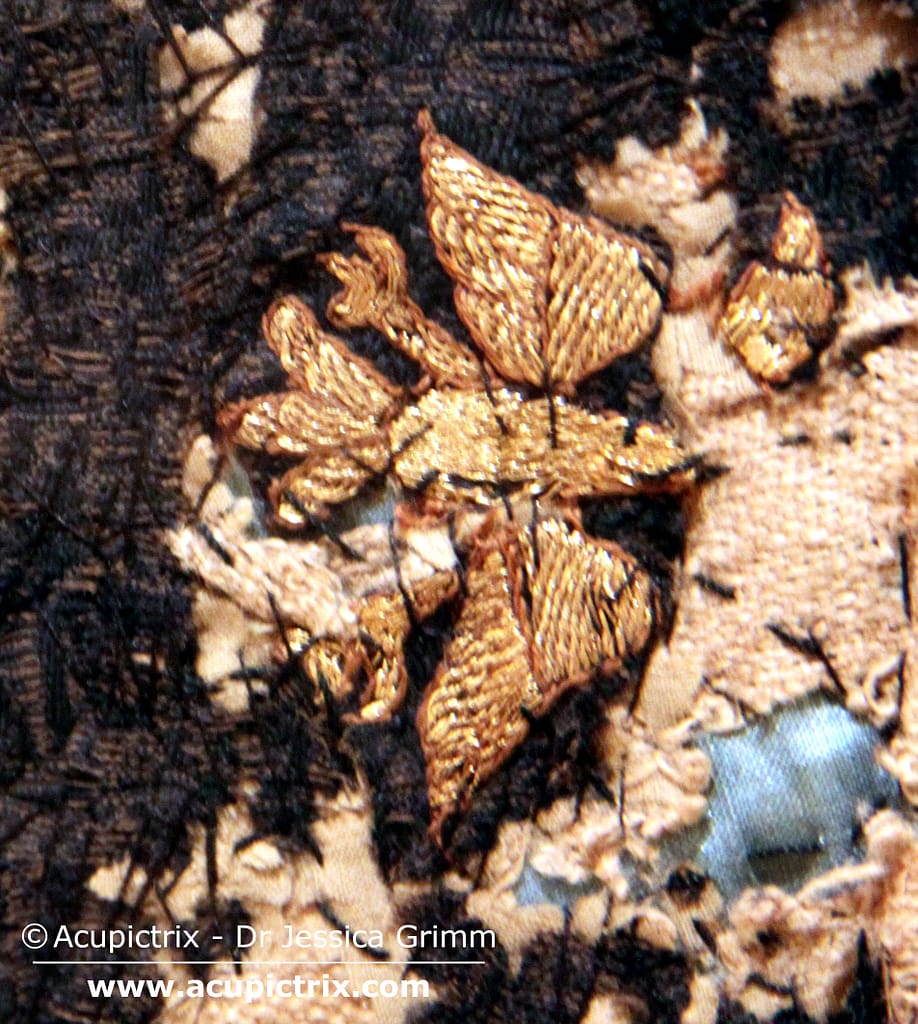
The above close-up gives you an idea of the embroidery technique used on the so-called chasuble of Giovanni Angeloptes. The eagle is outlined in red silk using stem stitch. The different parts of the eagle have been filled by couching down a single gold thread with a different red silk. The gold thread follows the shape to be filled and isn’t placed strictly horizontally or vertically as we saw last week. The couching pattern is also different. Instead of the bricking pattern imitating a plain weave, the embroiderer opted for slanted lines to imitate a twill weave. Please ignore the crude dark stitches. The conservator made them when stitching the remains of the chasuble to a support fabric.
At first glance, the chasuble from Hildesheim and the one from Ravenna don’t look that different. Both used a purple patterned silk as their base. They then embellished this fabric with goldwork embroidery. Crescents and rosettes/flowers for Hildesheim and eagles and crescents for Ravenna. The Hildesheim chasuble was further decorated with gold embroidered orphreys. Studying the embroidery reveals the differences. Underside couching of a double gold thread for Hildesheim in a bricking pattern versus surface couching of a single gold thread in a twill pattern for Ravenna. The gold threads follow the warp threads in Hildesheim, whereas they follow the flow of the design in Ravenna. One would be hard-pressed to value one above the other!
Literature
Carile, M.C., 2021. The so-called chasuble of Bishop John Angeloptes : A project for an extraordinary liturgical garment. Curation and Conservation: Dress and Textiles in Museums, poster presentation.
Rohault de Fleury, C., 1883-1889. La Messe. Études archéologiques sur ses monuments. 7, Paris.
Venturi, A., 1895-1896. Museo del Duomo di Ravenna: La “casula” di Giovanni Ageloptes. Le gallerie nazionali italiane. Notizie e documenti 3, pp. 258-260.

0 Comments