The Cathedral Museum of Pisa, Italy, holds an Opus ciprense embroidery in the form of a large antependium. We’ve already visited this museum to study the cope of Gelasius II. What makes this 14th-century antependium so special is that it is one of only three pieces of surviving Opus ciprense: embroidery made on Cyprus. The term is known from historical accounts, and even the high-quality Cypriot gold thread (or de cyphre) is well-documented. However, neither are these three embroideries well-studied, nor are internationally operating embroidery or gold thread workshops documented in Cypriot historical sources. It is thus unclear if all Opus ciprense embroidery and all or de cyphre originated on Cyprus. It might just have been an exotic name used as a marketing gag. We have already seen this for a particular style of alms pouches made in Paris. Let’s see what we will find studying the antependium in Pisa.

The Coronation of the Virgin is centrally depicted on the Opus ciprense antependium. Immediately surrounding the central scene are four saints: Saints Peter and John on the left and Saints Paul and John the Baptist on the right. Although the embroidery has almost completely fallen out, the two Johns are probably accompanied by the donor, Giovanni di Nicosia and his mother. How do we know it’s probably them? Through the embroidered inscription along the bottom seam: <Hu>nc pannum dominus frater Ioha(n)nes archiepiscopus Nicosiensis dedit ecclesie Pisane pro anima domine Iacobe m<atris sue>l Anno Domini MCCCXXV. It tells us that Archbishop Giovanni of Nicosia donated this antependium to the Cathedral of Pisa for the benefit of his mother’s soul in AD 1325. Don’t you love it when medieval embroideries come with an embroidered explanation?!
The other eight embroidered scenes on the Opus ciprense antependium show episodes from the Lives of Mary and Jesus. The four scenes on the left show the Annunciation, the Nativity, the Adoration of the Magi and the Presentation at the Temple. The four scenes on the right show the Resurrection, the Ascension, the Dormition, and Pentecost. If you are familiar with art history, you have probably realised that it is a happy mixture of Eastern (Nativity) and Western (Resurrection) iconographical traditions. Not too weird when you consult the map to see where Cyprus is located.

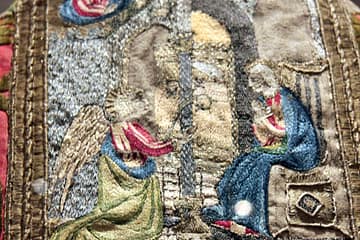
We’ve seen that the embroidery design of the Opus ciprense antependium in Pisa has a unique local style. But what about the embroidery techniques used? Anything unusual there? At first glance, nope. There’s the normal surface couching of two parallel metal threads (they are so tarnished that it is hard to tell if they were once gold and/or silver). Simple chevron patterns and bricking are used. The above detail of Mary shows a high-quality underdrawing on silk twill (very worn) backed with linen.

As you can see in the picture above, the silk embroidery techniques aren’t anything special either. We have, although very worn, beautifully shaded directional split stitch for the garments. The literature also mentions satin stitch and stem stitch.

But then, there’s this unusual goldwork technique seen in the garments of some of the figures. Can you see the red, blue and green haze in the picture with the three Magi above? This is achieved by loosely wrapping a silk thread around the metal thread. The resulting composite thread is then couched in the direction of the garment’s flow (typical of the 14th century). Some folds are then accentuated by couching a coloured silk thread over the metal thread layer.
Creating a composite thread is rare, especially this early in the medieval period. So, can we use the presence of these composite threads to identify Opus ciprense? Nope. The other famous piece of Opus ciprense, the central panel of the Grandson antependium, does not show it. And what about the third piece of known Opus ciprense embroidery? I haven’t been able to track that one down yet. So, for the moment, Opus ciprense remains a bit of a mystery!
Literature
Jacoby, D., 2014. Cypriot Gold Thread in Late Medieval Silk Weaving and Embroidery, in: Edington, S.B., Nicholson, H.J. (Eds.), Deeds Done Beyond the Sea: Essays on William of Tyre, Cyprus and the Military Orders presented to Peter Edbury. Ashgate, Farnham, pp. 101–114.
Schuette, M., Müller-Christensen, S., 1963. Das Stickereiwerk. Wasmmuth, Tübingen.
0 Comments