The 14th-century Grandson Antependium is a pretty mix of embroidery techniques, styles, languages and geographical areas. It is one of only three surviving pieces of Opus ciprense embroidery in the world. Another famous antependium in this embroidery style is held at the Cathedral Museum in Pisa, Italy. Let’s explore!

The Grandson antependium is housed at the Historisches Museum in Bern, Switzerland and catalogued under Nr. 18. It is 244 cm wide and 88 cm high and consists of three separate parts. The knight kneeling to the left of the central figure of the Virgin and Child is the donor of the piece. His coat of arms identifies him as Othon de Grandson (c. 1238-1328). Although born near Lausanne in Switzerland, he became a close friend of King Edward I of England. Othon de Grandson travelled widely throughout Europe and the Mediterranean area when he joined the 9th Crusade. Othon accumulated great wealth and donated it to various religious institutions in both England and Switzerland. This particular antependium was donated to the Cathedral of Lausanne, where Othon is entombed. With the amount of gold used for the embroidery, it must have been a very expensive piece.

The central part of the antependium shows the enthroned Virgin and Child with two vases with foliage and two angels with censers on either side. The design has a Byzantine flavour, which is emphasised by the Greek-embroidered inscription of Christ’s name. But that’s not the only language used. Mary is addressed in Latin, and the two angels are addressed in ancient French. The design isn’t purely Byzantine either: the censers are distinctively Western European. Byzantine embroideries featuring donor figures are not known from this era either. Where was this piece made? And for whom originally?
Most scholars now agree that the central part of the embroidery was likely made in Cyprus. The island is conveniently located en route to the Holy Land and also served as a base of operations when things went wrong during the crusade. Cyprus belonged to the Byzantine Empire with its Eastern Orthodox version of Christianity. At the same time, it had ample visitors from the West. Was the central composition mostly finished when Othon saw it at a Cypriot embroidery workshop? Were the texts added on his request? The knightly figure and the coats of arms certainly were.


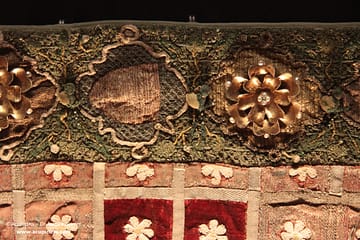
And then we have the two separate side panels. Very different from the central panel. Style, embroidery technique, and materials used differ from those of the central panel. And their design is non-religious. The side panels are thought to have been embroidered in England as they sport underside couching. Is this a rare remnant of non-religious Opus anglicanum? Did Othon come across two embroidered soft furnishings in England that, together with the panel he probably acquired in Cyprus, would make up a fitting antependium for the high altar in his cathedral back home? As the embroidery is cut at the top, the two panels were not specifically intended for that high altar when they were made. I think we see a rare glimpse of Opus anglicanum ‘for the noble home’ preserved in this extraordinary antependium. What do you think?
Literature
Martiniani-Reber, Marielle (2007): An exceptional piece of embroidery held in Switzerland: the Grandson Antependium. In Matteo Campagnolo, Marielle Martiniani-Reber (Eds.): From Aphrodite to Melusine: Reflections on the Archaeology and the History of Cyprus. Geneva: La pomme d’Or, pp. 85–89.
Stammler, Jakob (1895): Der Paramentenschatz im historischen Museum zu Bern in Wort und Bild. Bern: Buchdruckerei K.J. Wyss.
Schuette, Marie; Müller-Christensen, Sigrid (1963): Das Stickereiwerk. Tübingen: Wasmmuth.
Woodfin, Warren T. (2021): Underside couching in the Byzantine world. In: Cahiers Balkaniques 48, pp. 47–64.

0 Comments