Let’s trace changes in embroidery techniques from the 14th to the 16th century by examining a popular biblical story. The scene of Noli me tangere (touch me not), in which Mary Magdalene visits the grave and finds it empty, is one of my favourite biblical scenes rendered in medieval embroidery. In many of these scenes, Jesus is dressed like the gardener Mary Magdalene perceives him to be. These medieval gardeners can be very detailed. Sometimes, the shape of the blade on the embroidered spade is exactly the same as that of the rusty blades I found as an archaeologist. As the scene was quite popular in medieval goldwork embroidery, it is a perfect candidate for tracing changes in embroidery techniques over a period of about 250 years. Let the eyecandy commence!

One of the oldest pieces of goldwork embroidery that shows the Noli me tangere scene is the Bologna cope from AD 1304. This Opus anglicanum embroidery was made in England for Pope Benedict XI. The embroidery techniques used are very fine directional split stitch for the silk embroidery and underside couching in a simple chevron pattern for the golden background. The shading in Mary Magdalene’s blue mantle, lined with ermine, is exquisite. Interestingly, Jesus is portrayed as the risen Christ and not as a gardener.

Another beautiful version of the Noli me tangere scene can be found on the Syon cope. This embroidery was also made in England, between AD 1310 and 1320. Although the same embroidery techniques were used as in the Bologna cope, the relative amounts and distribution of the embroidery materials are very different. Far less gold is being used. Instead, the background consists of underside couched silk. And again, no gardener.

(Myrin, Ola. Historiska museet/SHM, (CC BY 4.0)).
Another rendition of the Noli me tangere scene can be found on an Opus anglicanum orphrey from Skå Church in Sweden. The piece is now kept in the Historiska Museet, inv. nr. 15336. You can see more pictures on the museum’s website. Again, the embroidery techniques used are the same as seen before. However, the underside couching of the background features an interesting pattern, much more sophisticated than the simple chevron we saw earlier. And still no gardener.

The Opus florentinum antependium now in the Musée des Tissus et Arts Décoratifs, Lyon, which I showed you a couple of weeks ago, also shows a lovely Noli me tangere scene. In terms of embroidery techniques used, gone is the underside couching. Instead, we have beautiful surface couching over string padding for the golden background. This embroidery was made in the 14th century, probably in Florence, Italy.

The orphrey on the so-called Lucca chasuble in the Domschatzkammer, Aachen, also features a lovely Noli me tangere scene. Just as in the previous piece of Opus florentinum embroidery, the golden background features a floral pattern created with string. But the gardener I promised you is still not there!
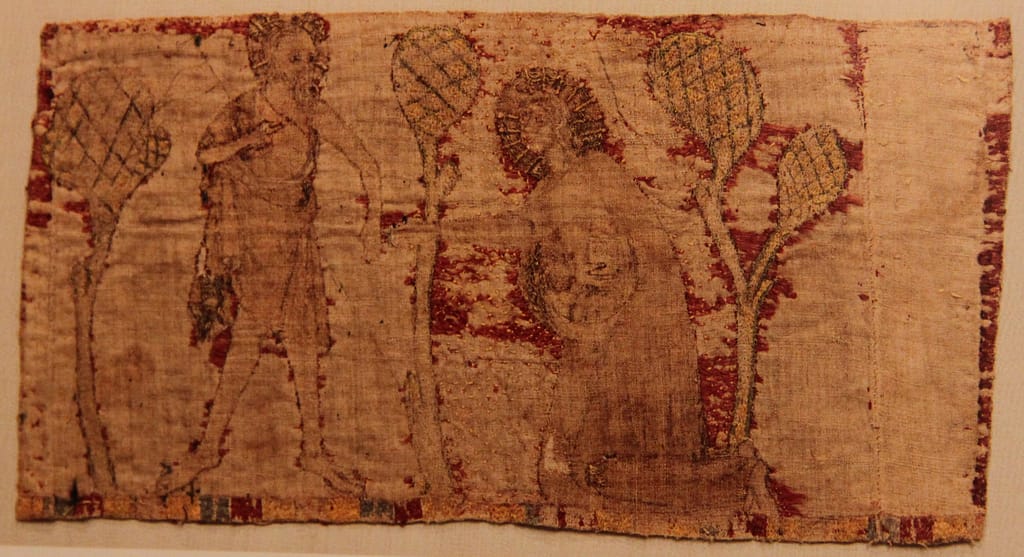
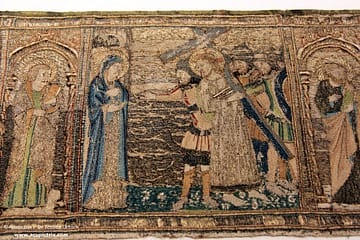
This badly preserved orphrey panel is kept at the Abegg Stiftung in Switzerland. It dates to the second half of the 14th century and was made in Northern Central Europe. No doubt, its poor state makes it difficult to pinpoint the embroidery more precisely. The embroidery techniques used are difficult to determine. However, there seems to be some string padding under the couched goldwork in the halos.

And finally, at the very end of the 14th century, we have a gardener! Amongst the many embroidered scenes on the vestments of Burtscheid Abbey is a Noli me tangere scene in which the risen Christ holds a spade. He isn’t a fully fledged gardener yet. In terms of embroidery techniques, we see directional split stitch and surface couching. There isn’t much shading in the split stitching. As seen in the Syon cope and the two Opus florentinum pieces, the gold threads follow the flow of the garments. This seems to be a characteristic of 14th century embroidery. Will Jesus become a fully fledged gardener in the 15th century? Let’s find out!
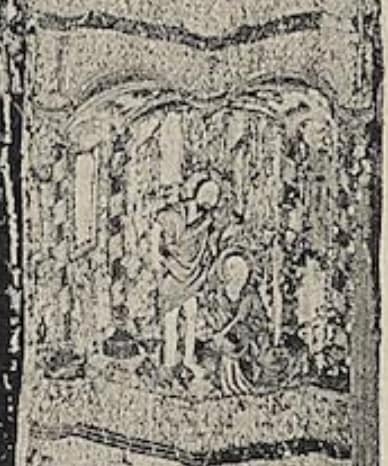
Unfortunately, our next example of a Noli me tangere scene has never been properly depicted in the literature. Although it is being held in the St. Annenmuseum in Lübeck, I have not been able to see the piece in person either. However, you can just about make out that Jesus is holding a spade in his left hand. But again, he isn’t a fully-fledged gardener yet. This embroidery was made around AD 1400 in Northern Germany. The embroidery techniques employed are split stitch and normal surface couching.

The gardener on the green cope from the St. Mary’s Church in Gdansk/Danzig has a proper medieval spade. Whilst the spade is made of wood, the “shoe” is made of iron. The embroiderer very cleverly added this detail in silver thread. You can read more about the embroidery techniques used in this French embroidery from shortly after 1460 in an older blog post.
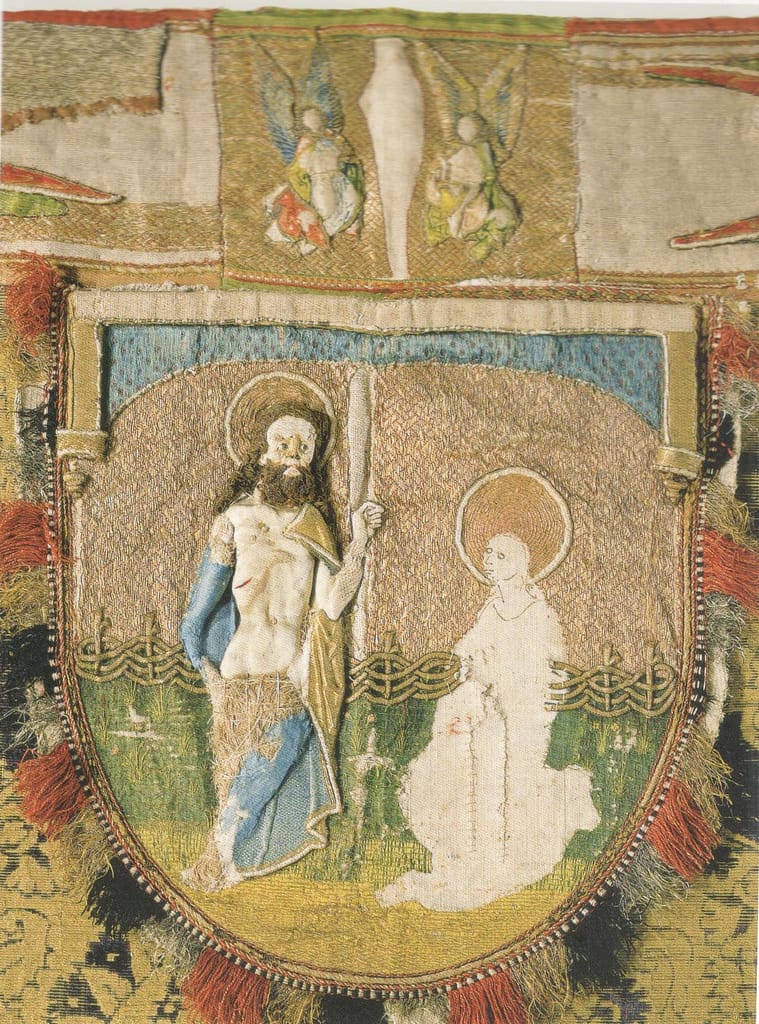
A damaged cope hood from Halberstadt Cathedral Treasury shows a Noli me tangere scene in stumpwork embroidery. Although Jesus has lost all his attributes, I have a feeling that this was once more a risen Christ than a gardener. The embroidery dates from the 1470s and was made in Lower Saxony. By the way, in terms of embroidery techniques, this is probably the first time we’ve seen a proper diaper pattern for the golden background.

The Catharijneconvent in Utrecht holds a cope made for bishop David of Burgundy. The Noli me tangere scene shows a risen Christ with a detailed spade. Whilst the majority of the spade consists of couched gold threads, the iron shoe is made of silver. There’s also a new embroidery technique on display: or nué for Jesus’ red mantle. The embroidery was made between AD 1475 and 1496 in the Northern Netherlands.
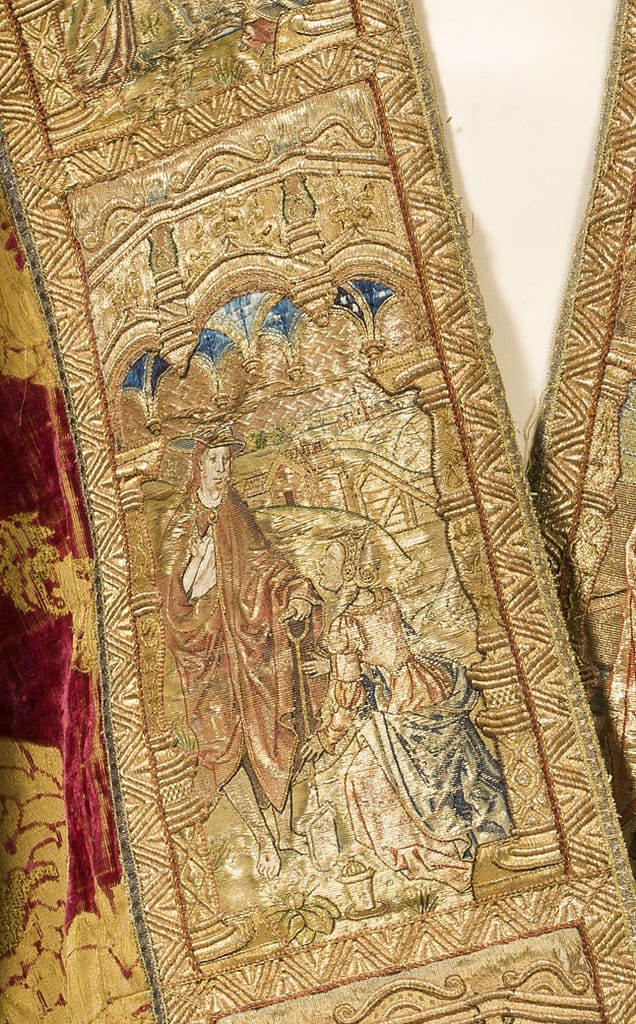
(KIK-IRPA, Brussels (Belgium))
The next Noli me tangere scene can be found on a cope kept at St. Christoffel church in Londerzeel, Belgium. It is part of a set of vestments that was originally made in AD 1516 in the Southern Netherlands for the Abbey of Roosendeal. Jesus is now not only holding a spade, but also wears a wide-brimmed hat to shield him from the sun whilst working outside. In terms of the embroidery techniques used, or nué is used more widely (the gold threads run the full width of the panel), and it is of better quality than seen in the previous piece.
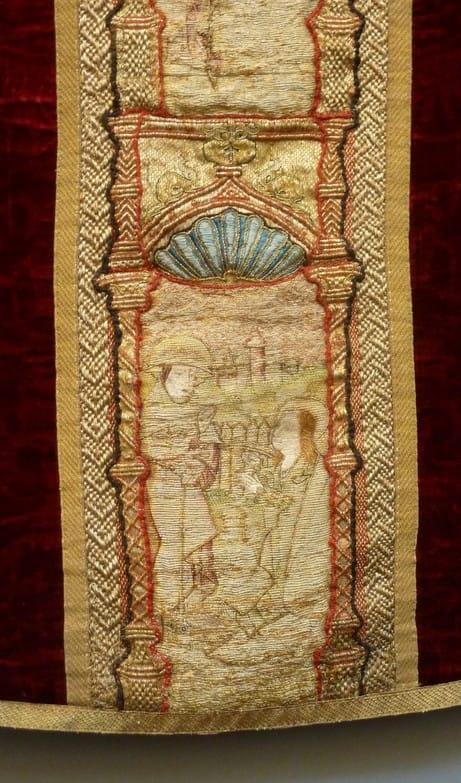

As we move up in time, we are bound to see twins as mass production of embroidered orphreys became the norm. The above orphrey panels clearly had a common design drawing. But the skill of the embroiderers executing the designs was very different. As was their choice of embroidery materials. Both embroideries were made in the 1520s in the Lower Rhine Area.

And the above Noli me tangere scene on a chasuble in the St. Nicolai church in Kalkar, Germany, is in the same vein too. The embroidery was made around AD 1525 in the Northern Netherlands. It seems that the wide-brimmed hat is a Dutch invention of the early 16th century. And in all likelihood, medieval gardeners in the Low Countries wore these wide-brimmed hats as a distinctive part of their working clothes.
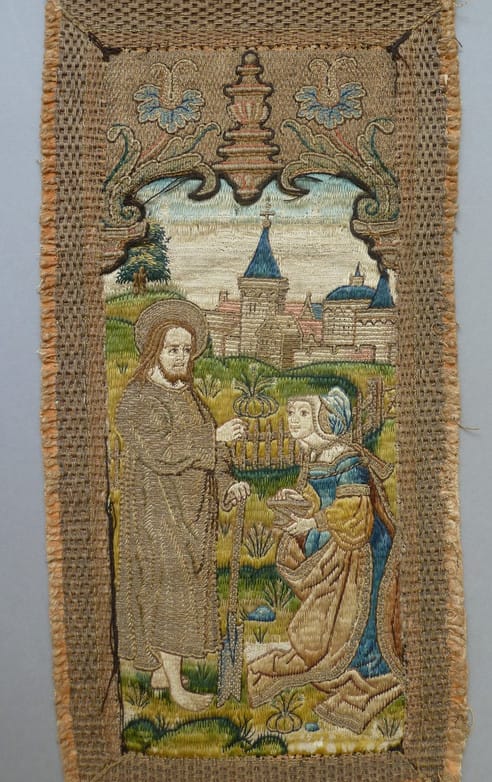
The orphrey panel above, depicting the Noli me tangere scene, was made in Amsterdam between AD 1525 and 1534. Although it is clearly related to the previous three panels, you can also see that we move from the Middle Ages to the Renaissance. Especially when you look at the frame’s decoration, with these large, fantastical flowers. And Jesus has the latest kit. No longer only an iron “shoe” to protect the working edge of his spade – he now has a completely iron blade. In terms of embroidery techniques used, I would say that these last three panels lack the skill of the embroiderers of the cope from Londerzeel. These last three panels were clearly mass-produced and intended for “middle of the range” buyers.

The Catharijneconvent in Utrecht has no shortage of embroidered Noli me tangere scenes. The above example was made between AD 1530 and 1549 in the Southern Netherlands. In terms of embroidery techniques used, the figures are still very skillfully embroidered. However, the stitch length of the silk embroidery in the background has increased. Laidwork (as seen in the fence and the castle) has become an important embroidery technique to quickly fill in the background.

All this standardisation that accompanies mass-producing goldwork embroidery in the late Middle Ages does not mean that high-end embroidery could no longer be produced. A case in point is this spectacularly embroidered cope hood from Gouda in the Netherlands. The embroidery was made between AD 1540 and 1550 in the Northern Netherlands. It features beautiful or nué in which the gold threads run the full width of the piece. The skill of the embroiderer was on par with that seen for the cope from Londerzeel, made in the South a generation earlier.
I hope you have enjoyed seeing so many embroidered versions of a single scene, tracing the developments over time. We started off with those one-of-a-kind pieces of Opus anglicanum embroidery with their characteristic underside couched gold (and silk) threads. We then moved on to the standardised scenes of Opus florentinum. Here, the backgrounds were beautifully embossed by working the gold threads over string padding. And we finally arrived at the mass-produced embroideries from the Low Countries. Or nué is introduced. And we see a clear differentiation in quality to serve both the “important” big churches and the “middle of the range” churches.
Literature
Borkopp-Restle, B., 2019. Der Schatz der Marienkirche zu Danzig: Liturgische Gewänder und textile Objekte aus dem späten Mittelalter. Berner Forschungen zur Geschichte der textilen Künste Band 1. Didymos, Affalterbach.
Browne, C., Davies, G., Michael, M.A. (Eds.), 2016. English Medieval Embroidery: Opus Anglicanum. Yale University Press, New Haven.
Descatoire, C. (Ed.), 2019. L’art en broderie au moyen âge: Autour des collections du musée de Cluny. Musée Cluny, Paris.
Leeflang, M., Schooten, K. van (Eds.), 2015. Middeleeuwse Borduurkunst uit de Nederlanden. WBOOKS, Zwolle.
Maier, A.R., 1916. Der Kirchenschatz der ehemaligen Abteikirche St. Johann in Burtscheid. Aachener Kunstblätter 9/10, 49–100.
Meller, H., Mundt, I., Schmuhl, B.E.H. (Eds.), 2008. Der heilige Schatz im Dom zu Halberstadt. Schnell & Steiner, Regensburg.
Michael, M.A. (Ed.), 2022. The Bologna Cope: Patronage, iconography, history and conservation. Studies in English medieval embroidery II. Harvey Miller, London.
Minkenberg, G., Ben Kayed, S. (Eds.), 2014. Verlorene Schätze: Ehemalige Schatzstücke aus dem Aachener Domschatz. Schnell & Steiner, Regensburg.
Stolleis, K., 1992. Der Frankfurter Domschatz: Die Paramente: Liturgische Gewänder und Stickereien 14. bis 20. Jahrhundert. Waldemar Kramer, Frankfurt am Main.
Werd, G. de, 2016. St. Nicolaikirche Kalkar. Deutscher Kunstverlag, Berlin München.
Wetter, E., 2012. Mittelalterliche Textilien III: Stickerei bis um 1500 und figürlich gewebte Borten. Abegg-Stiftung, Riggisberg.
2 Comments
Debbie · April 7, 2026 at 2:40 pm
Thankyou for sharing your knowledge and these fabulous and such precious embroideries . I hope you are enjoying a very Happy Easter ! 💐🕊️ x
Chris Berry · April 7, 2026 at 3:10 pm
Thank you for taking us on such a fascinating journey in this particular scene through the ages. It was so interesting to see the progression of the Christ figure. Many thanks Jessica.