My last blog post on the Cappa leonis in Aachen sparked quite a discussion amongst scholars and practitioners of needlelace embroidery. As most of it was sent via private email, I am going to summarise its contents in this additional blog post. By the way, I had to restrict the comment function on my blog due to severe attacks by spam bots. Only people with an account (such as all my members) can leave a comment when logged in. Do contact me (via the contact form at the bottom of the page) if you would like to have an account, so you can comment too.
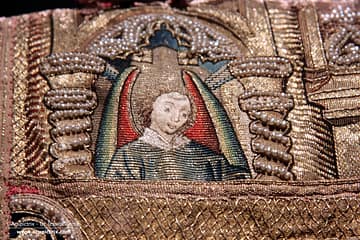
The first question that came up in the discussion was the dating of the needlelace on the orphrey of the Cappa leonis. Needlelace can be found earlier than the AD 1520 date of Emperor Charles V’s coronation. Gina Barrett of Gina-B Silkworks mentioned the bi-coloured buttons used to close the Vadstena Klosterregel manuscript (Sweden) from AD 1451. She also drew my attention to 12th-century repairs in parchment codices from Switzerland. Some use buttonhole stitches in a lacy manner to close up the holes.
In the same vein, Frida Sorber noted that needlelace appears as a decorative element on alms pouches/relic purses as early as the 14th century. Several examples are part of the basilica’s treasury in Tongeren, Belgium. In addition, a purse dating to the 13th century and two bishops’ gloves dating to the 14th century are entirely made of interlocking buttonhole stitches. More information can be found in the publication P.LACE.S cited below.
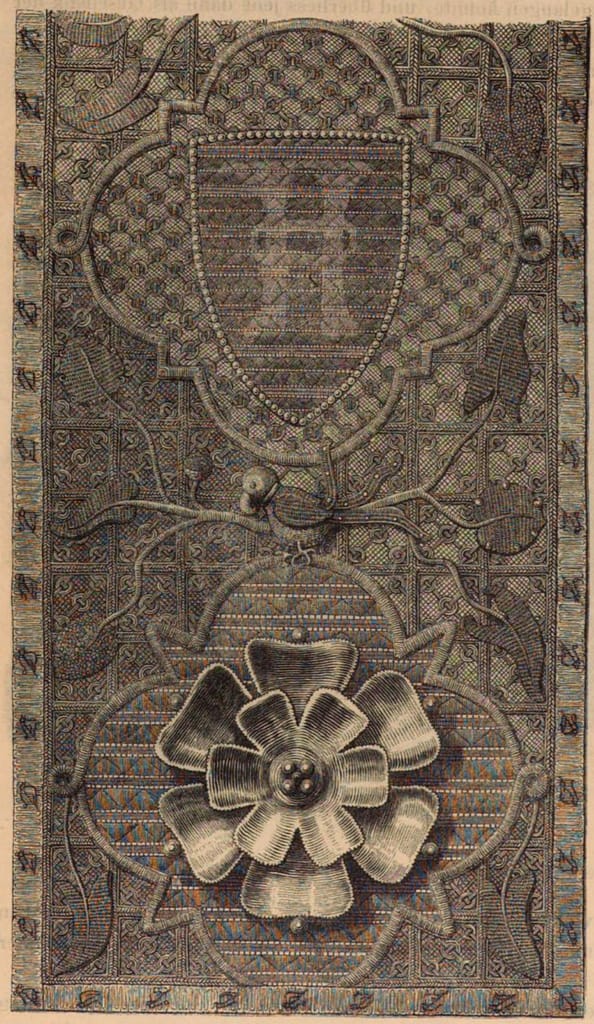
And now back to the dating of the orphrey on the Cappa leonis. It wasn’t dated based on the presence of needlelace. It was dated by the presence of the imprint of the Pillars of Hercules symbol on the coat of arms. Emperor Charles V used this symbol when he became grandmaster of the Order of the Golden Fleece. Today, the imprint is hardly visible. It was likely left by a metal decoration shaped like the Pillars of Hercules. This was captured on an idealised drawing in a 19th-century publication (see picture above).

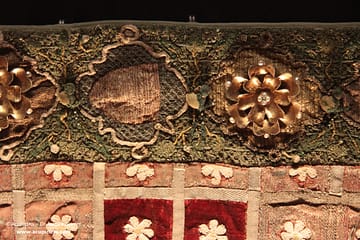
Both Gina and Frieda also commented on the flowers made with tiny knots. As far as I can see, these knots were stitched individually. I don’t think it is a knotted cord that has been couched down. And I do think that this is indeed an imitation of pearls. Not a cheap replacement at all. Making pretty consistent, evenly spaced knots is quite a skill. Just think of all the modern embroiderers you can scare away by mentioning the words “French knots” :).
As I mentioned in my last blog post, when we looked at my pictures of the Cappa leonis during our Stitch & Chat, Mickey remarked on the similarities to the binding of MS.8932, which Jacqui Carey studied. Jacqui has now seen the pictures as well and recognised some of the stitches as being on ‘her’ book binding. She sees this technique as sitting in between ‘normal’ surface embroidery and true needlelace. To better understand the technique, I have ordered her Medieval Almanac kit (which includes the book on MS.8932). Although I can’t start on it right away, I did do an unboxing video, which you can find on the forum. Do let me know if you have worked on the kit or are planning to do so!
Literature
Bock, F., 1860. Die deutschen Reichskleinodien mit Hinzufügung der Krönungs-Insignien Böhmens, Ungarns und der Lombardei in geschichtlicher, liturgischer und archäologischer Beziehung, 1. Theil (einfache Ausgabe), Wien.
Ceulemans, C. (Ed.), 1988. Tongeren. Basiliek Van O.-L.-Vrouw Geboorte. Textiel, Van de Vroege Middeleeuwen Tot Het Concilie Van Trente. Clenodia Tungrensis 1. Uitgeverij Peeters, Leuven.
Minkenberg, G., Ben Kayed, S. (Eds.), 2014. Verlorene Schätze: Ehemalige Schatzstücke aus dem Aachener Domschatz. Schnell & Steiner, Regensburg.
Sorber, F., et al., 2021. P.LACE.S – looking through Flemish lace. Lannoo Publishers.

0 Comments