Literature research on the Opus florentinum embroideries shown in last week’s blog post led to another related piece of gorgeous medieval embroidery. According to the reference, the designs on last week’s chasuble were related to those seen on an antependium now kept at Santa Maria Novella in Florence, Italy. Luckily for me, I saw that piece about a year ago, as it is on permanent display. Whilst the embroidery itself is of very high quality, there is something not quite right with the piece as a whole. Let’s explore another medieval embroidery conundrum!

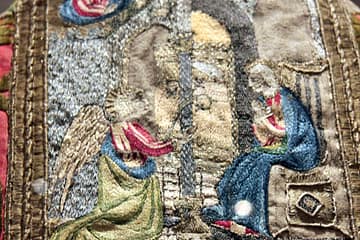
Let’s start with a detailed look at the embroidery techniques of this Opus florentinum piece. Each rectangular scene measures 18 x 26 centimetres. The above scene shows Saint Joachim sheltering with the shepherds when an angel announces to him that he will become a father at last. The embroidery designs were ordered from the Florentine painter Paolo Schiavo in AD 1466 according to the accounts of the Santa Maria e Santa Brigida al Paradiso monastery in Florence. This was a double community for Birgittine monks and nuns from AD 1395 until AD 1593. Especially, the female community flourished with women from the leading Florentine families becoming nuns there. The monastery was known for its scriptorium, where manuscripts were copied.
The museum’s caption mentions that the embroidery was made by the nuns. Unfortunately, I have no idea if this is based on actual written evidence. The fact that the embroidery scenes were made by the same hand or hands, and with considerable skill, hints at a professional embroidery workshop. Whilst it is possible that such a workshop was part of the monastery, it is equally possible that the monastery only commissioned the embroidery. Especially as the monastery was known for drawing its nuns from the leading, and thus financially well-off, families of Florence. It would also explain why they ordered the designs from an important local artist instead of using the scriptorium’s talent.

All embroidery is executed on fine linen with silk and metal threads. In the detail above, you can see that this piece of Opus florentinum embroidery is characterised by very fine directional split stitch for the figures. By contrast, the split stitches used for the wool on the sheep are much larger. They change direction frequently and are beautifully shaded to perfectly imitate woolly sheep.
The landscape consists of silk embroidery and couched pairs of gold thread. As both silk and metal thread embroidery are worked on the same piece of linen, there’s an interesting change in texture. Delicate silk flowers are worked on top of the silk-and-metal thread embroidery, adding depth. By the way, I would not call the couching of the metal threads for the background or nué. To me, true or nué needs two things: 1) shading achieved with different shades of silk and 2) shading achieved by varying the spacing of the couching stitches. Instead, the couching stitches in this Opus florentinum embroidery are regularly spaced and form a bricking pattern. Do let me know in the comments if you agree to this definition of the or nué technique.

Not sure what happened to the sky. Was it made of very light-blue silk that has just not survived? Was it a diaper pattern in gold threads that were unpicked and reused? The sky is bare in all other panels, too. And I think there are traces of a design drawing visible.

The designs of this Opus florentinum embroidery piece are whimsical and full of detail. One of the shepherds is playing his bagpipes – puffy cheeks and all. And the sheep dog has a golden collar.
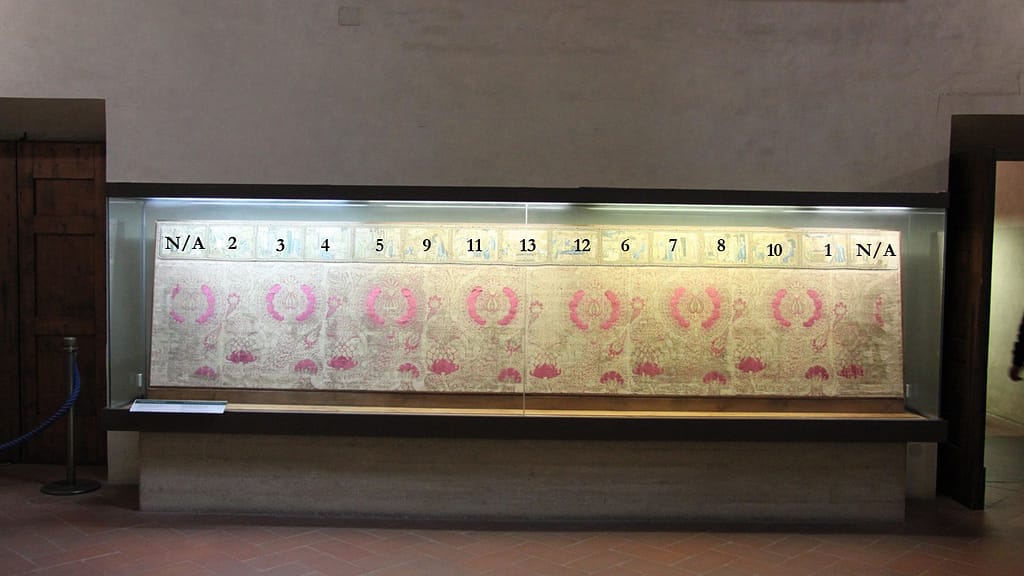
And now the conundrum with this piece of Opus florentinum embroidery! The 15 embroidered rectangles are in the wrong order. The panels at the start and the end depict three male saints each. The other 13 scenes are part of the cycle of the Life of the Virgin Mary. And as you can see from the picture above, they have been mixed up a bit. The order on the antependium is: Annunciation to Joachim, Joachim and Anne meeting at the Golden Gate, Nativity of Mary, Presentation of Mary, Nativity of Jesus, Annunciation of her death to Mary, Assumption of Mary, Dormition, Annunciation, Visitation, Marriage of the Virgin, Adoration of the Magi and Expulsion of Joachim.
The jumbling up of the order of the scenes does not make any theological sense to me. Please chime in in the comments if you think of an explanation. The only swap I can theologically understand is that between scenes 13 and 12. The Assumption of Mary so becomes the central scene. This makes theological sense as it is a very important concept. But why swap some of the other scenes? Was the piece restored, and were the scenes separated from their padded frame? Were they placed back into the frame in the wrong order by someone with little theological knowledge?

The treatment of the badly damaged last scene with the three saints proves that the hands handling this gorgeous Opus florentinum embroidery piece were not always appropriately skilled. The patches of darning are rather coarse! It is then, maybe, understandable that the scenes got mixed up during this restoration process?
Literature
Descatoire, C. (Ed.), 2019. L’art en broderie au moyen âge: Autour des collections du musée de Cluny. Musée Cluny, Paris.
Schuette, M., Müller-Christensen, S., 1963. Das Stickereiwerk. Wasmmuth, Tübingen.
2 Comments
Sandy P · May 20, 2026 at 3:27 am
I wonder if the mystery of the order of each piece is as simple as this was the order they were completed in or were mended. The other thought that came to mind was since each piece is essentially a patch (true, a large patch) that this is the way the base fabric fit together behind all the trims; and in this way some imperfections were hidden.
Acupictrix - Dr Jessica Grimm · May 20, 2026 at 9:03 am
Good point, Sandy! I am always amazed that these high-quality pieces have not been studied from an embroiderer’s point of view. There’s usually a lot of talk about the (famous) painter that must have supplied the design. Unfortunately, not so much discussion of the actual embroidery. But we are here to help! One piece at a time :).