Last week, we looked at the mitre of St Isidoro, with beautiful pearl embroidery, dating to the second quarter of the 14th century. Today’s mitre with pearl embroidery is slightly younger, dating to the last quarter of the 14th century, and was likely made in Paris. It was once housed in Sainte-Chapelle, the 13th-century royal chapel in the heart of Paris (France). I was fortunate to see the mitre at the 2020 embroidery exhibition in Musée de Cluny. The embroidery is very different in style and iconography compared to last week’s example. Let’s have a look!

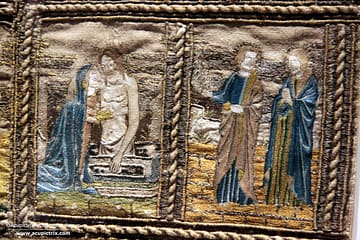
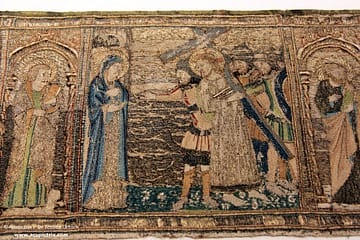
On the front, the pearl embroidery shows the Nativity with the Crucifixion above. The saint on the left is John the Baptist, and there’s a sanctified bishop on the right. The Adoration of the Magi with the Annunciation above is shown on the back. The scenes are flanked by Denis of Paris (patron saint of Paris) and Catherine of Alexandria. The lappets show Mary with Child on one side and a bishop on the other. Censing angels are depicted above these figures. The bottom rim is decorated with busts of the twelve Apostles.

The cutest scene on this mitre is the Nativity scene. Yes, there’s Mary with baby Jesus, and there’s the oxen and the donkey – classical components of a Nativity scene. But then there’s Joseph (left) drying a diaper by the open fire. And the maid on the right prepares a bath for baby Jesus. The design was inspired by the works of illuminator Jean Pucelle, who introduced this typical Italian iconography into French art.

The pearl embroidery is high-end and would probably have stood under the king’s patronage. The frames around the scenes consist of string padding with gimped couched passing thread. The figures’ clothing is mainly stitched in couched passing thread. Pairs of gold thread have been couched down with a gold-coloured silken thread. The gold threads follow the flow of the garments. Undergarments, faces, and hands have been stitched in finely shaded split stitches. The stitch direction follows the drape of the garments and the shape of the facial features, just as in Opus anglicanum. Parts of the figures have been padded to give them some dimension.

Or nué, or shaded gold, has been used for the grassy background. The gold threads run strictly vertically. And everything has been lavishly embellished with freshwater pearls. According to a church inventory from AD 1480, the mitre was also adorned with enamel plaques. There are also remnants of metal bezels that once held semi-precious stones. And do you see the tufts of yellow silk? That’s what is left of the stitches that once secured glass beads. How will you incorporate some bling into your embroidery today?
Literature
Blöcher, H., 2012. Die Mitren des hohen Mittelalters. Abegg Stiftung, Riggisberg.
Descatoire, C. (Ed.), 2019. L’art en broderie au moyen âge: Autour des collections du musée de Cluny. Musée Cluny, Paris.
0 Comments