In my current exploration of Opus florentinum goldwork embroidery, I came across an orphrey fragment that puzzles me. Firstly, what does it depict? Is this the Lamentation of Christ as the museum caption suggests? Or is this the Entombment of Christ? And why is the embroidery executed the way it is, with one third of the scene being stitched on a separate piece of cloth? And why was there no attempt at having the embroidered border continue seamlessly? Is what we see today the same as what was embroidered in the second half of the 14th century? Let’s have a closer look!

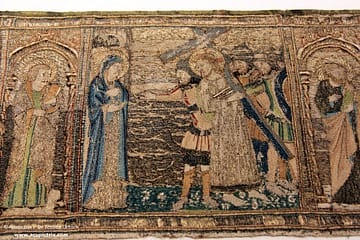
The above orphrey fragment was made in Florence, Italy, in the second half of the 14th century. Its size suggests that it once sat in the middle of the orphrey of a cope, just above the hood. As seen with the Opus florentinum antependium in Lyon, this orphrey once consisted of many rectangular scenes depicting stories from the New Testament (more scenes once sat on either side). From left to right, we see two female saints, a woman supporting the body of Jesus in the tomb and two male saints. But what is actually happening?
According to the museum catalogue, this is the Lamentation of Christ, with the central scene depicting Jesus emerging from the tomb, supported by Mary. This happens when you do not bother to read the Bible, but still want to research art from the Middle Ages. Faith is not required, but you need to be familiar with the religious writings and teachings on which this art was based. According to the Bible, Jesus did not need his mum’s help to resurrect.

Instead, we see a woman putting a dead Jesus in the tomb. The two men on the right probably depict Joseph of Arimathea and Nicodemus, two men involved in the entombment of Jesus. Strictly speaking, the Bible reports that the women who were close to Jesus did not partake in the actual burial (they watched from a distance). However, the Pieta, in which Mary holds Jesus’ dead body, is a well-known iconography. I therefore agree with the catalogue that the woman supporting Jesus’ body is Mary.
Interestingly, the scene with Mary and the scene with Joseph and Nicodemus also technically form a unity. The border with the thick rope padding continues around both scenes. But the same padded frame also suggests that the sequence once ended on the left side of the scene with Mary and Jesus.

Now look at the scene with the two saintly women. The frame has been cut on both sides. I therefore think the two women were not originally part of the Entombment scene. They were likely part of the scene where the Marys came to the grave the next day to find it empty. The scene with that empty grave or a grave with an angel is now missing. What could have happened?
If this is indeed part of the orphrey of a cope, it might have been shortened at some point. Originally, one side of the orphrey showed scenes of the Passion, culminating in the Entombment, as part of the centre above the hood. The other side showed Jesus’ appearances after his resurrection, leading up to Pentecost/Ascension. What do you think? Do you feel that looking closely at the actual execution of the embroidery can help interpret goldwork fragments like these?
Literature
Descatoire, C. (Ed.), 2019. L’art en broderie au moyen âge: Autour des collections du musée de Cluny. Musée Cluny, Paris.
0 Comments