Today, we will explore a beautiful piece of Opus anglicanum embroidery from the third quarter of the 14th century. It is known as the “Vic Cope”, after the Cathedral it was used in, and is now kept at the Museu Episcopal Vic in Spain. By the way, this museum should be on your list, as it has a complete floor dedicated to textiles from the Cathedral Treasury. You can take as many pictures as you like, as long as you don’t use flash or a tripod. Let’s explore this magnificent piece of Opus anglicanum embroidery!

As you can see in the picture above, the Vic Cope was cut up and made into several other vestments. You can find a downloadable article on its restoration in the literature list below. The cope no longer has its orphreys, hood or outer border, a faith it shares with many Opus anglicanum copes.

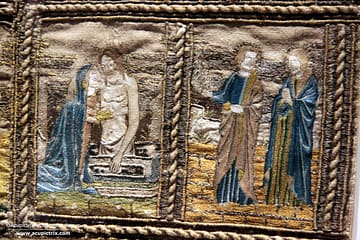
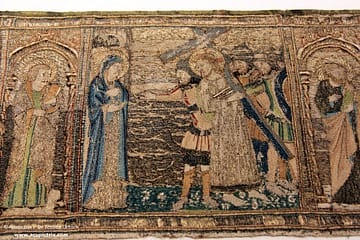
The design, with its three concentric bands of embroidered figures and scenes, is a classic one for Opus anglicanum copes. The central column shows three elaborate scenes: the Adoration of the Magi, the Nativity and the Coronation of the Virgin. This part of the vestment would sit centrally on the wearer’s back and be easily legible to onlookers. The central scenes are surrounded by Apostles, Saints, (musical) Angels and the Green Man. Each scene or figure is identified by beautifully stitched lettering.

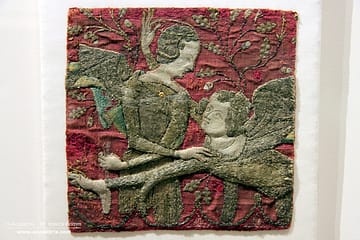
The embroidery on the Vic Cope is classic Opus anglicanum: directional split stitch and underside couched metal threads. The underside couching uses simple bricking and a chevron pattern. In addition, the embroidery on the Vic Cope uses linen string padding to accentuate the clothing’s folds. To stitch on the red velvet, it was backed with linen (38 x 45 ct) and covered with a thin silken fabric, which was carefully cut away once the embroidery was completed. Stitching directly onto the velvet without this layer is impossible, as the velvet’s hairs will interfere with the stitching.
Although the Vic Cope is distinctly English, with Saints such as Edward the Confessor, Thomas Becket, Alban and Edmund of Bury, it was likely ordered by Ramon de Bellera, then bishop of Vic (died AD 1377). Upon his death, he left the cope to the Cathedral of Vic, where it can be traced in the archives right up until the 17th century. Some time after its last mention, the cope was taken apart to become a lectern hanging, two dalmatics, and a book binding, for continuous use in the Cathedral. Now, this is a great testimony to the quality and timelessness of its Opus anglicanum embroidery!
If you would like to see more detailed pictures of the Vic Cope, why not become a Member? You get instant access to the additional material for each of my blog posts. In addition, you will have access to my self-paced embroidery courses, eBooks, tutorials, weekly and monthly Zoom meetings and a forum. Join today to unlock your benefits!
Literature
Browne, C., Davies, G., Michael, M.A. (Eds.), 2016. English Medieval Embroidery: Opus Anglicanum. Yale University Press, New Haven.
Calonder, N., Woś-Jucker, A., 2008. Conservation of the cope of Bishop Ramon de Bellera. Quaderns del Museu Episcopal de Vic 2, pp. 83–99.
0 Comments