The Musée de Cluny presented a lovely collection of embroidered alms pouches from the 14th century in its 2019/2020 exhibition. Some were definitely made in Paris; others were made in cities elsewhere in France known for their embroidery workshops, such as Toulouse, Lyon, and Tours. Although the names under the guild regulations from the 13th century suggest that the majority of the embroiderers were female, the embroiderers associated with the 14th century French courts are always male. This might reflect different areas of occupation between female and male embroiderers, or it might indicate a change over time in the development of the embroidery trade. But where do alms pouches stand? A couple of weeks ago, we looked at one of these alms pouches produced in Paris in great detail. Let’s have a look at its contemporaries.

Largest piece: 17.7 x 32.5 cm.
Some scholars believe that these alms pouches were worn by men rather than by women. This is based on the fact that they are rather large. Additionally, contemporary depictions show men wearing, or being given by a woman, those large trapezoid bags. All bags are embroidered with peculiar secular scenes, and some have embroidered coats of arms. The high-end materials required and the professional embroiderer’s hours would have made these bags quite expensive. Therefore, these pieces were intended for the nobility and often began a second life as reliquary bags when they were gifted to the church. Indicating that it was then their value that mattered, and the embroidered scene was now secondary.
And the scenes on these alms pouches are rather peculiar – hardly ever fully understood by modern onlookers. For instance, the fragments of the alms pouch above show a sleeping “wild man” being crowned by the lady on the left, whilst the lady in the middle plays the fiddle and the lady on the right ties his foot to a tree. Is this a man being tamed by love? Or is the sleeping giant Merlin? And this is thus a scene from the tale of King Arthur?


Using a well-known tale for the scenes on alms pouches was seen more often. For instance, the fragments of the above alms pouch (Lyon, Musée des Tissus et des Arts décoratifs, MT 30020.1 et 2) probably depict two episodes from the 12th-century French poem Erec and Enide. The embroidery was made in Paris around AD 1340, and the two remaining pieces are a little over 20 cm square.

As far as I am aware, none of the alms pouches can be linked to their former owners. The above alms pouch, for instance, is known as the one from Henry I, Count of Champagne. However, this Count lived from AD 1127 until AD 1181, about 150 years before the bag was embroidered. The main scene shows a unicorn hunt.

Besides a unicorn hunt, 14th-century alms pouches featured many more “courtly scenes”. The above alms pouch from the Onze Lieve Vrouwe Basiliek in Tongeren, Belgium, is almost cartoon-like. Why is the knight riding behind the lady? Why does he fall off his horse as soon as they try to enter the castle via the back door? Is this the medieval equivalent of the many jokes about women parking cars?

And what to think of this scene? A lady riding backwards on a phoenix, trying to shoot a rabbit. An angel (or Amor, the God of Love?) above hands more arrows to her. Is this some vulgar riddle in which the rabbit stands for fecundity?
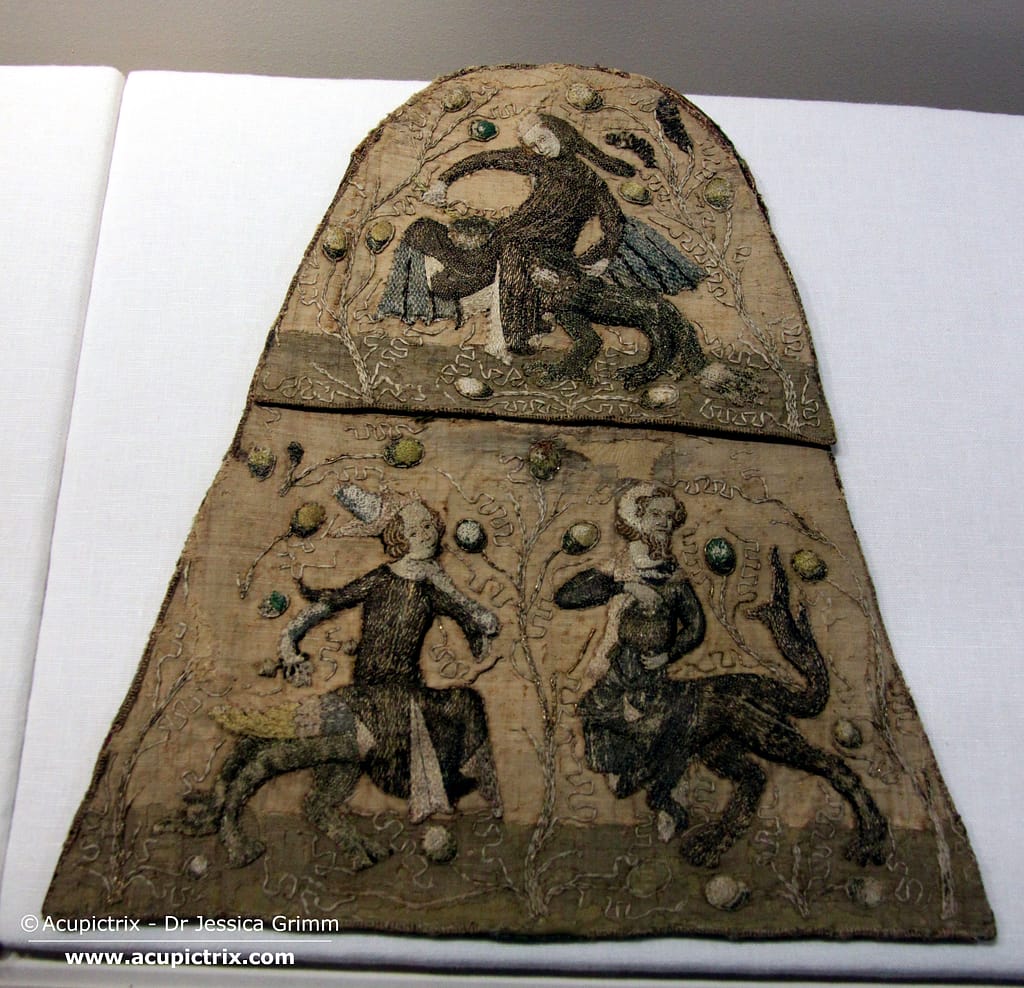
And then there’s this alms pouch with the musicians. However, unlike the alms pouch in Xanten, this one has musicians that are partly human, partly animal.
Seeing this lovely collection of 14th century alms pouches, I wonder how many people fully understood the messages on them? After all, they were worn above the owner’s clothing, and they are made in such a “stiff” way that the scenes weren’t obscured by folds or creases. But you probably needed to be in the “inner circle” to really see them. The small details cannot be seen clearly from too far away. Did the owner need to point out the double meaning(s)? Or were they obvious in certain circles? Or even understood by all? And who came up with the designs? Did the makers fully understand what they were stitching? What do you think?
And who made these beautiful pieces of embroidered art? Quite a few use raised embroidery techniques alongside couching and split stitching. Techniques also used in contemporary religious embroidery. The above examples are all of (very) high quality. Are these private commissions for the embroidery guild or the guild of the alms pouch makers, as mentioned in the blog on the bag now in Xanten? Or were some bags made by the male court embroiderers?
Literature
Descatoire, C. (Ed.), 2019. L’art en broderie au moyen âge: Autour des collections du musée de Cluny. Musée Cluny, Paris.
0 Comments