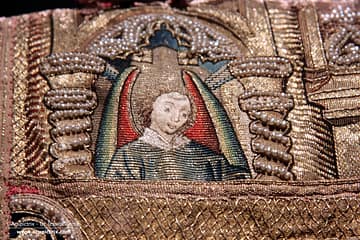
This week, we’ll return to the Museu Episcopal de Vic in Spain. Apart from the Vic Cope, the museum has many more medieval embroidered textiles worth exploring. First up is an antependium that was likely made in the workshop of the Monastery of San Joan de les Abadesses. Between AD 1114 and AD 1592, the monastery housed a community of Augustinian canons. As the antependium shows the embroidered coats of arms of abbot Arnau de Vilalba, who served from AD 1393 to AD 1427, it is thought the embroidery was made around AD 1393, when he took office. This is one of these rare “missing link” embroideries that show the early stages of the development of the or nué, or shaded gold, embroidery technique.

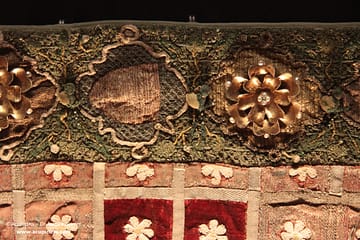
The red antependium in the Museu Episcopal de Vic shows, from left to right: Mathew, Marc, Christ, John and Luke. This is a classical depiction of the Salvator Mundi with the four Evangelists. In between the embroidered figures are the coats of arms of Abbot Vilalba and embroidered flowers (pansies?). All embroidery is executed on linen and then appliqued onto the red silk. The only exception is the fine stems and tendrils of the flowers.

Interestingly, the figures on the antependium in the Museu Episcopal de Vic are arranged in a hierarchy. Obviously, the most prominent figure, the Salvator Mundi, sits in the middle and is much larger than the other figures. But that isn’t all. This figure is also embroidered with the most visible gold. There’s very little silk embroidery. The gold threads are used for the mantle, where they are couched down in pairs with yellow silk in a bricking pattern. They follow the flow of the garments, and folds are accentuated with a thick red silk couched on top. The throne is completely executed in Burden Stitch with the threads running in different directions for the different parts.

The two figures closest to the Salvator Mundi, Marc and John, have mantles stitched in “directional” or nué. This means that the pairs of gold thread follow the garment’s drape. In true or nué, the folds are a complete illusion with threads running strictly horizontally. From my own research into the technique of or nuè, following the element’s flow seems to be the earliest form of the technique.

The two figures furthest away from the Salvator Mundi, Mathew and Luke, are almost completely embroidered in beautiful silk shading. There’s some embellishment with gold threads, but that is it.
Whilst the emphasis on the central figure of the Salvator Mundi makes complete sense, I am unsure of what to make of the hierarchy of the Evangelists. As always, I am pretty sure this is intentional and not just decorative. Unfortunately, I am not enough of a theologian to understand the finer points of the differences between the Evangelists as perceived in late 14th-century Spain. If you have any ideas, please chime in below!

0 Comments