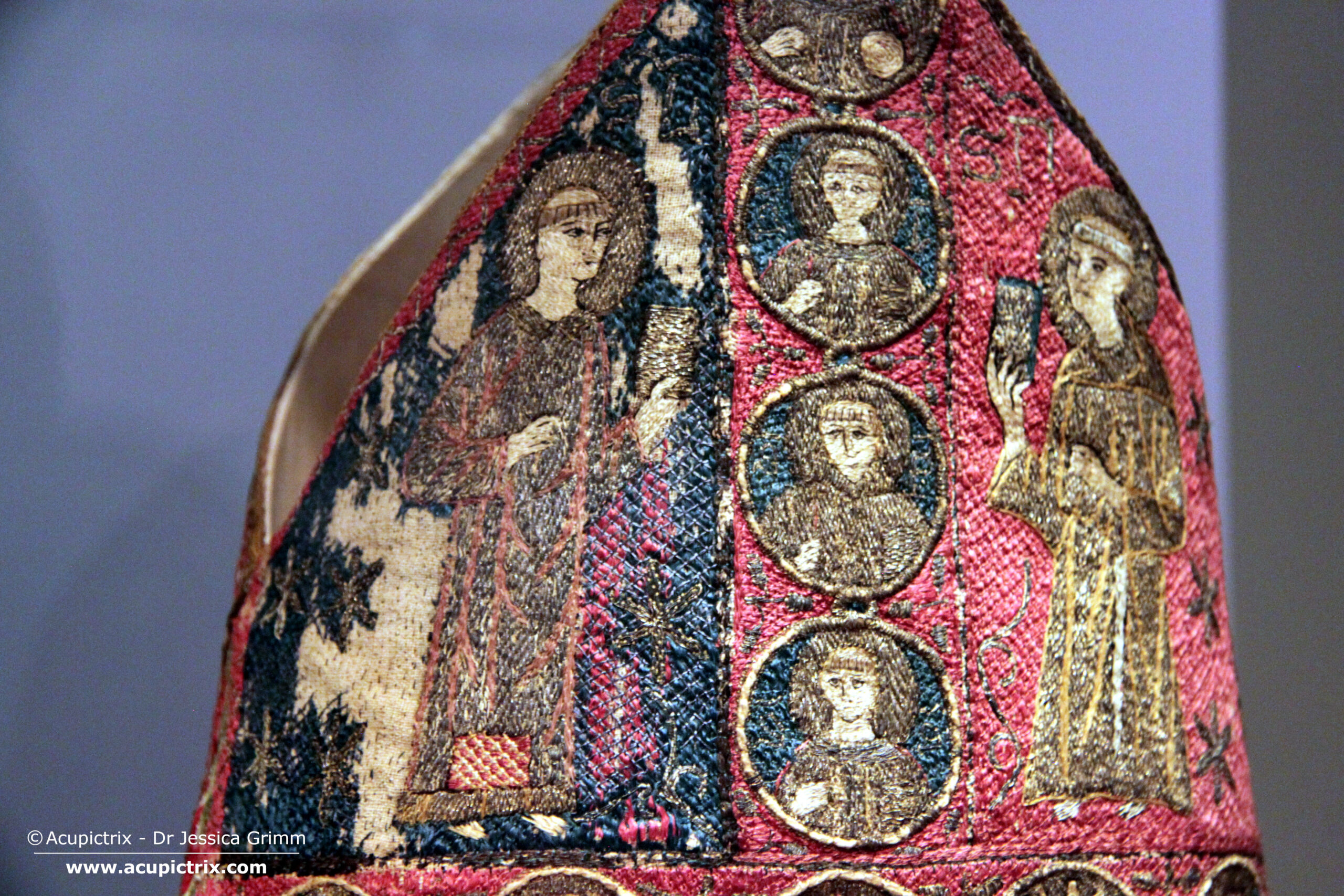
Last week, I took the train to Burtscheid (Aachen) to revisit the 14th-century goldwork embroidery. I took lots of pictures so I can study the embroidery from the comfort of my home, with the bonus of blowing them up on screen. We already know that the embroideries are no longer attached to their original vestments (or to something else original), but what can the embroidery techniques themselves tell us about them? Was this the work of the Cistercian nuns themselves? Or was the embroidery done by professionals? Let’s have a closer look at some Christmassy scenes!
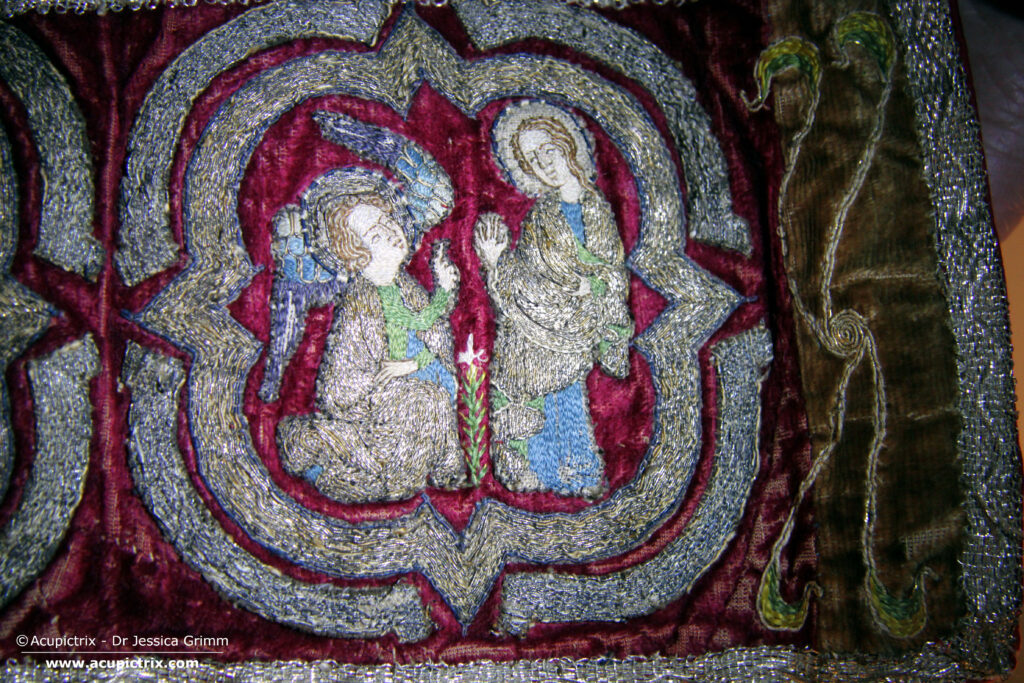
Let’s start with the scene of the Annunciation. It is located on the left arm of the dalmatic. This is also the scene I plan to recreate to answer questions about how long it took to embroider the 61 scenes.
Each scene measures about 12 x 12 cm at its widest points in the outer frame. These frames are so regular that it means that a template was used to draw them on the linen embroidery fabric. The linen count is somewhere in the region of 46-48. It looks pretty even, but might not be an evenweave. This fine layer of linen is backed with a coarser one. Probably something in the high twenties or low thirties.
When you look at the silk embroidery, you will notice that there is hardly any shading. We often see these very stripy garments with very bold shading. But not this time. Gabriel’s wings in the above Annunciation scene are quite the exception. The shape of the wings has been filled with split stitch bands in four shades of blue. On top, a single metal thread was couched in the shape of individual feathers.
One of the things I don’t really get as an embroiderer is the way Mary’s outstretched hand has been stitched. If it was always the plan to cut out the embroidery and use it as an applique, why stitch this particular form of a hand? Why the spaced-out fingers? When you try to cut this out, you have a sliver of bare linen between the fingers. Why not stitch a hand with the four fingers touching each other?
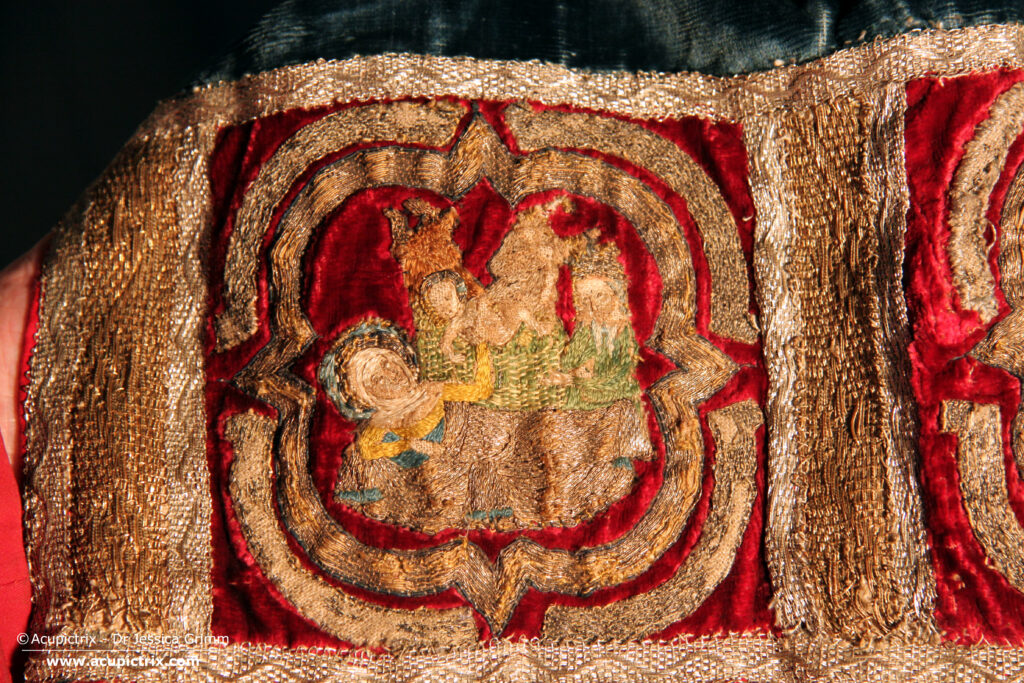
And here we have the Nativity scene. It seems that the embroiderers used different types of metal thread. The inner frame around the scenes is more golden in colour than the outer frame, which looks more silvery. However, the silver isn’t super tarnished. On the contrary, Mary’s and Jesus’ halos look almost black. It also seems that the threads of the frames (similar to a Passing thread #3) are a little thicker than those used in the scene.
The metal threads are couched down in pairs with a silken thread. This thread is now suspiciously blush in colour. I think this is a faded version of the original red, a very popular couching colour. The silvery outer frame has a white silken couching thread. The couching pattern is normal bricking.
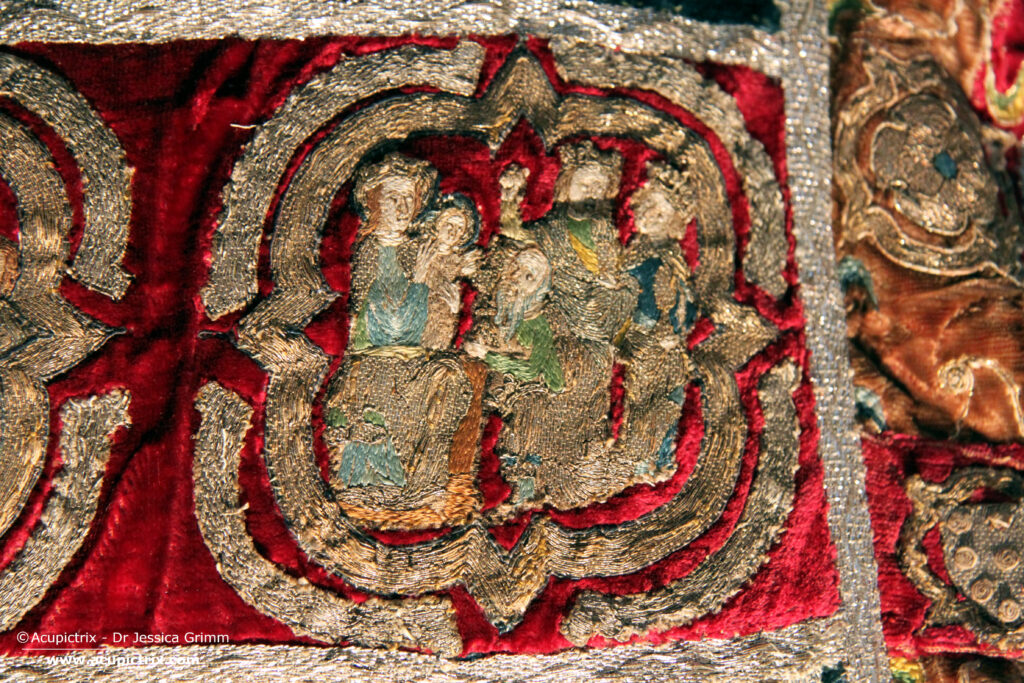
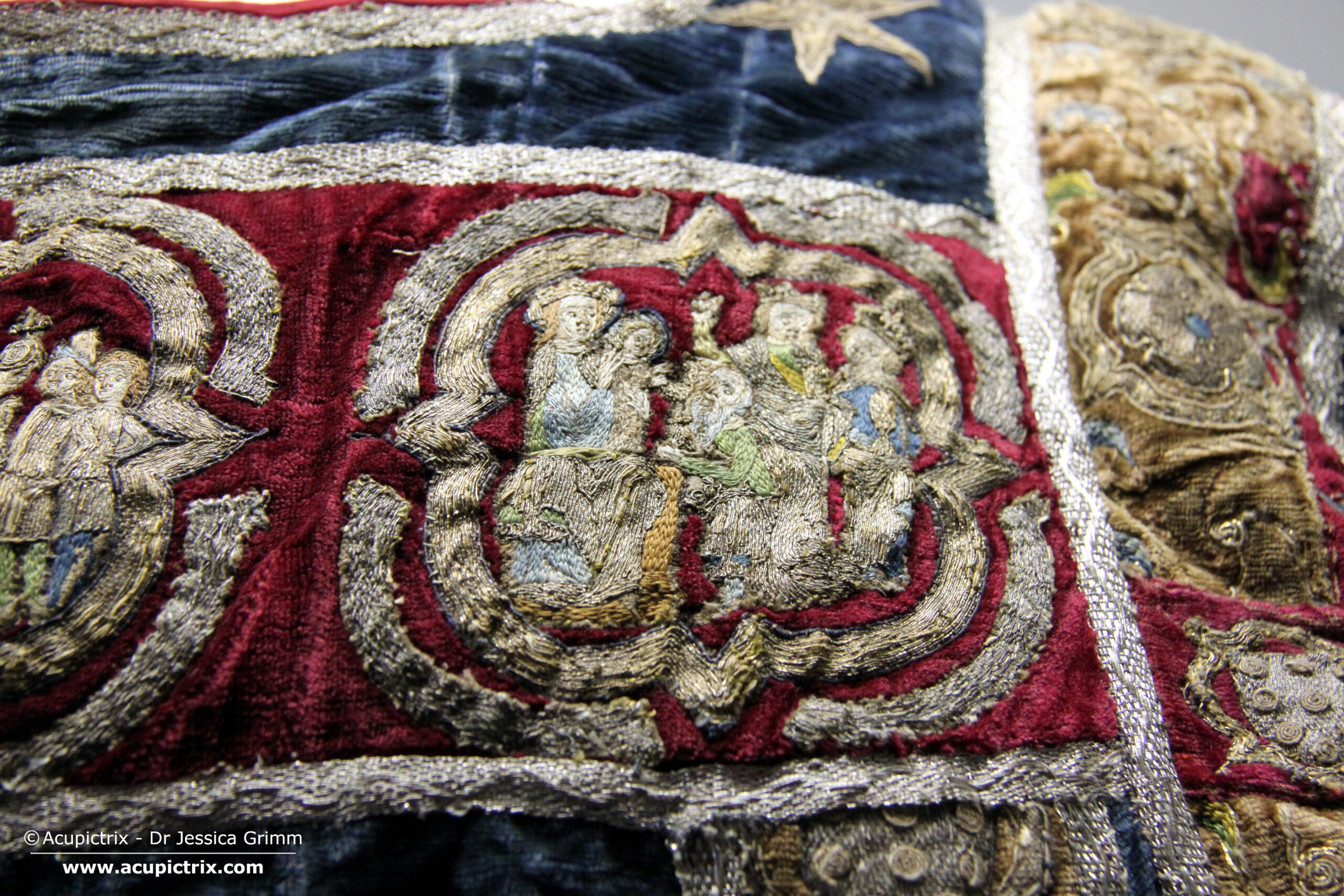
When you look at the golden parts of the clothing in the above Adoration scene, you see that they follow the drape of the garment. Each segment has the threads running in a different direction. And to make a scene easier to read, the silken couching thread might have a different colour. For instance, the middle King has blue instead of blush (red).
Although the faces are usually damaged, the stitching is superb. The different parts of the faces are stitched in tiny directional split stitches. This is the same technique as was used in Opus anglicanum. On the contrary, the split stitches used for the undergarments are much less refined. This probably means that the master embroiderer worked on the faces. The Journeymen and/or apprentices worked on everything else. Indeed, this is very likely the work of professional embroiderers and not that of the average Burtscheid nun with a passion for embroidery.
And whilst the Burtscheid nuns did probably not make the original embroideries, it is possible that they were responsible for recycling the scenes onto the present vestments. In the process, some of the embroidery was likely “touched up”. For instance, when you look at the pictures in last week’s blog post, spangles were added as well as some silk embroidery directly executed on the velvet (see the lily in the Annunciation scene).
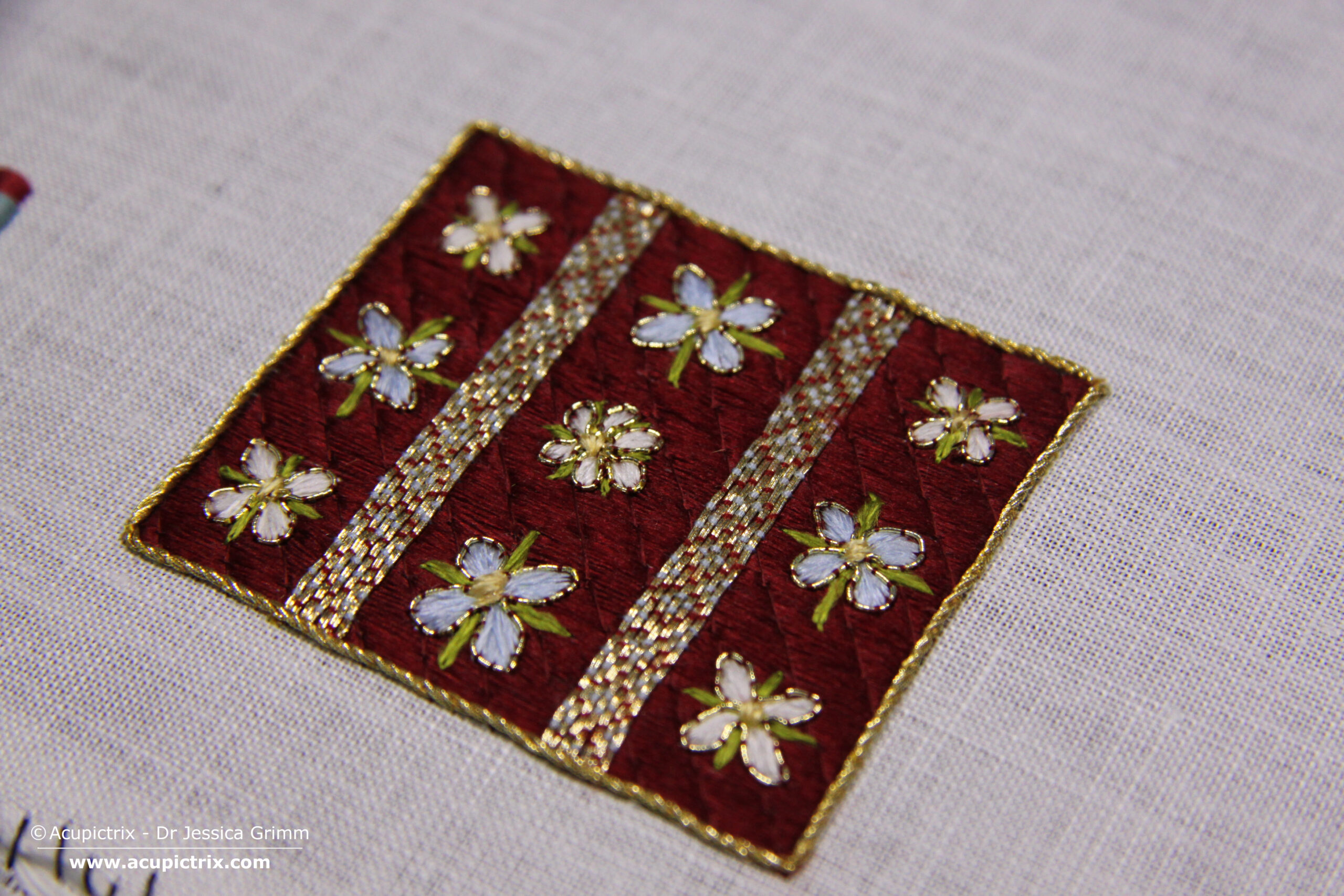
I am looking forward to recreating the Annunciation scene and seeing how close I can get to the original. It will also be interesting to see how different the scene looks with bright red (non-faded) couching stitches. And with that, I am saying goodbye. I am taking a two-week break over Christmas to work on my eLearning Platform and to plan next year’s blog topics and events. Right after, I’ll be off to Brandenburg Cathedral for a research trip. The next blog post will appear on Monday, the 12th of January.
Thank you for going on these medieval embroidery adventures with me, and see you in the new year!
3 Comments
Mary Coble · 15. December 2025 at 21:29
Thank you Jessica. Enjoy your break and safe travels.
Vanessa · 15. December 2025 at 23:56
Thanks for all the information you’ve shared this year; I’m looking forward to learning even more next year. Enjoy your holiday break – hopefully the computer work is less frustrating going forward.
Dr Jessica Grimm · 16. December 2025 at 17:55
You are very welcome, Vanessa! And a happy holiday season to you, too.