
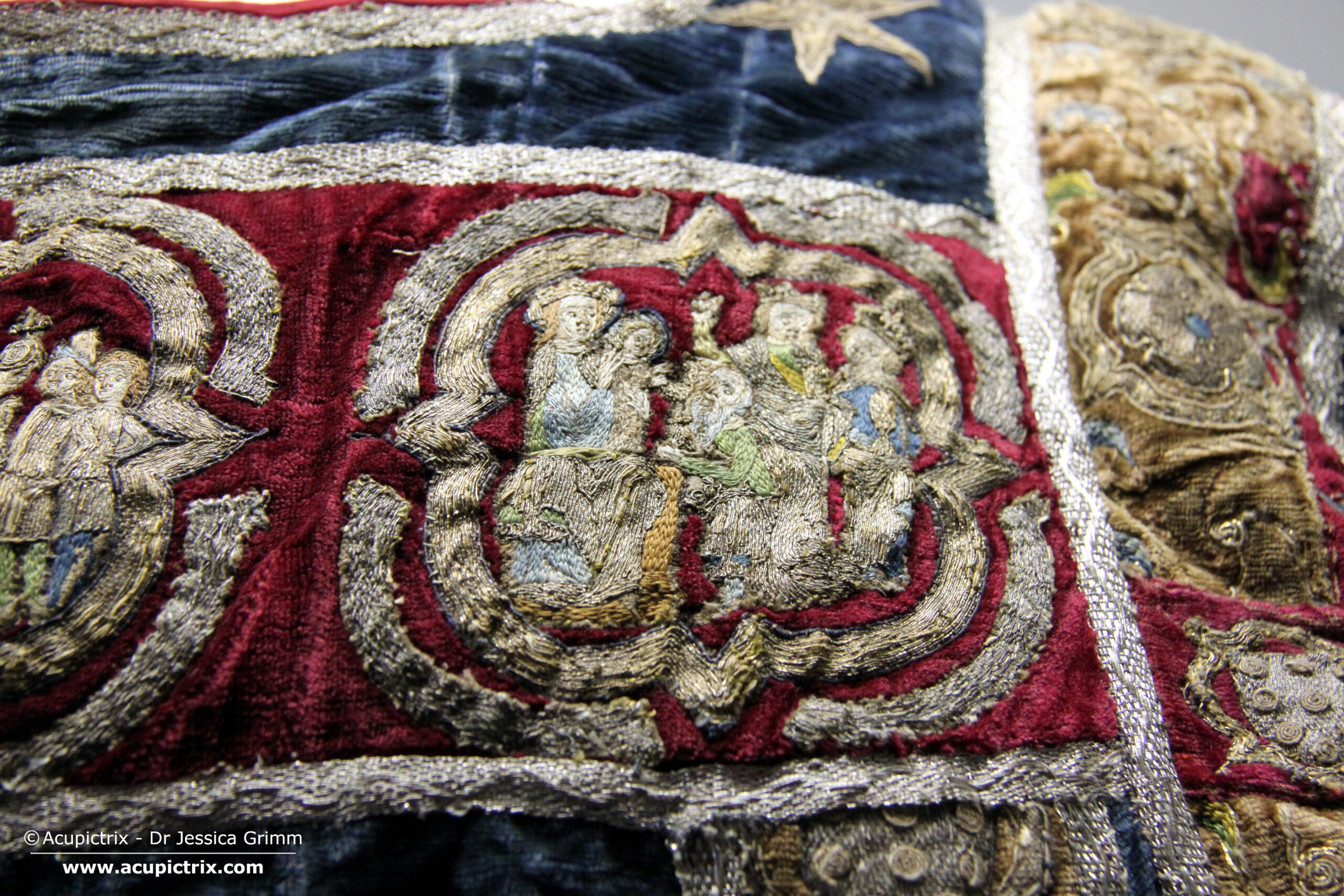
In early 2024, I discovered the charming 14th-century goldwork embroideries of the former Abbey Church of St. Johann in Burtscheid, near Aachen, in the literature. My first visit a couple of months ago was graciously made possible by the parish sacristan and the Historical Society of Burtscheid. We agreed that these embroideries deserve to be known to a broader audience. I will therefore return to Burtscheid this week to study the embroideries more extensively to make a reproduction of one of the scenes. Once the reconstruction is finished, I will hold a lecture locally and online for my Patrons, as their generous monthly contributions make my study travels possible. Now, let’s have a look at these vestments!
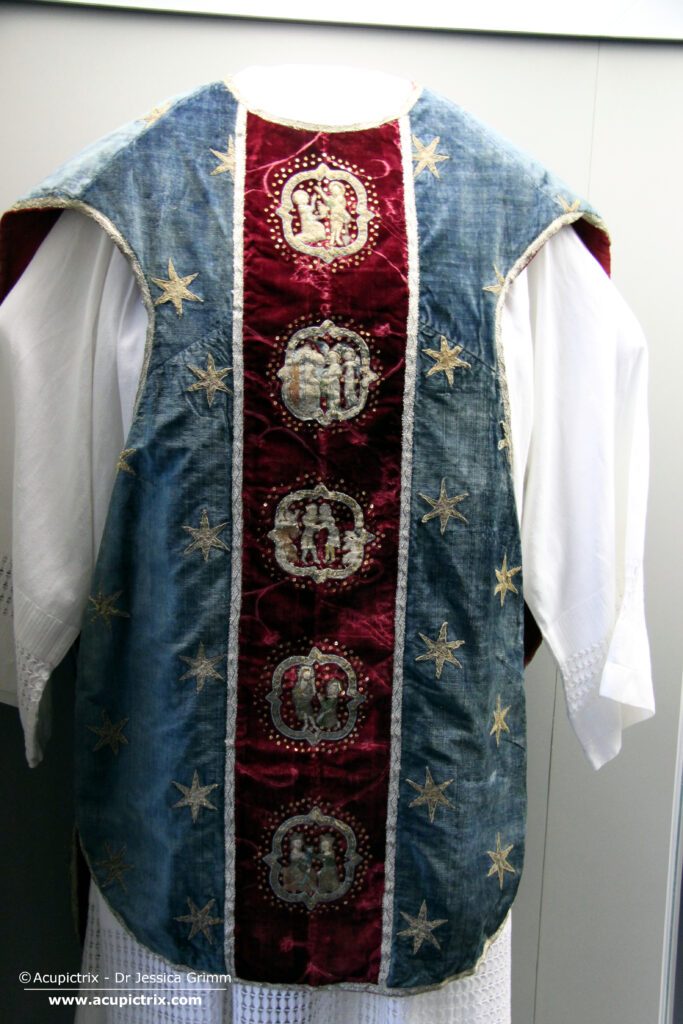
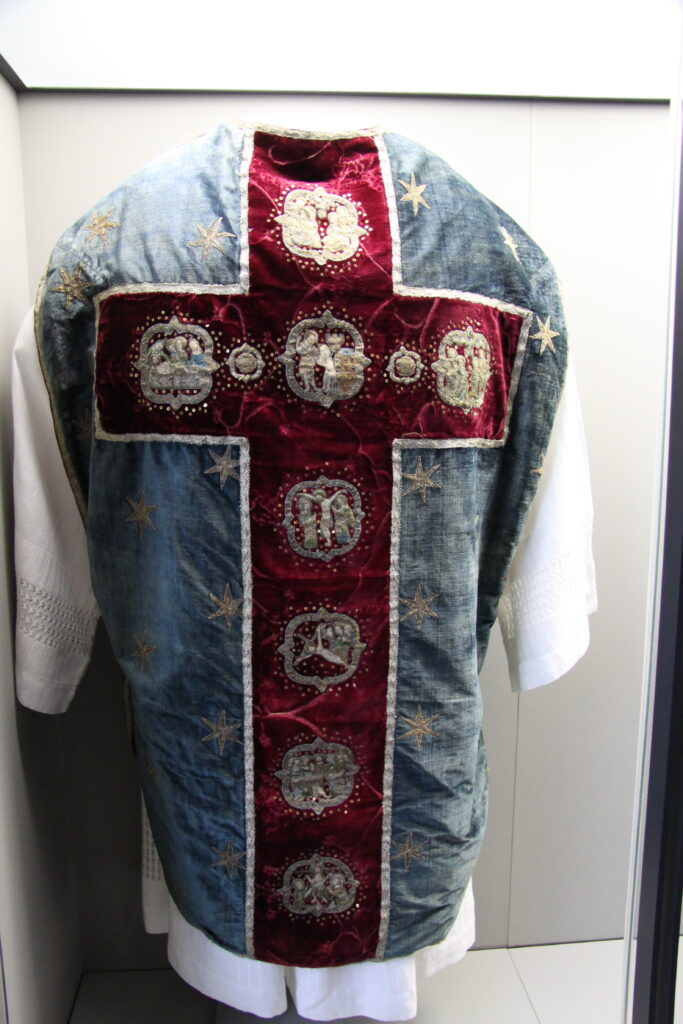
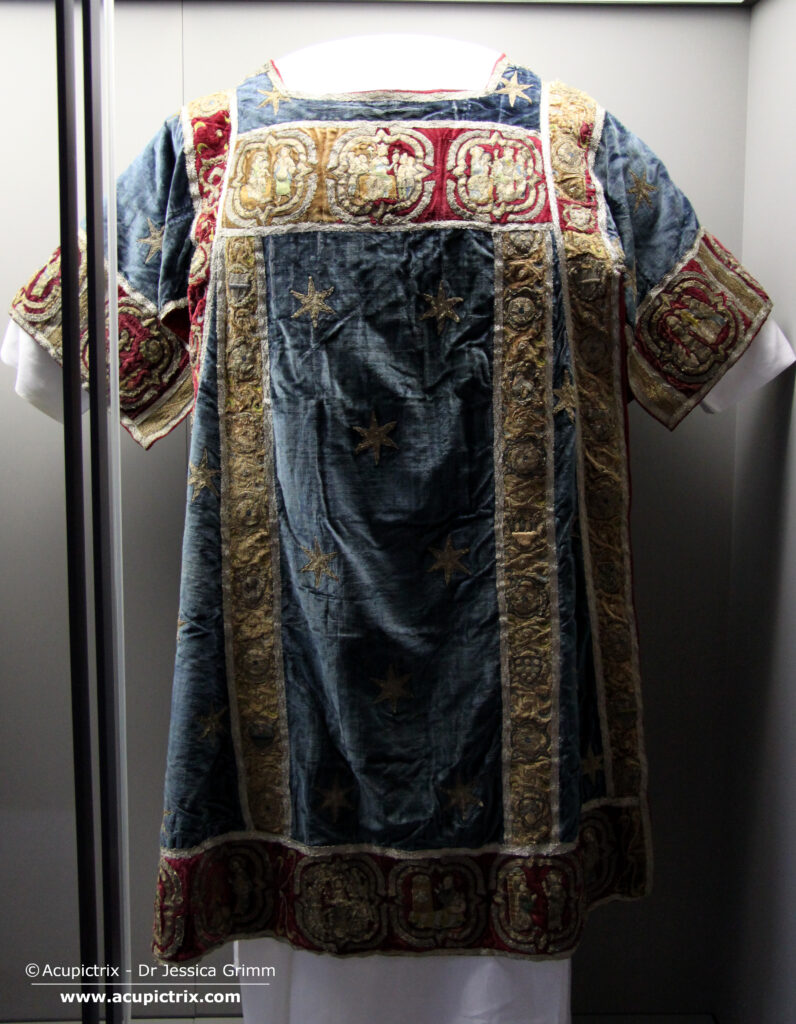
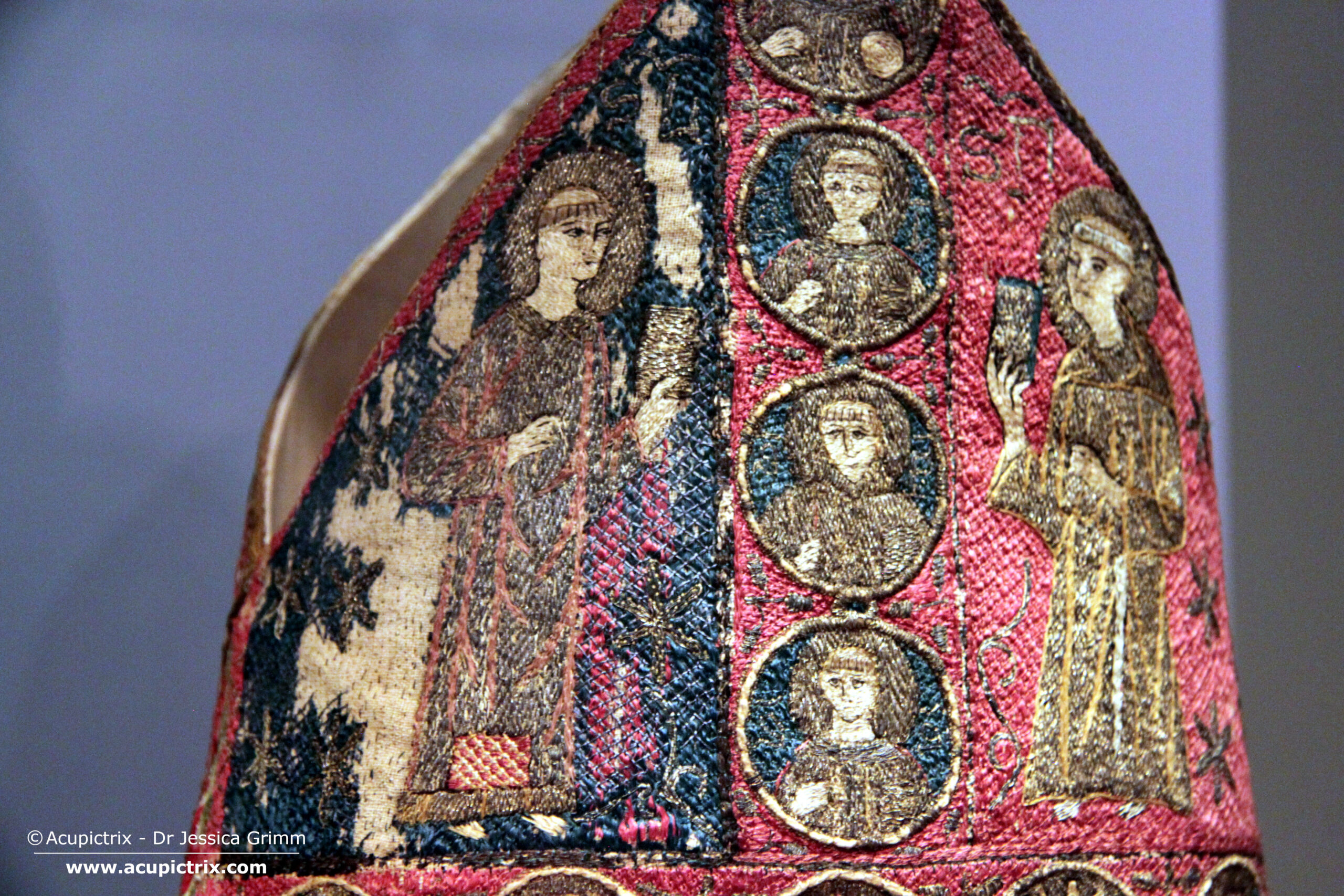
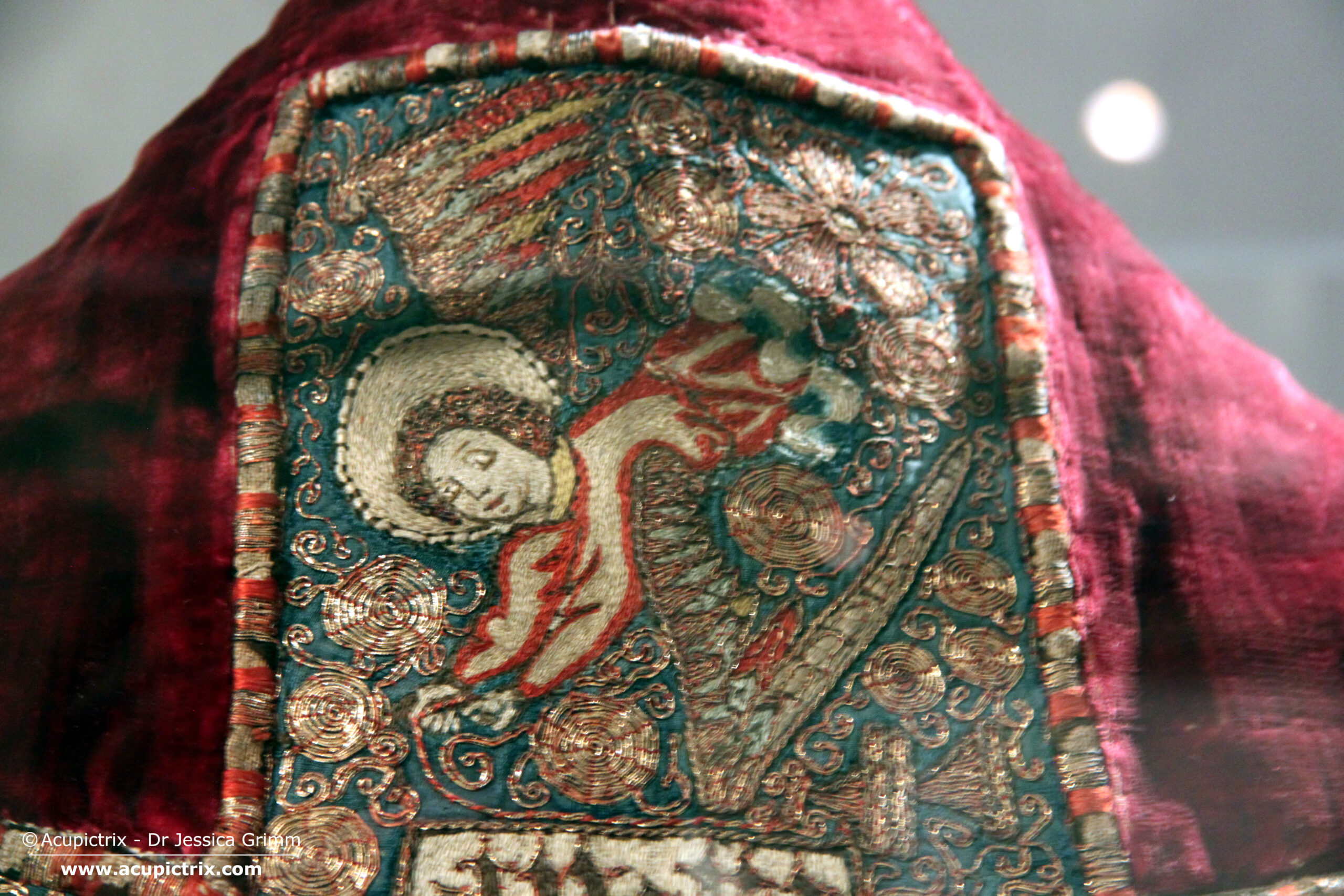
Burtscheid Abbey was a Benedictine monastery founded in AD 997 by Emperor Otto III. After AD 1220, it became a Cistercian nunnery. The nunnery was dissolved in 1802. The set of vestments consists of a chasuble, a dalmatic, a tunicella, a stola and three maniples. The late 14th-century embroideries have been taken from their original textile(s) and reconfigured onto this newer set of vestments. In all, there are 61 embroidered medallions depicting scenes from the Old and New Testaments. Maybe all the scenes were once part of a single bell chasuble or a cope. Just like you see on the famous English copes from the 14th century (for instance: V&A 175-1889, the Butler-Bowden cope and the Vic cope). However, none of these has the staggering number of 61 complete scenes.
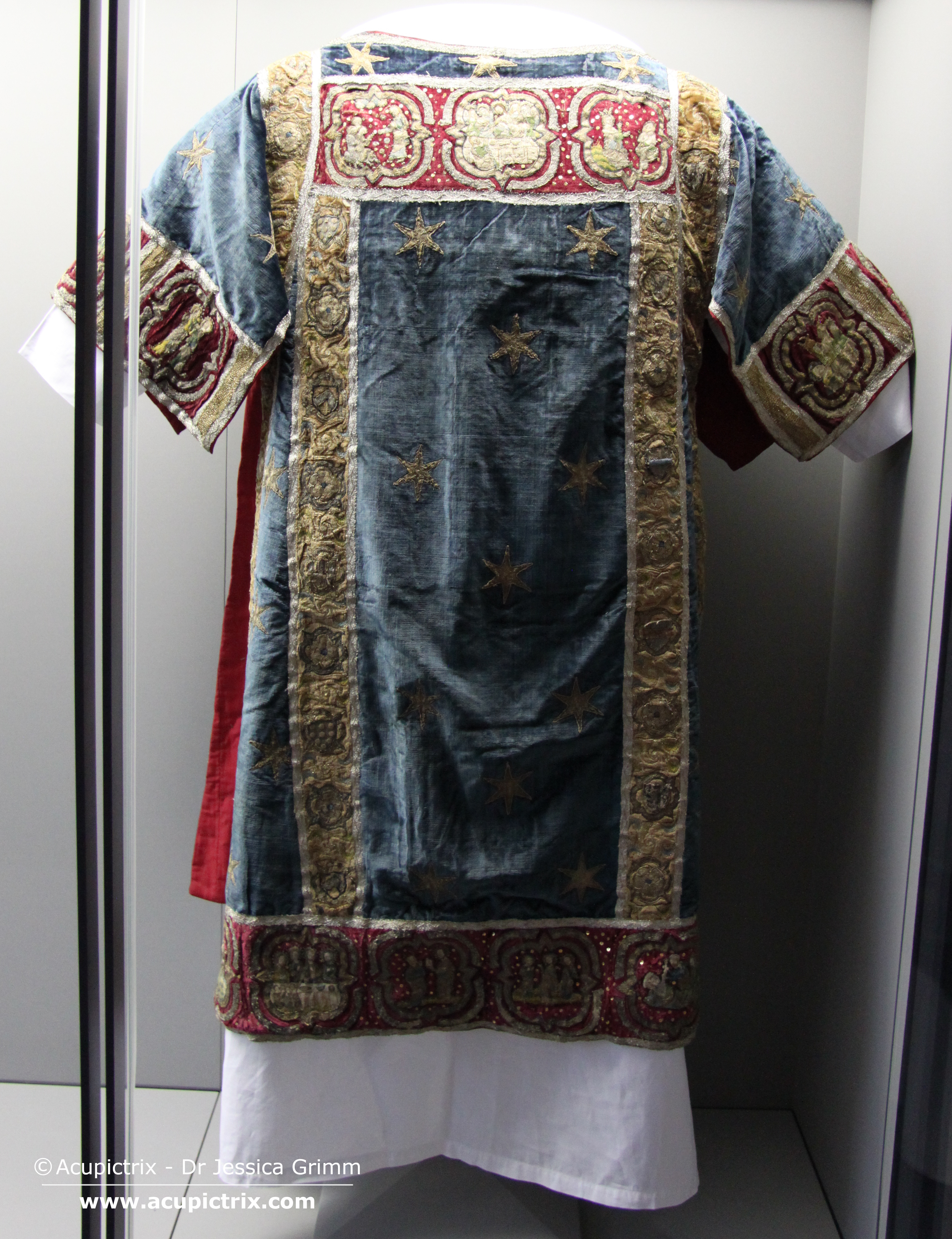
Does this mean that the scenes were always divided over multiple vestments? I am not sure. We do have sets of vestments from the 15th century with a continuous theme. For instance, the vestments of the Order of the Golden Fleece displayed at the Imperial Treasury in Vienna. We don’t seem to have this for earlier times. For instance, the Opus anglicanum chasuble (dalmatic) and cope from Anagni Cathedral, dating to the late 13th century, have two completely different iconographic cycles. The same is true for the two chasubles and the cope from St. Blasien im Schwarzwald, now in Sankt Paul im Lavanttal and the Österreichisches Museum für angewandte Kunst, also dating to the late 13th century.
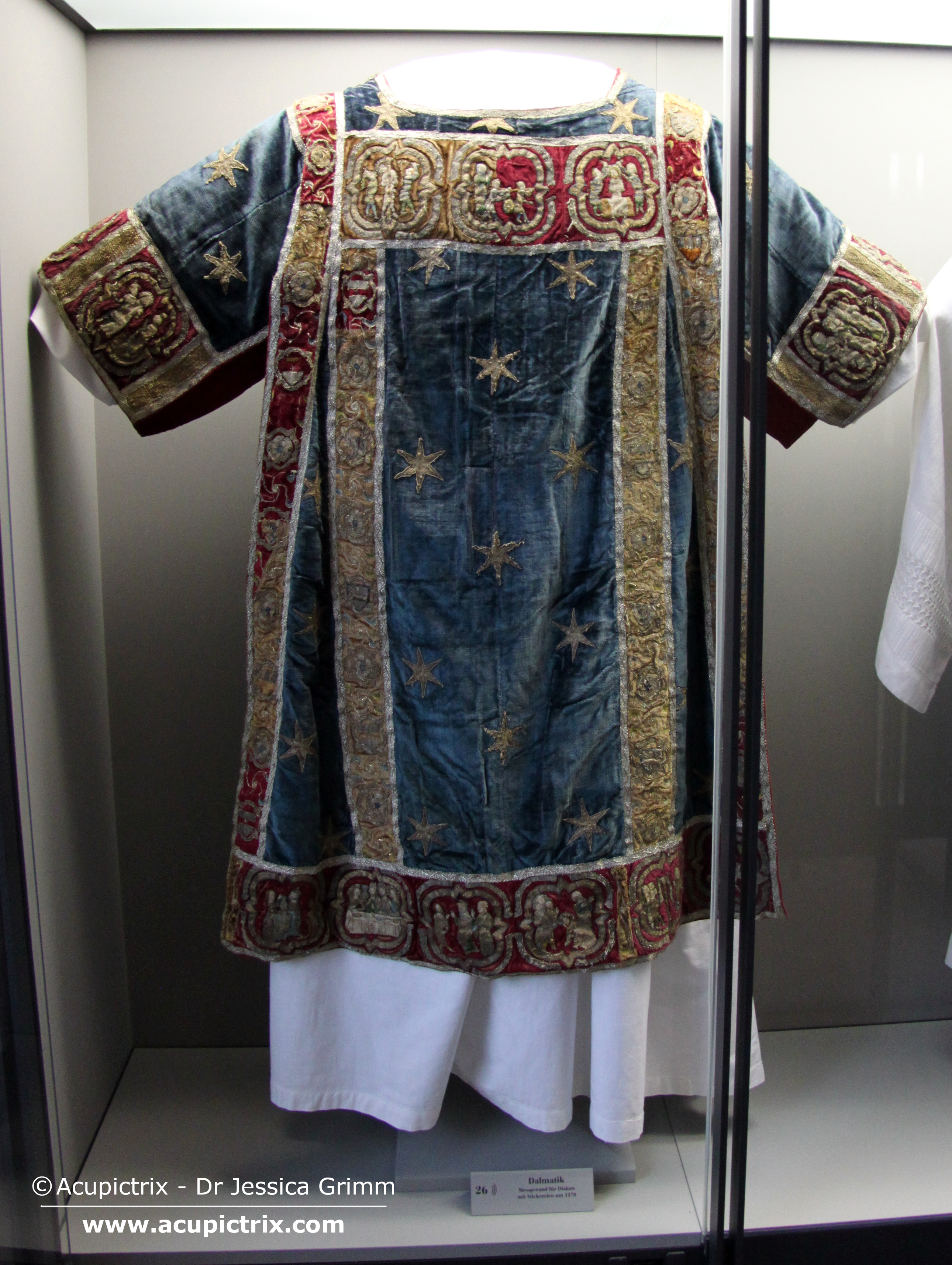
So, if 61 scenes are rather a lot for a single vestment and we don’t really have examples of iconographic cycles divided across multiple vestments this early, there are only two possibilities. Firstly, the situation in Burtscheid is (now) unique. The original configuration of the 61, and possibly more, scenes over a (bell) chasuble and two dalmatics is historical. This is either truly unique or the only case that has survived to the present day. Or, secondly, the scenes were originally not intended for vestments. Instead, they were once part of a wall-hanging of some sort. Much like the wool on linen embroideries seen in the “Heideklöster” of Lüneburg Heath, for instance, at Wienhausen.
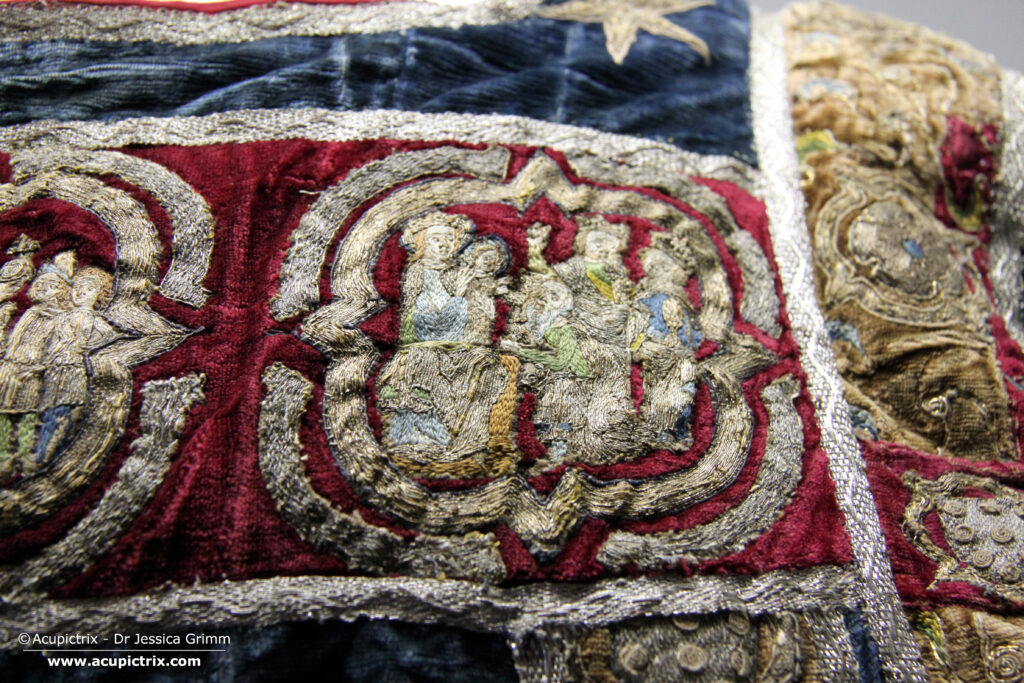
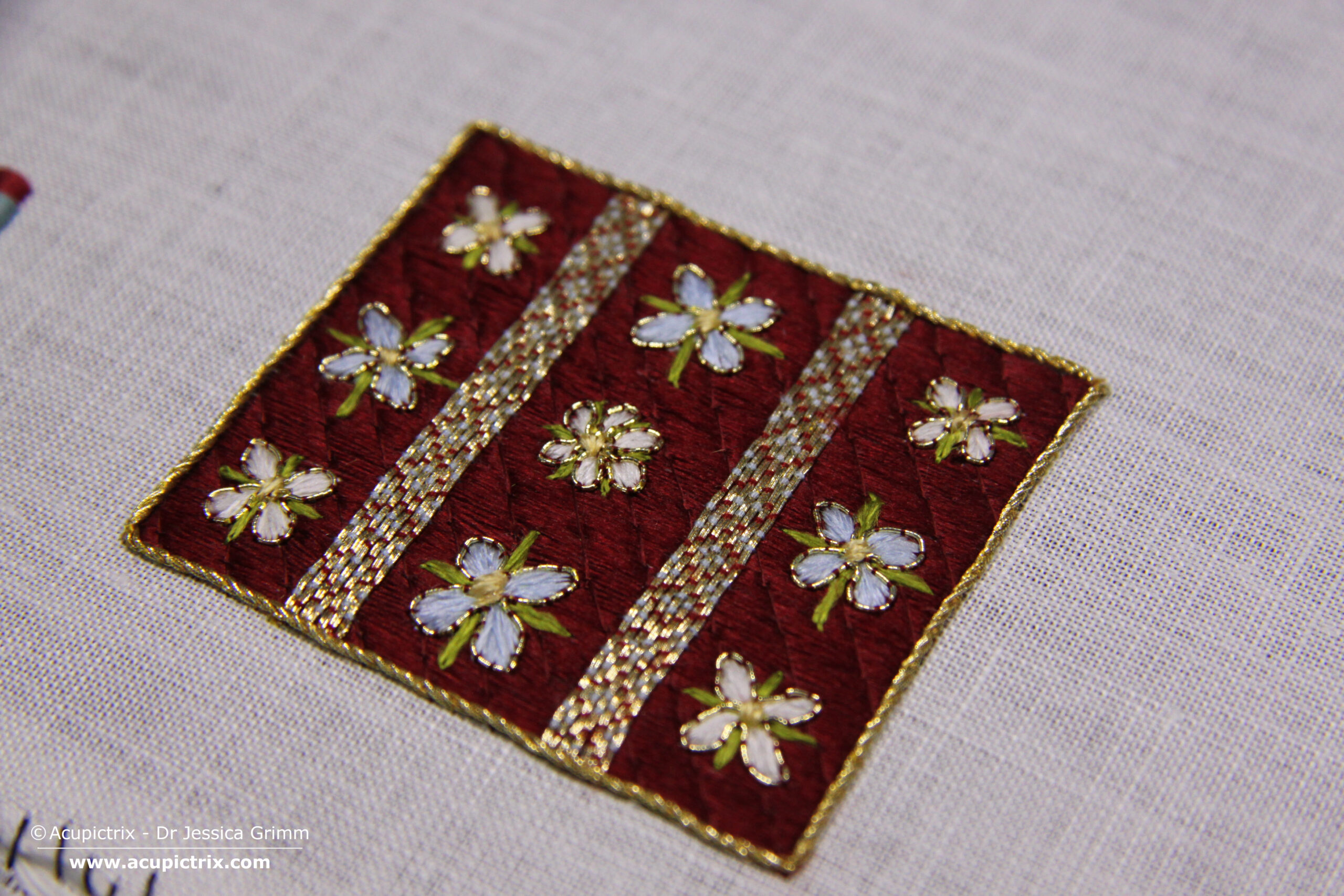
Interspersed among the embroidered scenes in Burtscheid are the coats of arms of six local families. Their names are: Von dem Bongart, Schönau, Schellart, Von Neurath and Engelstorp or Von Barmen. One embroidered coat of arms cannot be identified at all. Mechtild von Schönau, Mechtild von dem Bongart and Richmodis Schellart were abbesses of the Cistercian nunnery of Burtscheid in the second half of the 14th century. Additionally, the obituary of the nunnery mentions several members of the Engelsdorf and Neurath families. It is thus likely that these powerful medieval women and their families gifted these precious gold-and-silk embroideries to the Cistercian nunnery at the end of the 14th century.
Next week, we will have an in-depth look at the actual embroidery!
Literature
Grimme, E.G. (1996): Kirchenschätze der ehemaligen Abteikirche St. Johann und der Pfarrkirche St. Michael in Aachen-Burtscheid. Thouet Verlag, Aachen.
Maier, A. R. (1916): Der Kirchenschatz der ehemaligen Abteikirche St. Johann in Burtscheid. In Aachener Kunstblätter 9/10, pp. 49–100. You can find a free download here.
3 thoughts on “St Johann in Burtscheid – 14th-century goldwork embroidery”
Just utterly breathtaking that these beauties have survived ! Thankyou for sharing . Debbie 🕊️🙏🏻💐
This is really beautiful! The faces are amazing. I wonder whether the spangles on the chasuble belong to the original embroidery or were they added later? Looking forward to your updates!
They were added later.