We have no contemporary eyewitness accounts of the first Christmas. Still, quite a few of the nativity scenes in the Western world look very much the same. How did that happen? And how does this relate to a group of almost identical embroidered vestments made in Germany in the second half of the 15th century? What technological innovation ensured near-identical serial production? A perfect story to explore in the last days running up to Christmas 2020!
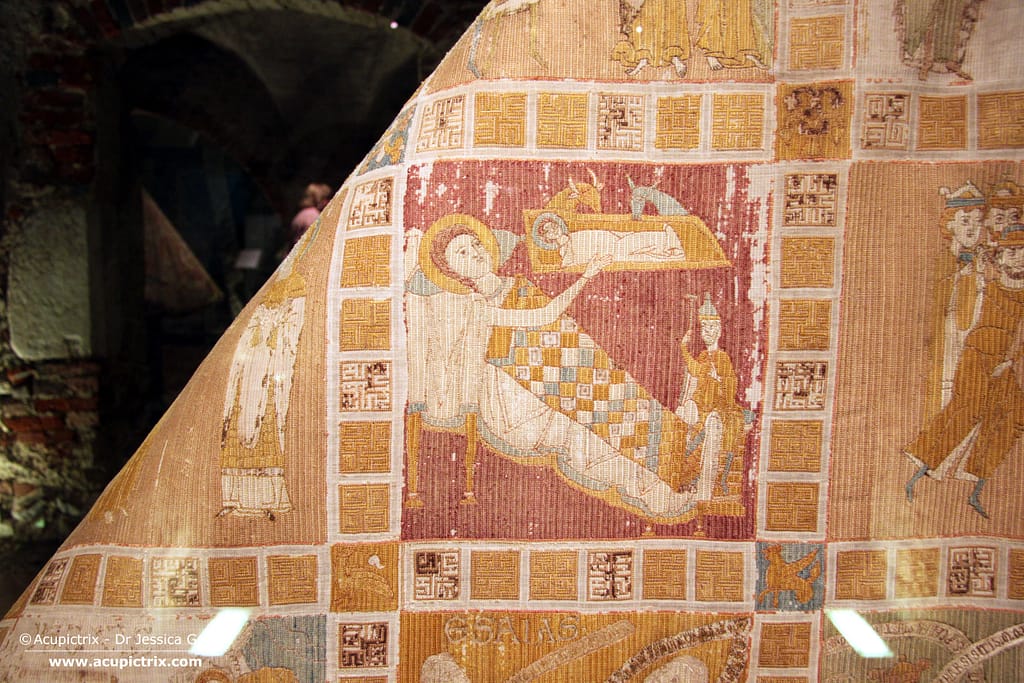
As said, conventional wisdom holds that none of the witnesses to the first Christmas left a written, signed account of the events. But throughout the ages, some people have claimed to have been transported back in time and witnessed the scene. They had a revelation. For Western Art, the revelations of Saint Bridget of Sweden (AD c. 1303-1373) are very important. Saint Bridget describes the scene as follows: Mary, a bare-headed, blond-haired woman, kneels with Joseph in prayer over the infant Jesus, who radiates divine light. Saint Bridget became something of a celebrity during her life, and her revelations were depicted in images that went viral across much of Europe. It successfully replaced earlier conventional depictions of the nativity in which Mary reclines on a bed (still popular in Orthodox Christianity). You can see an example on the chasuble from St. Paul im Lavanttal (on the back, at the top; the scene with the red background).


The images of the revelation of Saint Bridget were so popular that they were also reproduced in embroidery for the orphreys found on chasubles. These orphreys are so similar that their designs must have a common source. Printing on paper using woodcuts and metal engraving was invented in the first decades of the 15th century and quickly became popular for cheaply spreading imagery. Research into the composition of the design lines on some of these orphreys has shown that these designs were likely printed onto the embroidery fabric as well. If you click the pictures of the pieces from the MET and the Wartburg, you can explore more images on the institutions’ websites.

And here is a fragment kept at the Bayrisches National Museum (Inv. Nr. T297) with the singing angels. Although these embroideries were made in serial production, slight variations do exist not only in the colours used, but also in the number or arrangement of the figures. In this case, a more pleasing composition was achieved by adding a third angel. There are quite a few other examples out there, but I don’t have pictures of them that I am allowed to publish. If you would like to dive a little deeper into the topic, please explore the literature.
Literature
Fricks, J. von, 2010. Serienproduktion im Medium mittelalterlicher Stickerei – Holzschnitte als Vorlagematerial für eine Gruppe mittelrheinischer Kaselkreuze des 15. Jahrhunderts. In: U.-Ch. Bergemann & A. Stauffer, Reiche Bilder. Aspekte zur Produktion und Funktion von Stickereien im Spätmittelalter, Regensburg: Schnell & Steiner.
Wetter, E., 2012. Mittelalterliche Textilien III. Stickerei bis um 1500 und figürlich gewebte Borten, Riggisberg: Abegg-Stiftung.


0 Comments