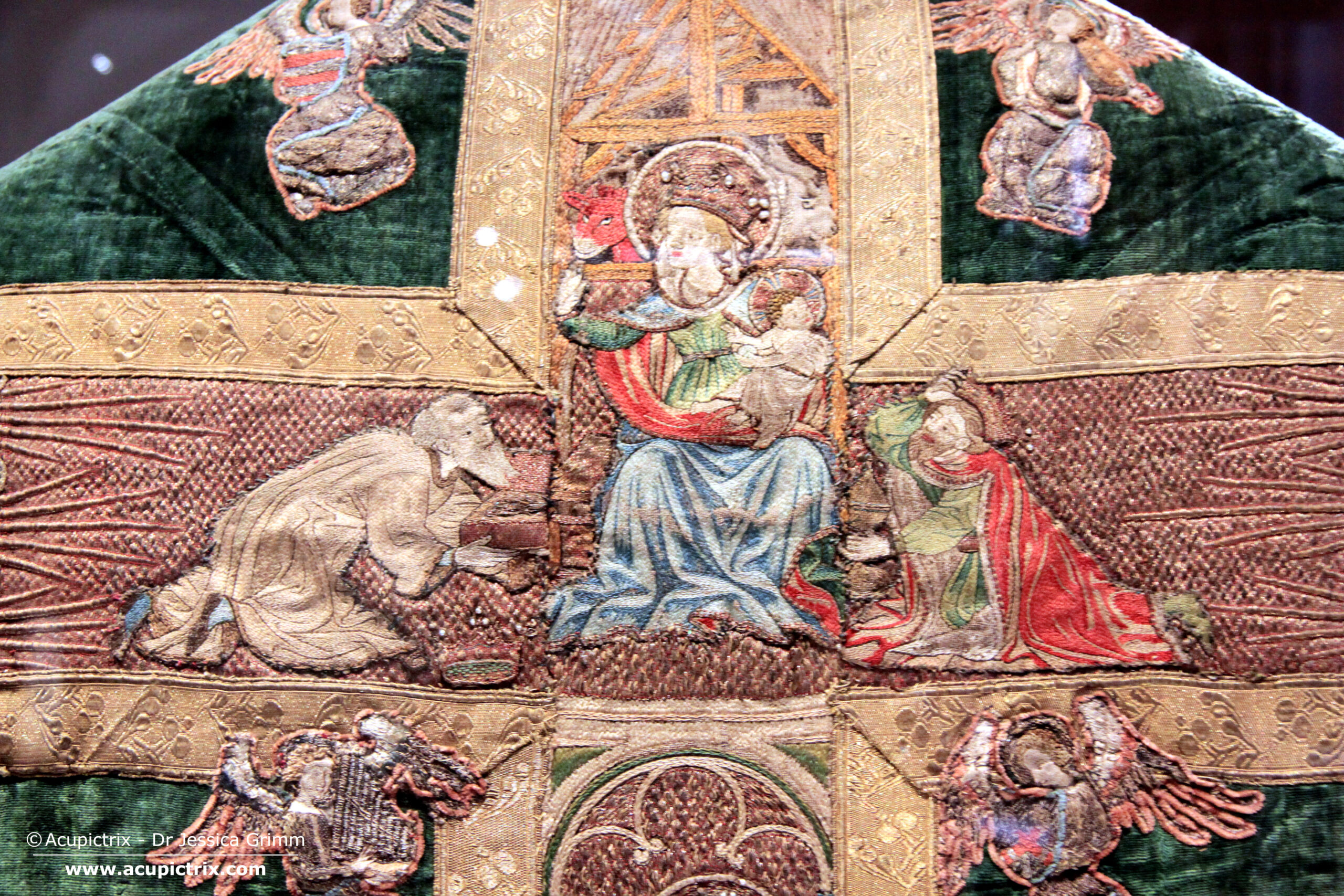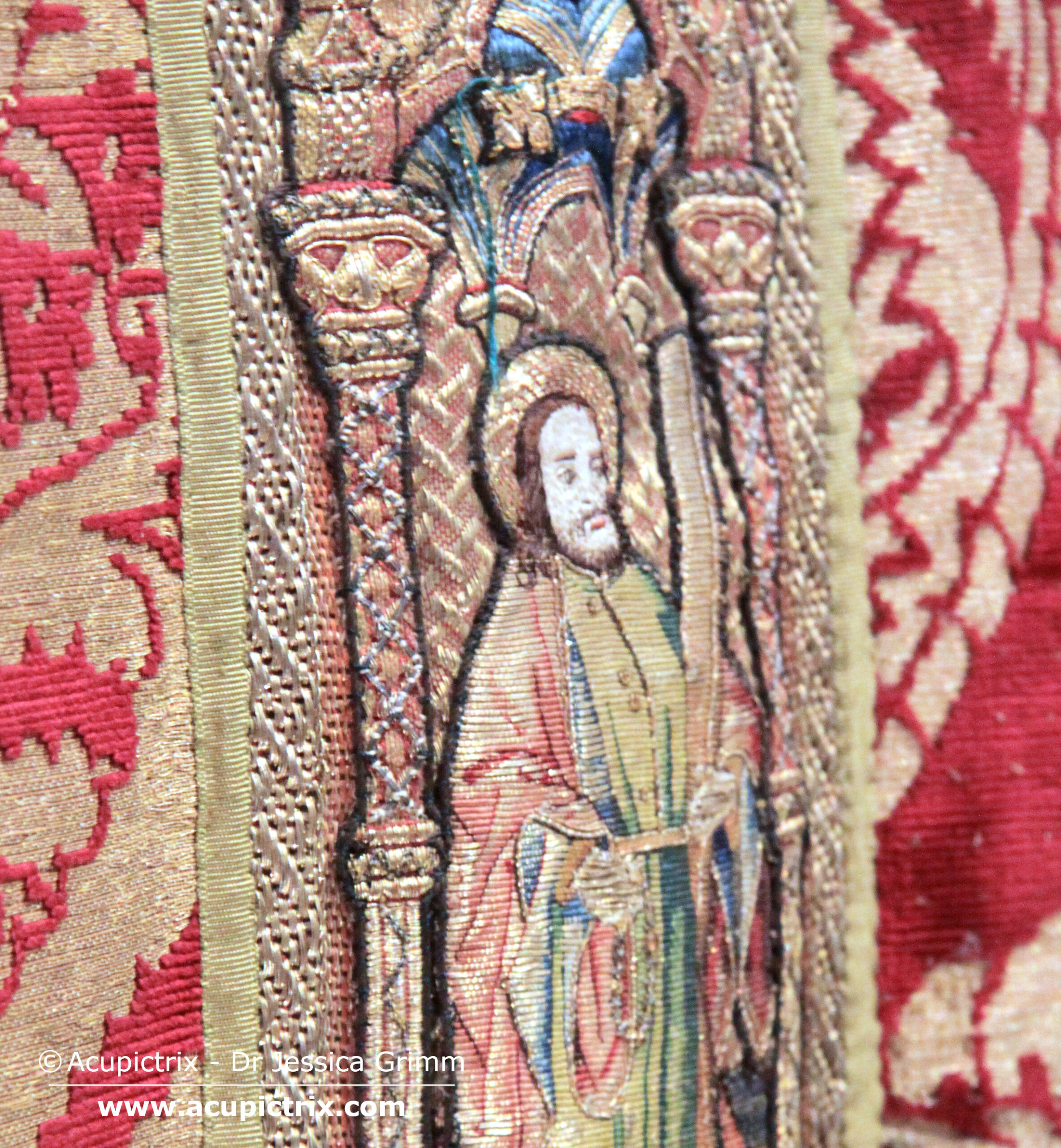
Stitch Tutorial - Detail Dalmatic (Nativity) of the Schlosser Ornat, Inv. Nr. 124 I-III, Dommuseum Frankfurt.

Stitch Tutorial: a Dutch column made in Cologne?

When I started work on this week’s stitch tutorial, I had the growing feeling that things weren’t quite what they seemed at first. That’s the great thing about doing research. I usually have no idea where the medieval embroideries will lead me. Dead ends are common. But so are those ‘aha’ moments. In this case, it was the latter. Let’s dive in! And here is the culprit. No, not Saint Andrew. It is the columns Read more
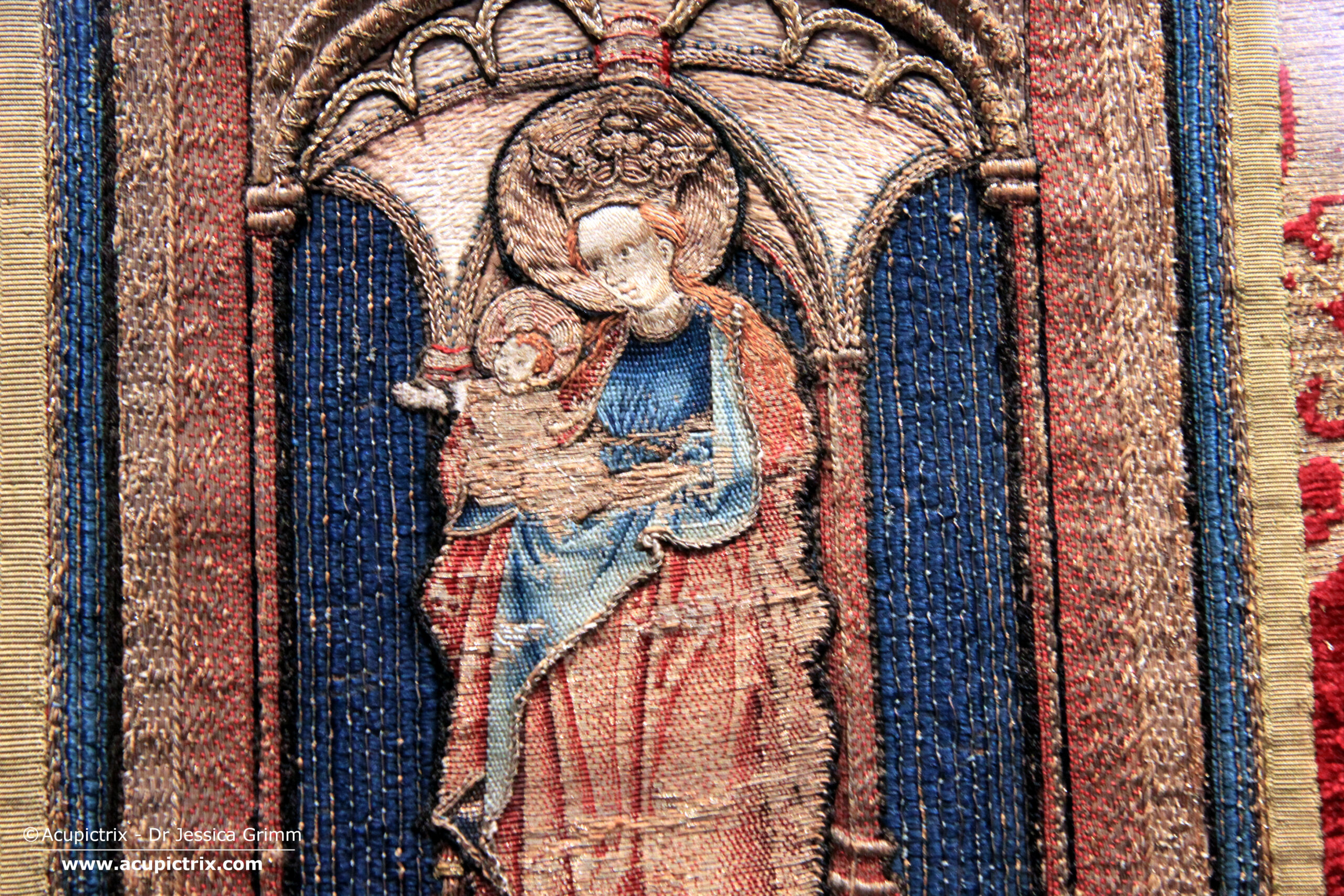
Mary with Child on the chasuble of the Schlosser Ornat, Inv. Nr. 124 I-III, Dommuseum Frankfurt.

Do we collectively lose embroidery techniques and standards?

Not sure how many of you studied last week’s pictures of the Schlosser set of vestments, focusing on the embroidery techniques used. If you did, you might have spotted the same oddities as I did. For starters, there’s the ‘enhancement’ of the faces with oil paint. Not an unusual practice. The skill needed to work these super-fine silken stitches to render the faces was something the restorers of these late-medieval embroideries could no longer do after Read more

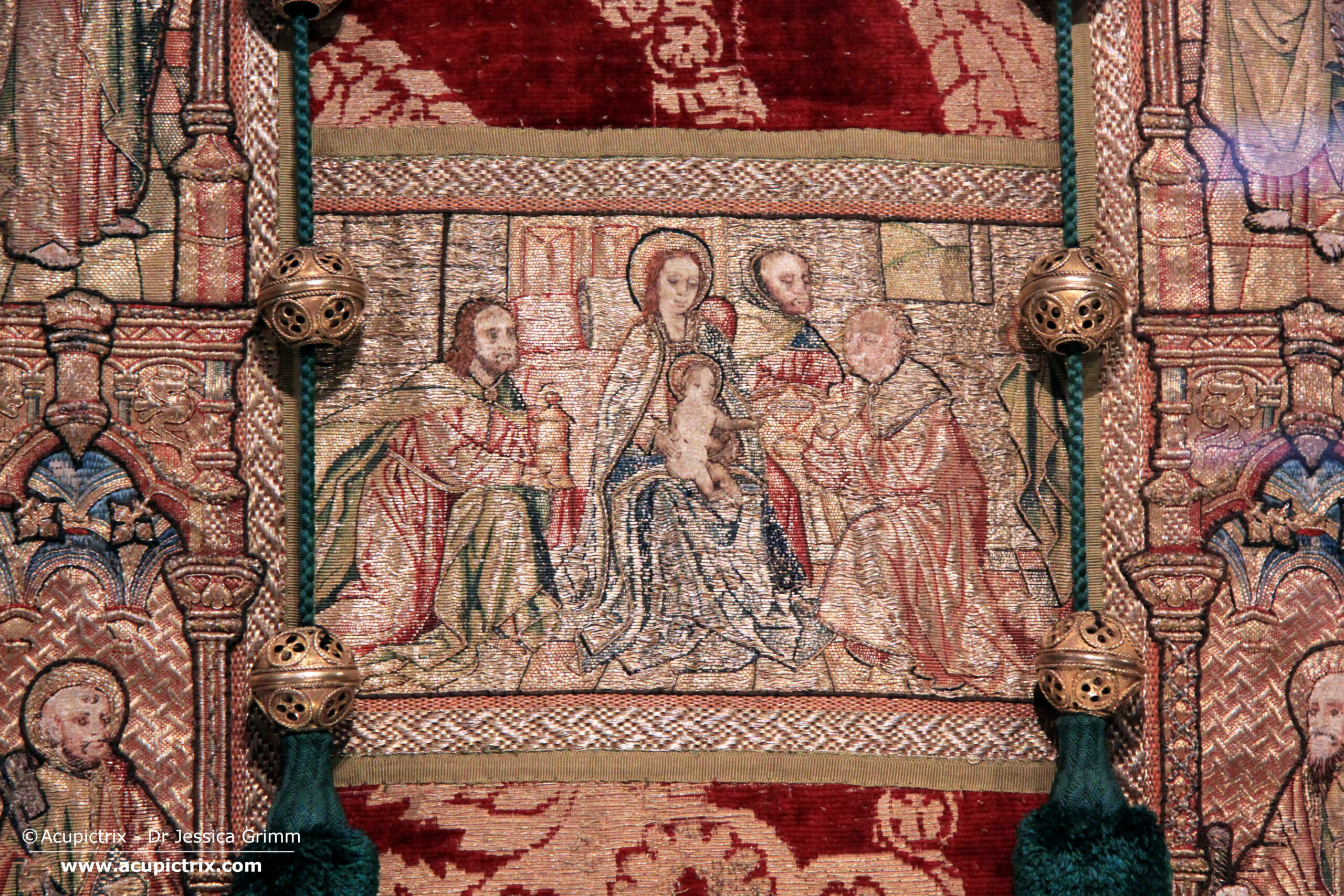
Detail dalmatic (Adoration of the Magi) of the Schlosser Ornat, Inv. Nr. 124 I-III, Dommuseum Frankfurt.

The Schlosser Ornat: from Cologne to Frankfurt

One of the highlights of my museum tour at the end of November last year was the Dommuseum Frankfurt. It has nine medieval embroidered vestments on permanent display. Well worth a visit! At the beginning of the year, I showed you a green chasuble with embroideries from the mid-14th century and the second quarter of the 15th century, both made in Cologne. This time, I will introduce you to the Schlosser Ornat, a vestment set with embroideries made Read more

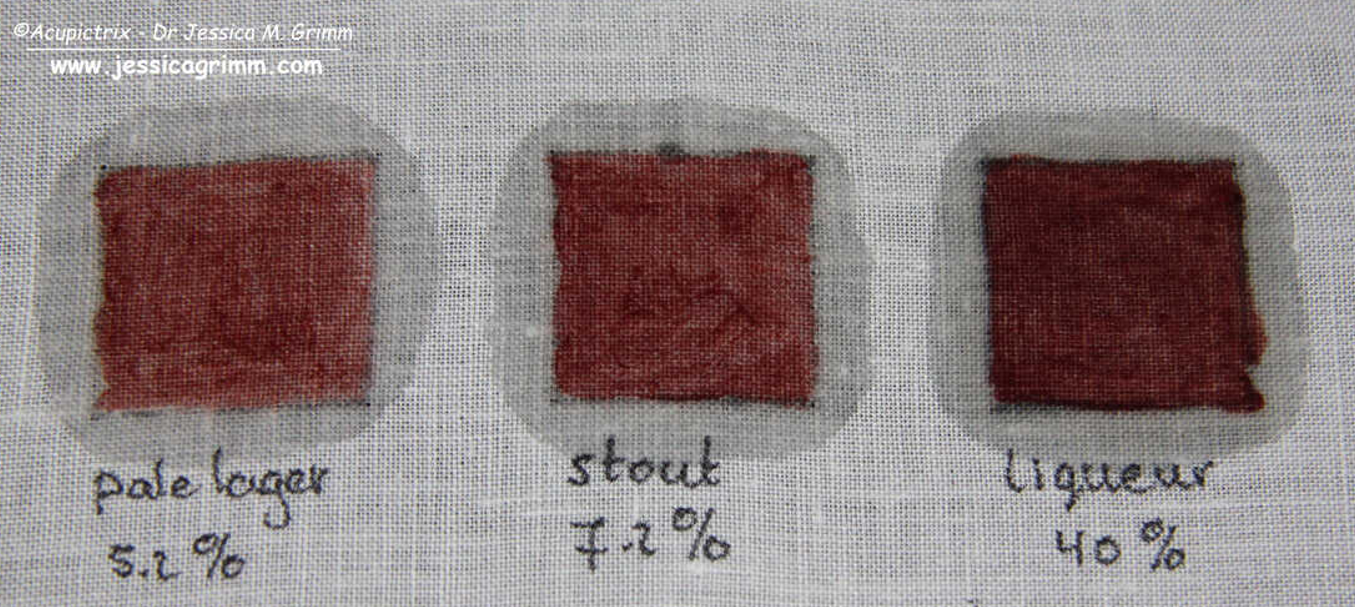
Madder Experiments - Paint-like substances made with madder powder and booze, still wet

Booze and Madder: some embroidery experiments

Asking for beer at 9:30 a.m. raised a few eyebrows next door at the abbey. Assuring Friar Markus that it was needed for an embroidery experiment did little to improve matters. But it was the truth. What had happened? During my MEDATS talk, I asked the audience for help with the madder conundrum. Whilst oil will do the trick, the greasy halo is very unsightly. Afterwards, I was contacted by Deborah Fox, who had done some Read more

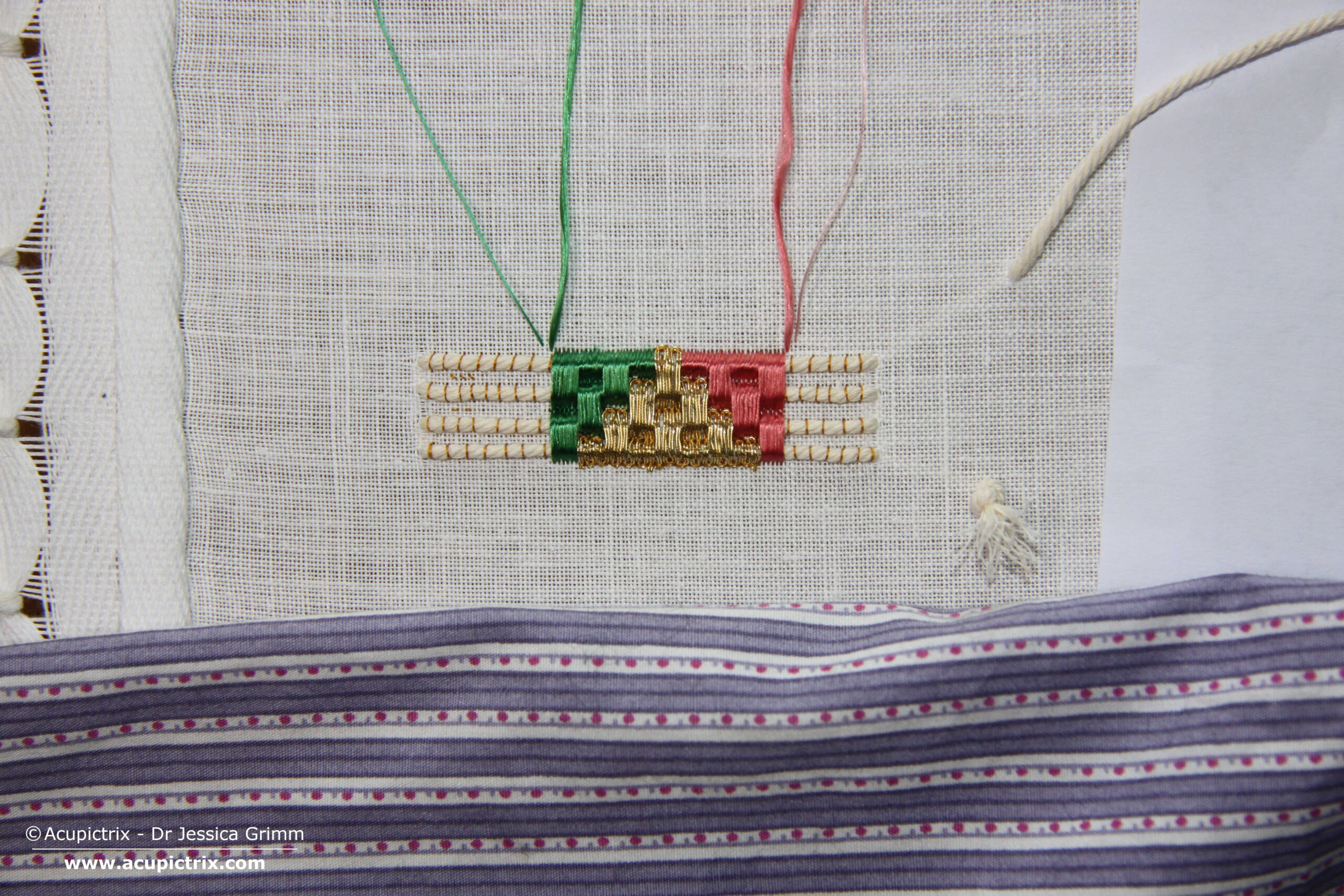
Goldwork Embroidery Tutorial - Applying silks over padding

Goldwork Embroidery Tutorial: a fancy border with triangles

This week, I have a goldwork embroidery tutorial for you inspired by a late 15th-century embroidered chasuble kept in the Domschatz of Fritzlar. It has these lovely textured bands or borders between the individual orphreys. The border is made by couching gold threads and coloured silks over string padding. It seems to be a very ‘Central European‘ thing to do. The technique is not difficult at all and would look great in a modern piece Read more

Model book - Hungarian Museum of Applied Arts, Inv. Nr. 7393, originally from a church in Carinthia, Austria.

Reconstructing a model book for late medieval embroidery

When we looked at the embroidered chasuble from Fritzlar with the Virgo inter Virgines iconography last week, I was sure I would find many Doppelgängers. I had seen this iconography many times before, and I was pretty sure that these pieces were all very similar. Nope. They are not. As soon as you look at these pieces in more detail, you will find they are all different. Either in the placement of the individual figures and/or in the Read more

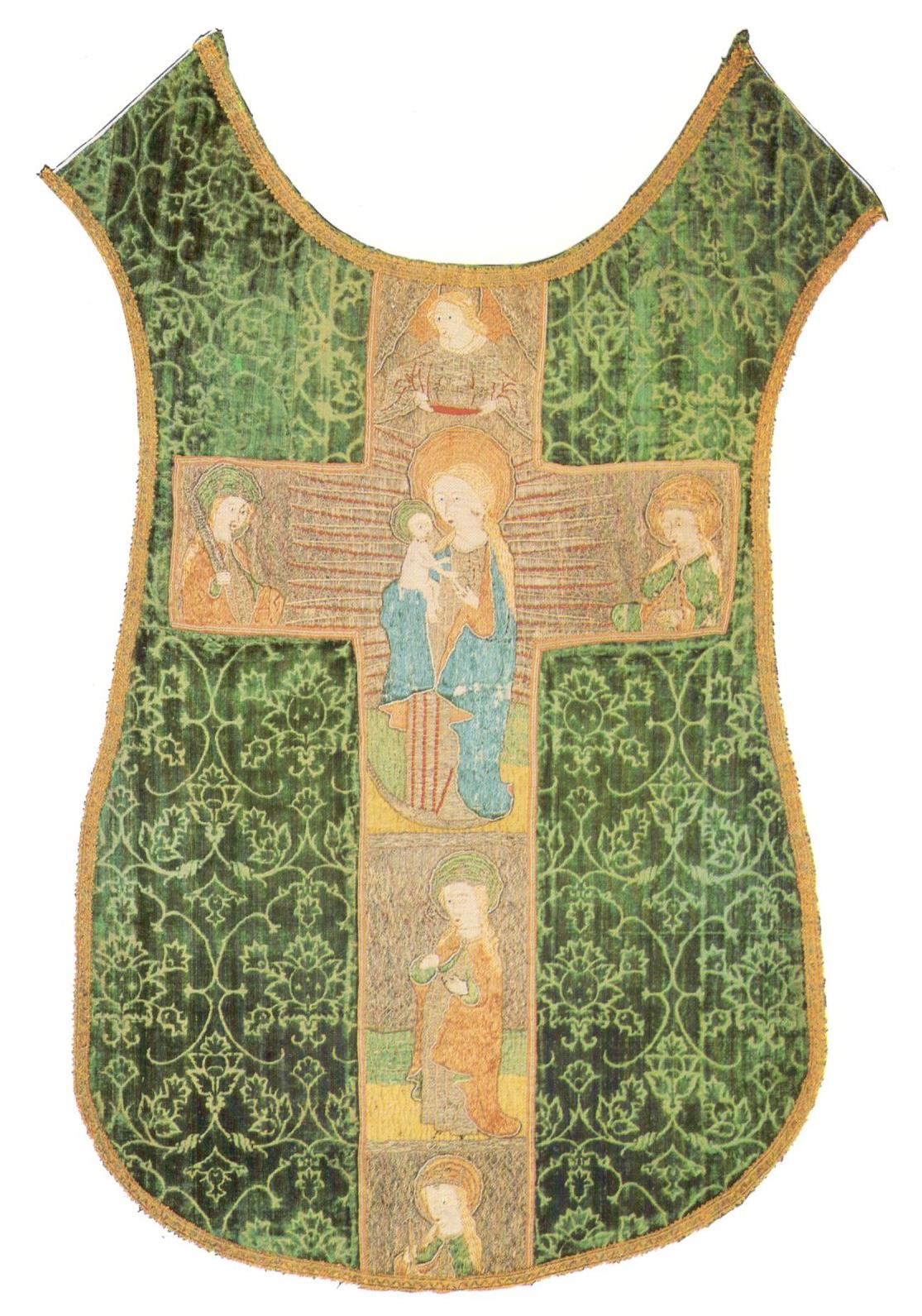
Virgo inter Virgines - Embroidered chasuble cross made in the late 15th century in Central Germany, Domschatz Fritzlar Inv. Nr. 704071

Virgo inter Virgines: 15th century embroidery from Germany

Late last year, I visited the Domschatz of Fritzlar. This small museum displays several embroidered medieval textiles, which you can photograph as long as you don’t use flash. The textiles are extremely well-lit and very close to the display case’s glass. This means that you can examine them very well! Today, we will discuss one of the embroidered chasubles on display featuring the Virgo inter Virgines iconography. It was made in Central Germany in the late Read more

Stitch Tutorial - Adding the freshwater pearls onto the string padding

Stitch Tutorial: 14th century Pearl-edged nimbus

Today’s stitch tutorial is all about the white string we see in many medieval goldwork embroideries. This padding is often all that remains from the original bead embroidery worked with freshwater pearls. When we are really lucky, a few pearls still adhere. As is the case with the chasuble I showed you two weeks ago. In this stitch tutorial, I will show you how the padding and the beading were worked. I was really surprised by how Read more

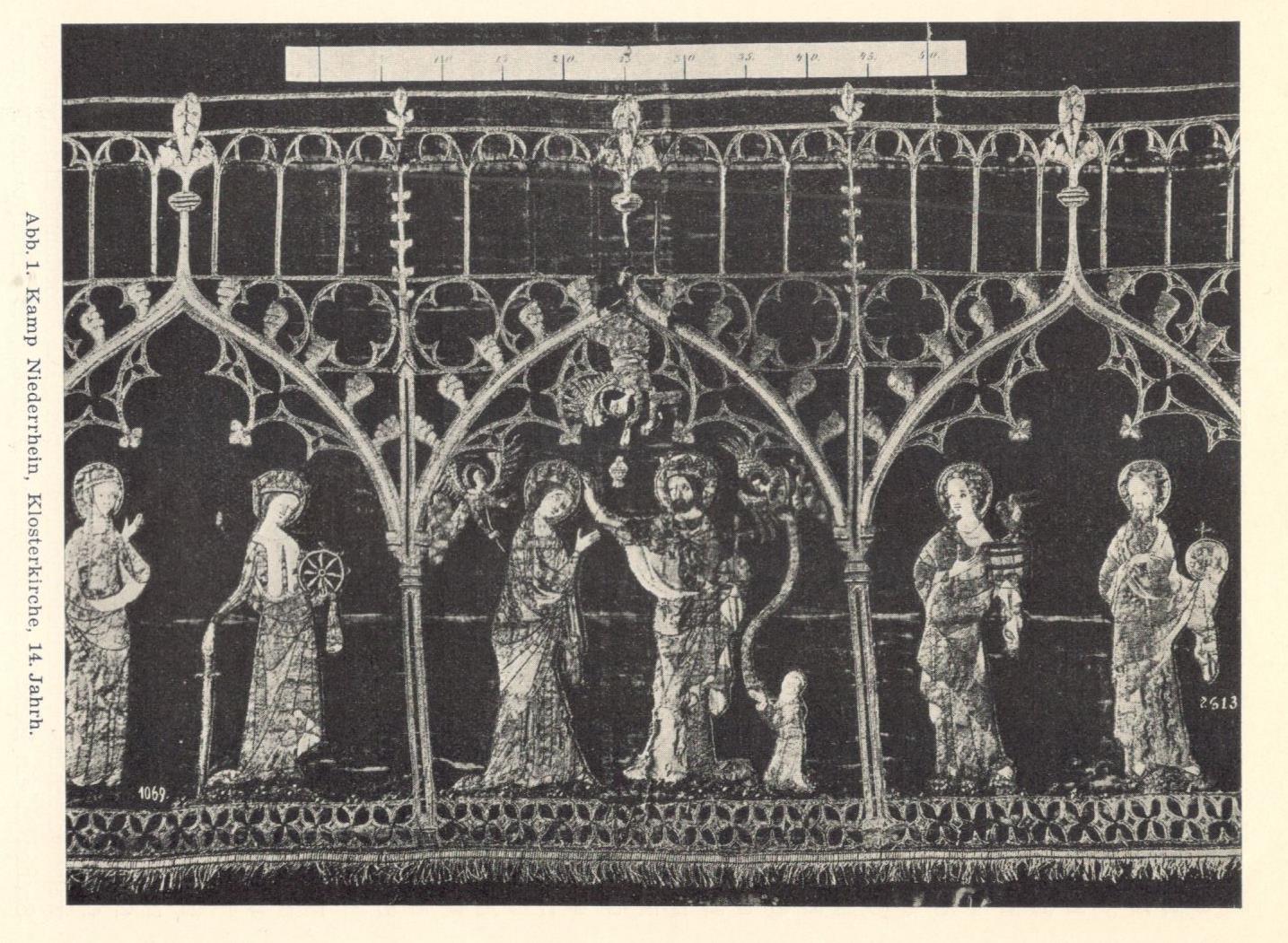
Cologne - Antependium Kamp Abbey (Reichelt 1937)

Spectacular Cologne embroidery from the 14th century

It never ceases to amaze me that, after having studied medieval goldwork embroidery for quite some time now, I still find spectacular pieces that I had never previously heard of. Casual references in the literature lead me to obscure, tiny museums that happen to house a real treasure. The original authors, mostly late 19th- and early 20th-century, raved about these pieces. And rightly so! But for one reason or another, these pieces never made it Read more

Cologne - Chasuble cross Inv. Nr. 118 Dommuseum Frankfurt, with the Adoration of the Magi.

Medieval embroidery from Cologne: musical angels

We will start the new year with an interesting chasuble I encountered at the Dommuseum Frankfurt. The chasuble features embroidery from Cologne dating to the mid-14th and the second quarter of the 15th century. The museum, housed in the historical cloisters, is well worth a visit. Many medieval vestments are on permanent display, and you are allowed to take pictures. This blog post explores the Schlosser Ornat vestments kept at the same museum. From the above Read more