Mitres
Mitres also survived surprisingly well. They can be found in Cathedral treasuries all over Europe. They were often found when a tomb of a clergyman was opened in the 18th or 19th century. Several mitres are held in museum collections all over Europe that look remarkably similar. They are relatively small, as was the fashion at the time, and they depict the martyrdom of Thomas Becket (AD 1119/20-1170) and/or that of Saint Lawrence and Saint Stephen. Becket was the archbishop of Canterbury, who was murdered in his church by knights due to a conflict with Henry II (AD 1133-1189). He soon became a saint. These mitres likely were produced at a somewhat larger scale in England to foster the cult of Saint Thomas Becket (Blöcher, 2010, 2012). With pilgrims coming to Canterbury being an important economic factor.
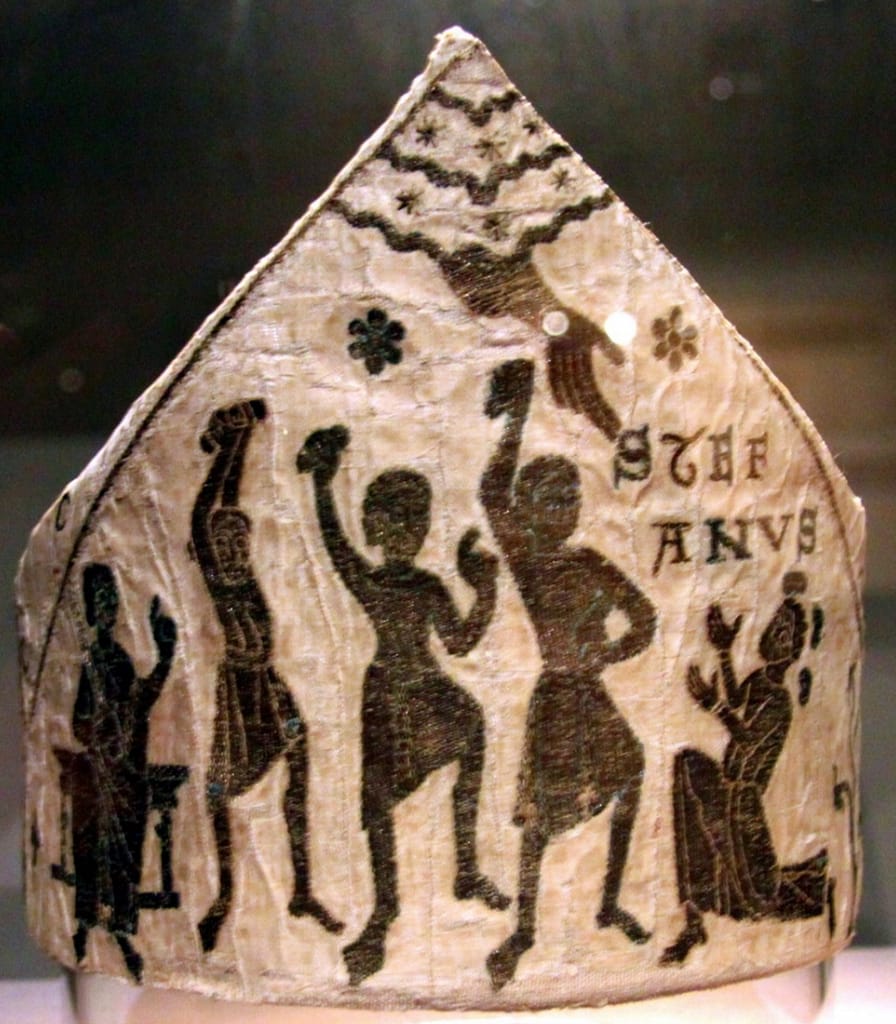
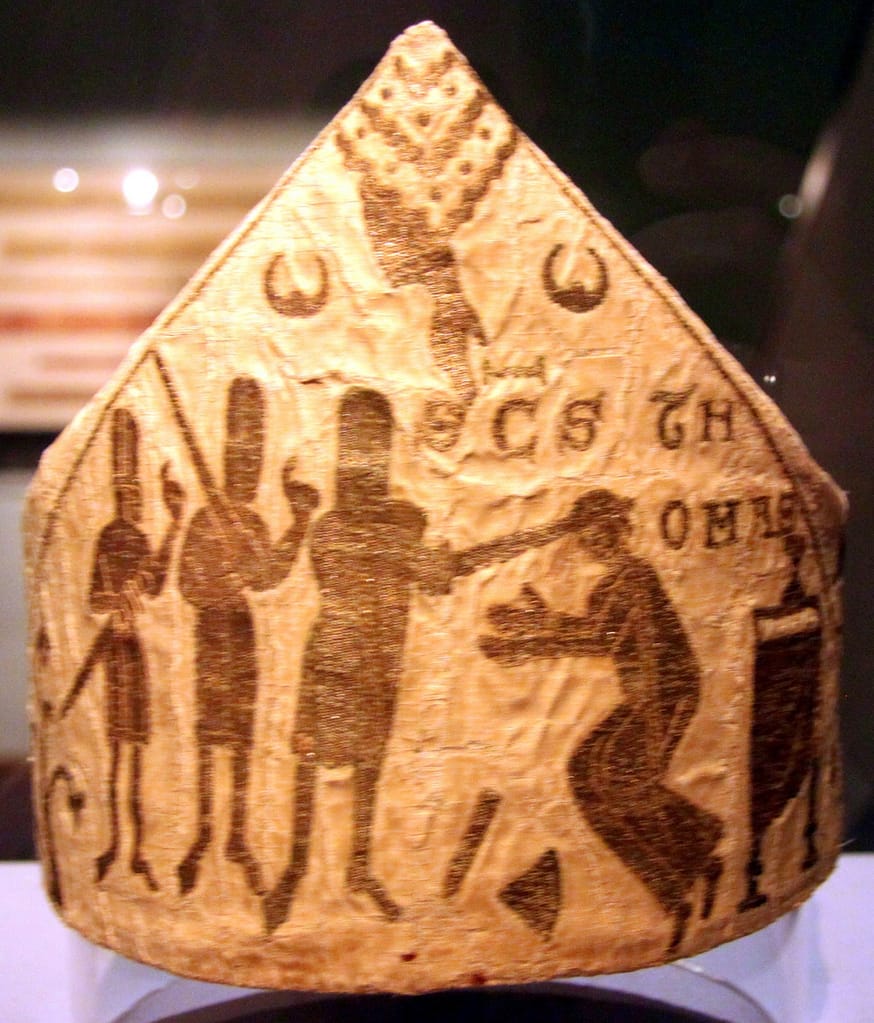
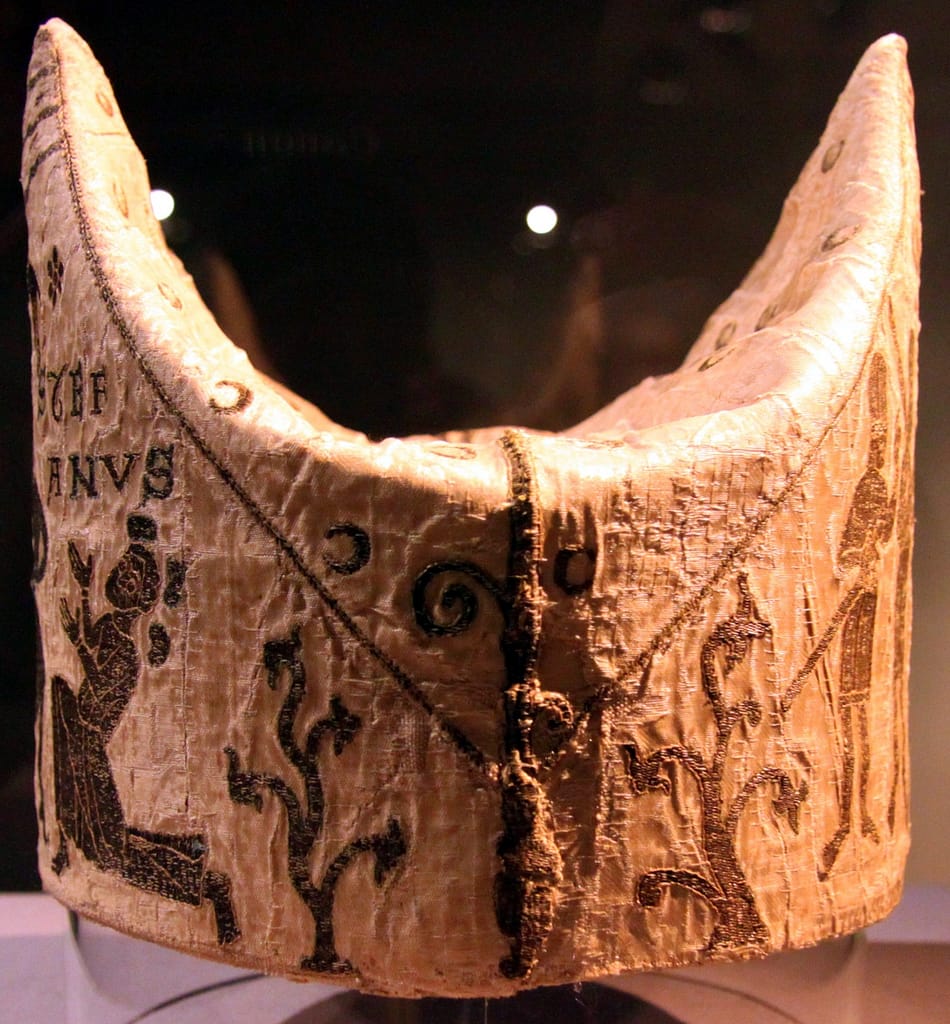
One such mitre was made around AD 1220 and is held at the Bayerisches Nationalmuseum (Figure 7, Figure 8 & Figure 9). The underside couching is done with threads made of gold foil wrapped around a silk core. The fabric is a samite reinforced with linen. A near-identical mitre (B 561) is held in the treasury of the Cathedral of Sens in France. A very similar mitre, still with its lappets, is now held at the Depot de la Société Archéologique de Namur (TO28) but originated in the Augustinian Priory of Oignies (near Aiseau in Belgium). In this case, the martyrium of St Thomas Becket is paired with that of St Lawrence. Further related mitres can be found in Anangi Cathedral, Italy, Braga, Portugal and Tarragona, Spain.
Another mitre (Figure 10), originally from Sens Cathedral, which holds the vestments worn by St Thomas Becket, is on loan from Westminster Abbey to the Victoria & Albert Museum. It is, in fact, a fusion of two different mitres. The mitre itself and the lappet with the scrolling date to AD 1200-1230. The lappet with the figure is a little older and dates to AD 1180-1210. It looks similar to the lappets found on the mitre from the Augustinian Priory of Oignies (see lecture and above). The embroidery on both parts is executed with a single silver gilt thread on Italian silk reinforced with linen.

A mitre (38.887) decorated with stars with flower hearts can now be found in the Boston Museum of Fine Arts. The mitre originally comes from St Peter Abbey in Salzburg, Austria and was made in the second third of the 13th century. The gold thread embroidery is executed in underside couching on a silken background. You will find that this mitre is often ascribed to a German embroidery workshop. However, I agree with Heidi Blöcher (2012) that there are no parallels in Germany for technique or decoration.
Although stylistically, we move from the Romanesque period (c. AD 1000-1150) into the Gothic period, embroidery seems to be a bit more conservative than, for instance, painting, sculpture, and architecture. Except for the action-laden figures on the mitres, all other depicted figures are static and somewhat stiff. A typical characteristic of Romanesque art. The many examples with scrolling foliage and animals, on the other hand, were inspired by designs from the Orient (Descatoire, 2019).