Materials and Makers Lesson 3
From the information above and the information for lesson 2, you will see several developments in Opus Anglicanum taking place over time. The oldest pieces often show non-religious ornamentation nearly completely worked in metal threads with a high gold content (stockings and shoes). Then, typical religious scenes start to appear which are still worked primarily in metal threads (now gilded) on backgrounds of precious imported silk fabrics (Clare chasuble). These precious silk fabrics form part of the design. Parallel, all-over ornamented vestments appear. The embroidery is executed on linen. The figures are now mainly embroidered in silks, but the background is formed of underside couched gold threads (Pienza cope). The only exception to this rule is the Syon cope, where the background is also worked in silks. From the 15th century (AD 1400-1499) onwards, the goldwork embroidery in England was strongly influenced by that of Continental Europe. Serial production of orphreys and appliques becomes the norm. Underside couching is no longer practised. Instead, the figures are now placed on a golden background formed of surface-couched diaper patterns. English embroidery is no longer a sought-after export item. Instead, embroidery from Continental Europe is now the luxury embroidery of choice (compare Heard, 2016; Wetter, 2016).
Since the time of Henry III (AD 1207-1272), London was a centre of embroidery production (Hourihane, 2016). After AD 1200, there are many references to embroidery and the embroidery trade in the records preserved. However, since terminology was not always consistently used, with broderer meaning embroiderer or embroidery merchant, their interpretation is not always clear-cut (Davies, 2016; Michael, 2022). Unfortunately, none of the mentioned makers can be linked to any surviving Opus Anglicanum embroidery pieces.
In the accounts of Henry III, we frequently encounter embroideress Mabel of St Edmunds, who likely ran a workshop in London. In AD 1239, she was commissioned by the King to work on a chasuble and an offertory veil. Mabel has been paid regularly during the two years she has worked on this project. Upon completion, the work is being appraised ‘by the better workers of the City of London’ upon whose recommendation the outstanding fee is paid. Mabel is also granted the leftover materials. Although Mabel embroidered for the King, two men were entrusted by the King to supply Mabel with everything she needed: the clerk Edward of Westminster and the cloth merchant Adam de Basing (who likely ran a vestment workshop). When Mabel worked on the chasuble, she also supplied the King with an offertory cloth, apparel, a stole, a fanon[1]– an amice, collars, cuffs, and several other ornaments and unspecified works for his chapel. Between 1243 and 1244, Mabel designs and embroiders a banner for the King to go in Westminster Abbey (Kent Lancaster, 1972).
We meet another embroideress, Aleyse Darcy, in a quitclaim from AD 1304:
“On Wednesday the Feast of the Apostles Simon and Jude [28 October] in the 32nd year of the reign of King Edward, came Thomasin Guydechoun, of Luka, before John le Blound, the then Mayor of London, William de Leyre, and other Aldermen, and acknowledged the following writing to be his deed. To all those who this letter shall see and hear, Thomasin Guydichon of Luka, greeting in God. Whereas I had in time past granted, released, and quitclaimed unto Aleyse Darcy, who was the daughter of Messire Thomas Darcy, all my share, and all the right and claim that I ever had, or could have, in one piece of cloth, embroidered with divers works in gold and silk, which she is now preparing, eight ells in length, and six ells in breadth, for ever; in consideration of 300 marks sterling which I lately received for the aforesaid Aleyse from Messire Henry de Lacy, Earl of Lincoln, and Sir John de Sandale, clerk, for another embroidered cloth which the said Aleyse and myself sold to the Earl of Lincoln aforesaid,— as by a letter of quitclaim, sealed with my seal, the which was made at London, on the Monday next after Christmas Day in the year of Grace 1302, more fully appears;— be it known unto all of you that I, the aforesaid Thomasin, do will and do grant, for myself, for my heirs, and for my executors, that the said release and quitclaim shall be firm, stable, and in all points fulfilled, according to the force and the virtue of the said letter of quitclaim. And thereupon, I do further release and quitclaim unto the aforesaid Aleyse, by the present letter, all the action, and the right and claim, which I ever had, or in any manner ought to have, in the cloth of gold aforesaid; in such manner that neither I, the aforesaid Thomasin, my heirs, nor my executors, nor any other man, by us, for us, or in our name, may or can, from this day forth, claim, challenge, or demand, at any time whatsoever, any right or claim whatsoever against the aforesaid Aleyse, against her heirs, or her executors, by reason of the said embroidered cloth which she is now preparing. In witness of which thing I have to this letter set my seal. Given at London, etc. Of this are witnesses, Salamon le Cotiller, William de Lanfare, etc. Also, be it known, that Sir Robert Fitz-Walter (fn. 7) was present at the time of the acknowledgement aforesaid.” (Riley, 1868).
This quitclaim shows that embroidery was an international affair in the early 14th century. A presumably English embroideress worked with a cloth merchant from Lucca, Italy, to finish an embroidery for the Earl of Lincoln. As the silken fabric for these embroideries needed to be imported from Italy, Spain, and Asia, the involvement of Italian merchants was only logical.
In the second half of the 14th century, we learn of Alice Catour, a mistreated embroidery apprentice to Elias Mympe. Her father appeared before the Mayor and the Aldermen of the City of London (AD 1369) to have his daughter released back to him. Not only had Elias beaten the girl, but he also had given her only an apprenticeship of five years instead of the required seven. And he had forgotten to enrol her properly with London’s authorities. (Davies, 2016).
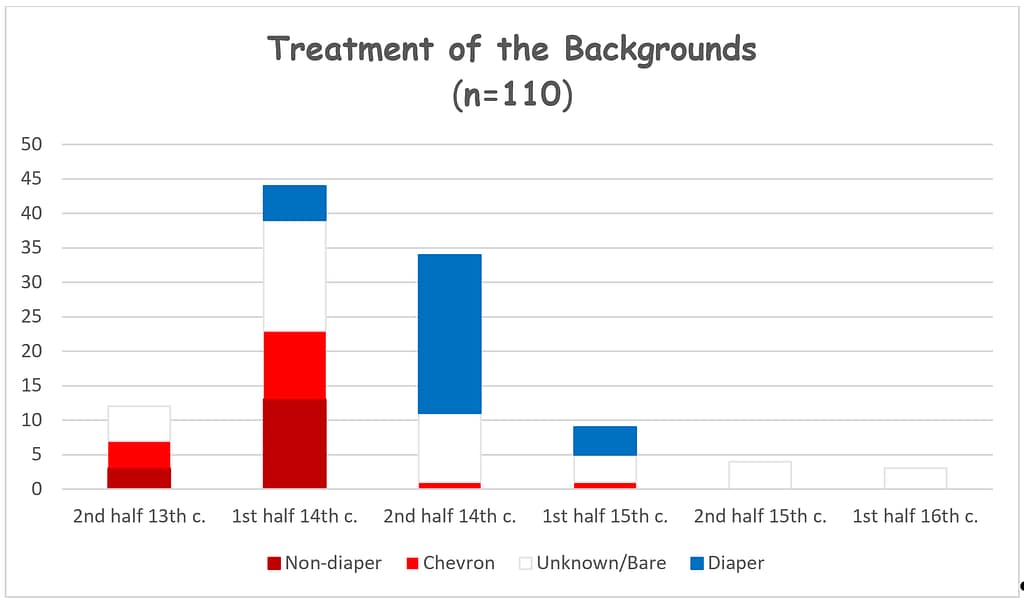
In the 14th century, women disappeared from the historical record, and men took over. It cannot be ascertained if this also means that women ceased to embroider professionally. However, as can be seen from Figure 1, this is also precisely when the complex geometrical diaper patterns start to appear and take over the golden backgrounds of the embroideries. Those intricate floral patterns, Fleur-de-Lys or double-headed eagles are gone forever. Whilst those patterns need transferring onto the fabric[2] and then filling in (see, for instance, 1919,0305.1). The diaper patterns can be simply created by counting the linen threads. Could this shift towards complex geometric patterns, which generally seem to suit male brains better, perhaps mean that women were pushed out of certain areas of the embroidery profession?
And where did these men come from? Some of the embroiderers named in the historical records were foreigners like John of Cologne, who worked for Edward III in the AD 1330s (Monnas, 2016a), Giles Avenel of Brussels who worked for the Black Prince in the AD 1350s (Davies, 2016), Stephen de Vyne from Flanders worked for King Richard II in the AD 1390s (Davies, 2016). Martin Jumbarde was another embroiderer from Flanders who worked during the late 15th century for Kings Edward IV, Richard III and Henry II (Sutton, 1982). They brought with them the new style and techniques employed in the Low Countries.
Some historical records give a glimpse of what a late medieval embroidery workshop in London might have looked like. The will of Thomas Carlton, a London embroiderer who lived in the second half of the 14th century, makes it evident that he possessed a Bible and a book on the lives of the saints (Legenda aurea?)[4]. These would have been helpful in planning the designs for his embroideries in his workshop. In another case, we learn that the embroidery workshop of William Sauston, embroiderer to King Richard II in AD 1396, included embroiderers, tailors, painters and other workmen (Davies, 2016).
Regarding the official organisation of the embroiderers in London, they did not have a formal embroiderers’ guild until Queen Elizabeth I granted a charter in AD 1561. However, long before that, embroiderers joined related guilds such as the tailors, or they organised themselves temporarily as and when needed (Davies, 2016).
[1] A papal vestment.
[2] On a late 13th-century cope in the Cathedral treasury of Anagni even the chevron pattern has been meticulously drawn out (Mortari (1963) and Monnas (2016b)).
[3] The result is the same for the ante quem date.
[4] A collection of Vitae of the Saints compiled and written by Jacobus de Varagine between AD 1259-1266.