Footwear
The tombs of the higher-ranking clergy that were opened in the 18th and 19th centuries often contained beautifully gold-embroidered footwear. Due to how bodies rot and its implications on textiles, footwear is usually the best-preserved part of a once lavishly clothed corpse.
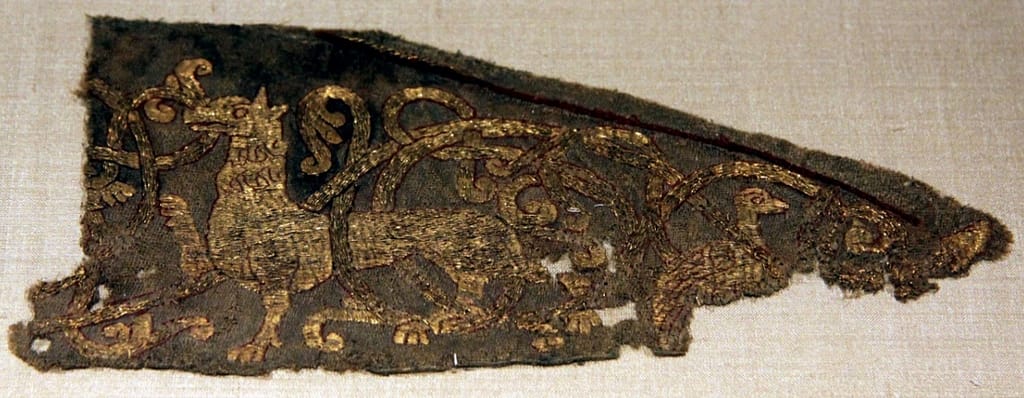
(Musée des Arts Décoratifs, inv. 16325).
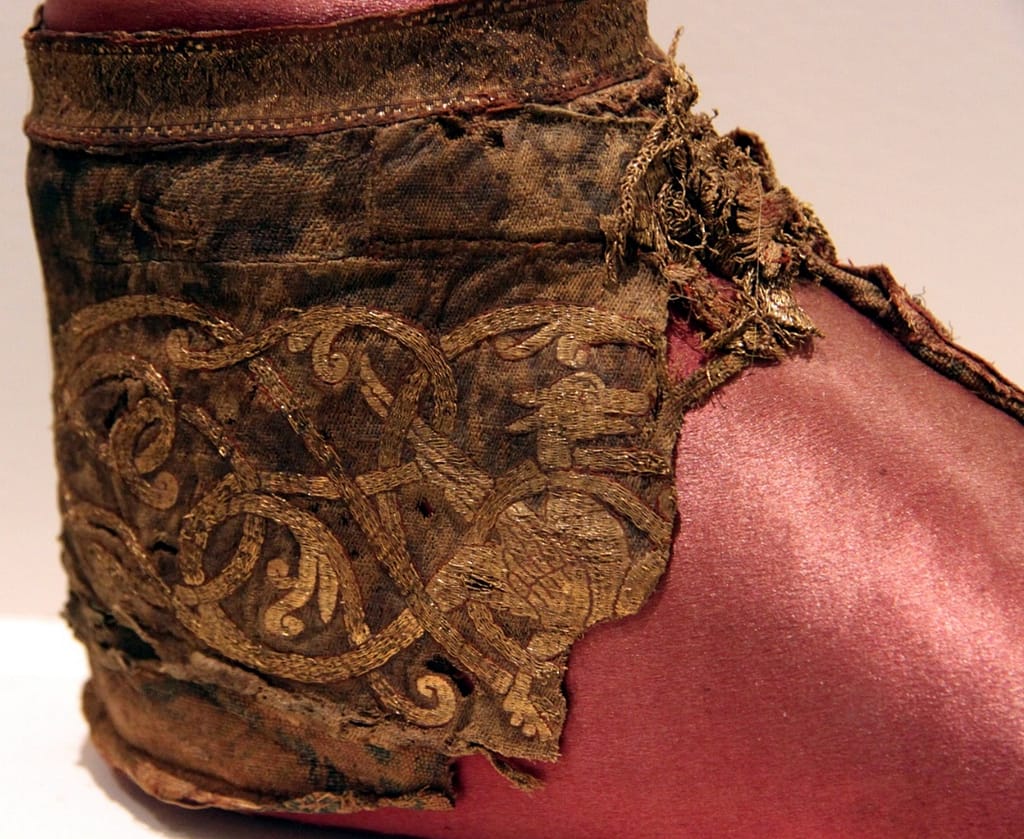
Fragments (Figure 3 and Figure 4) of the beautifully embroidered shoes of a bishop named William, who was interred at Périgueux Cathedral, are now dispersed over three museums (Musée de Cluny Cl. 12113, Musée des Arts Décoratives 16325, and Musée des Tissus MT 25078 & MT 25079). They were made in the 12th century, before AD 1173, in either England or France. The single threads of gold foil wrapped around a silk core are couched on samite. The design consists of animals amidst scrolling foliage.
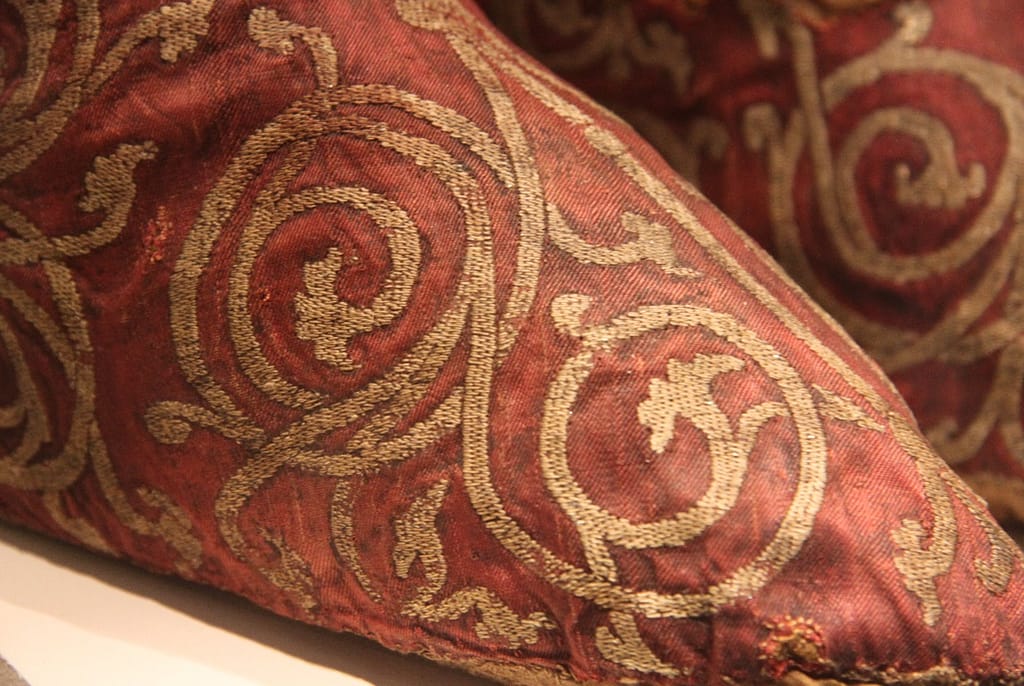
The Victoria & Albert Museum (1380-1901), the British Museum (1891,0713.2) and Worcester Cathedral all hold fragments of the same pair of episcopal stockings and shoes found in a tomb that is believed to belong to Bishop Walter de Cantilupe of Worcester (V AD 1266). The stockings and shoes were made c. 1220-1250 in England. They depict a throned king with a sceptre amongst scrolling[1] ornaments. The underside couching is executed with a single silver-gilt thread on a red silk twill. The stiffness of the figures identifies the design as Romanesque. Beautifully embroidered shoes (Figure 5) were found in the tomb of Edmund of Abingdon. Although he was archbishop of Canterbury, he needed to seek refuge in France due to a conflict with King Henry III. He died at the Cistercian Abbey of Pontigny in AD 1241. When he was canonised six years later, his tomb was opened, and his body clothed in richly embroidered vestments. The shoes, together with a stole, a maniple and a mitre, date from this occasion (Christie, 1938).
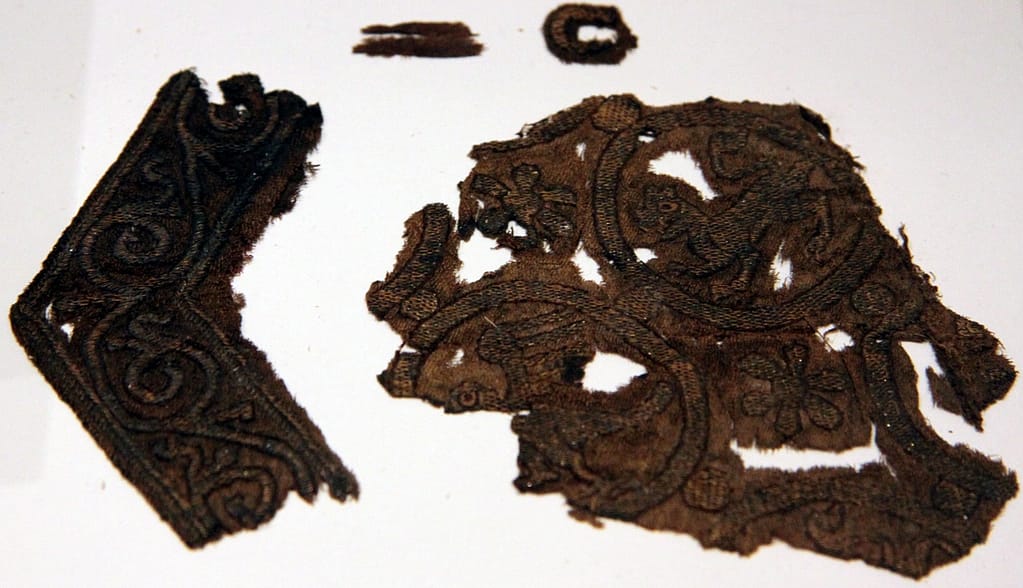
Fragments of another liturgical shoe (Musée Cluny Cl. 20197, Figure 6) were found in the tomb of an abbot of the Benedictine Abbey of Saint-Germain-des-Prés in Paris. An eagle and a lion can be seen within roundels surrounded by flowers and foliage. The underside couching is executed with a single gold foil thread on samite. The shoe was made in France or England at the end of the 12th century.
[1] Compare with page f.12v of the Psalter of the Diocese of London (Lansdowne MS 420) held at the British Library (Michael (2016).