Classic Opus Anglicanum c. AD 1250-1350 (1400)
As evidenced by Figures 1 & 2 of lesson 2, the goldwork embroidery on these “classic” Opus Anglicanum pieces is dominated by the underside couching technique. Furthermore, silk embroidery plays an increasingly important role. Apart from a horse trapper, a surcoat and a seal bag, all surviving embroideries from this period are vestments or other textiles used in the church.
Chasubles
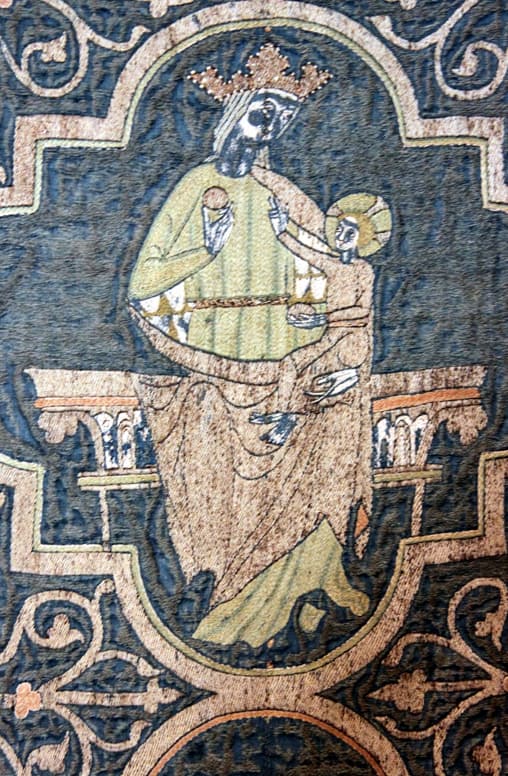
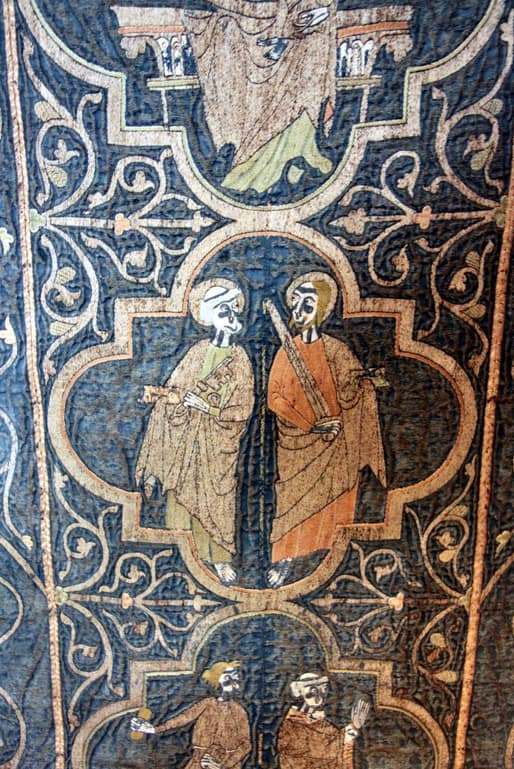
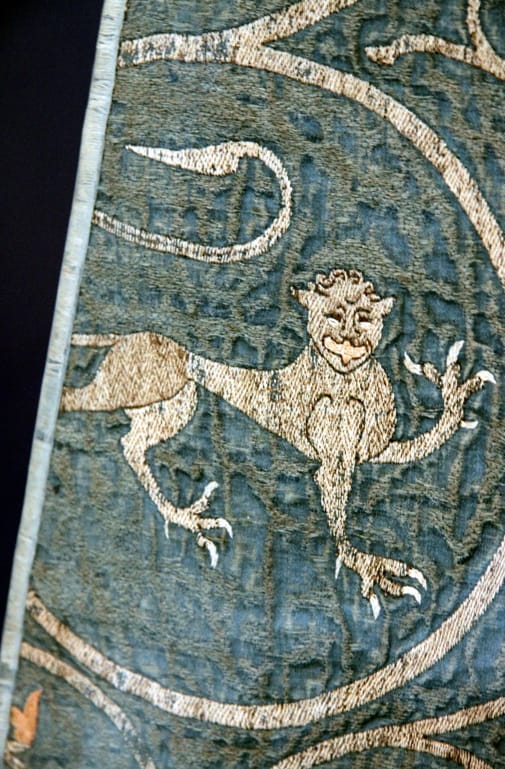
Probably the most famous chasuble of them all is the so-called Clare chasuble (Figure 1–Figure 3) held at the Victoria & Albert Museum (673-1864). In its imagery, we see a combination of foliate scrolls with animals and figurative scenes in barbed quatrefoils. The four figurative scenes on the back of the chasuble show from the top: the crucifixion with Mary and St John standing beneath the cross, the Virgin and Child enthroned, St Peter & St Paul and the martyrium of St Stephen. Whilst the underside couching of most of the embroidery uses the bricking or basket weave pattern; that in the clothing of the figures uses a chevron pattern. The embroidery uses silver gilt and silver thread and is executed on blue Iranian half-silk called kanzi[1] (Monnas, 2016b) reinforced with linen. The chasuble was made in England between AD 1272-1294.

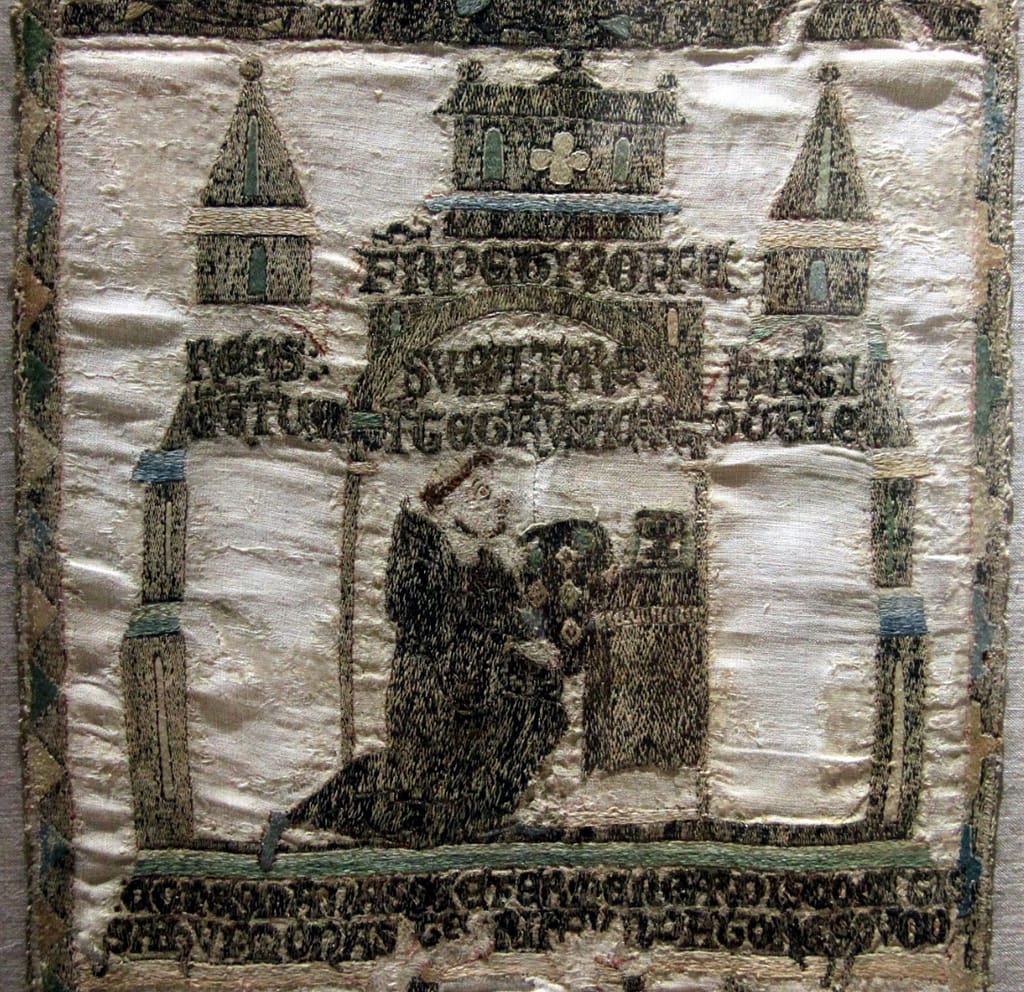
(Musée Cluny Cl. 2158).
A possible chasuble column (Figure 4 & Figure 5) is held at the Musée Cluny (Cl. 2158). It shows from top to bottom: Virgin & Child enthroned with St Viventius & St Peter, Monastery of St Vivant de Vergy and Count Manassès & Countess Ermengarde. The embroidered writing explains that Manassès and Ermengarde are the benefactors of the monastery of St Viventius. The rounded arches under which the figures are placed are according to the conventions of Romanesque art. The embroidery is executed with gold threads in underside couching on silk reinforced with linen. The piece was made in France or England between AD 1250-1299.
Preserved in its original bell chasuble shape is the Melker Kasel from Stift Melk in Austria, now kept at the Österreichisches Museum für Angewandte Kunst in Vienna (T 8724-1). The crucifixion with Mary and St John beneath the cross is depicted on the front and the back. Fleur-de-Lys are powdered in the background of the scene. Quatrefoils alternatingly filled with white roses and foliage cover the rest of the chasuble. The embroidery is executed with metal threads on violet silk backed with linen. The chasuble was made in London around AD 1300.
The Metropolitan (27.162.1) holds a chasuble that has also been cut back into the more modern fiddle form. On the front, sitting on folding chairs beneath pointy Gothic arches, are, from top to bottom: St John the Evangelist & St John the Baptist, St Peter & Saint Paul and St Andrew & St James. On the back, from top to bottom: Coronation of the Virgin, Adoration of the Magi and the Annunciation. Angels and foliage surround the scenes. The underside couching is very sophisticated, with changes in direction for different parts of the design and the use of both the bricking pattern and the chevron pattern. The embroidery is executed with silver-gilt and silver threads on plain silk[2] on velvet and backed with linen. The chasuble was made in England around AD 1330-1350.

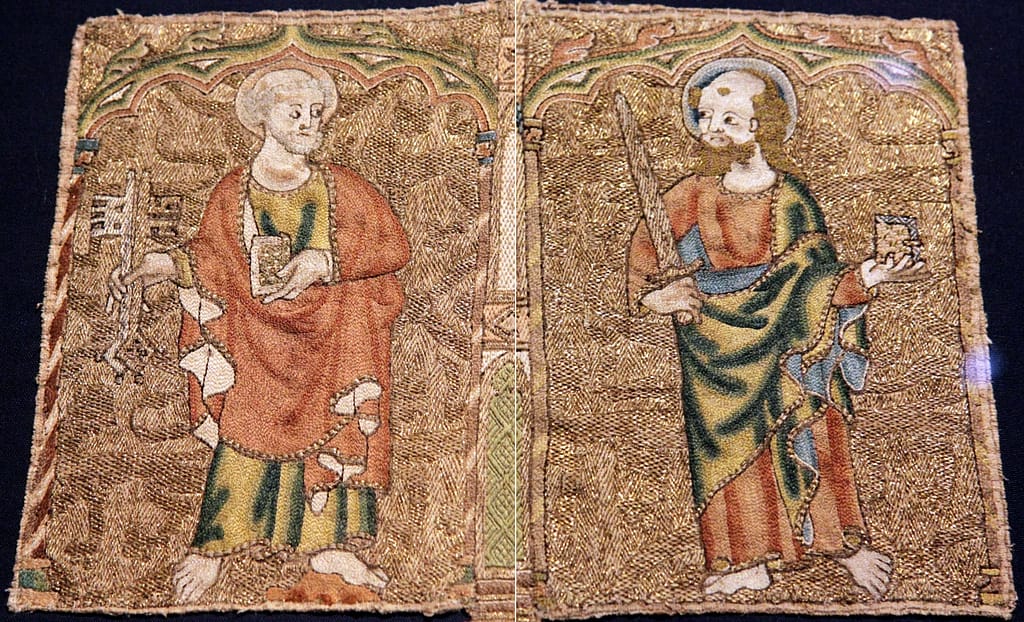
A chasuble cross known as the Marnhull orphrey (Figure 6 & Figure 7) is held at the Victoria & Albert Museum (T.31-1936). From the top, the orphrey shows the following scenes under Gothic arches: Christ in Judgement, St Peter, St Paul, Crucifixion with Mary & St John, Christ carrying the cross and the Flagellation. The bottom scene has been cut off.
The figures are now entirely worked in silk on a golden background with a foliage design in underside couching. The embroidery is executed with silver-gilt and silver thread on a linen background. The orphrey was made in England between AD 1310 and 1325 and displays the coat of arms of the Wokyndon family, who were benefactors of St Paul’s Cathedral.
A possible partial chasuble column or cross is held at the Metropolitan (2009.300.2750). It shows Christ’s genealogy, known as the Tree of Jesse. It is quite comparable in style to the Marnhull orphrey. The embroidery is executed in underside couching with metal threads on linen. It was made around AD 1350-1374 in England.
[1] A satin weave with silk warp and cotton weft.
[2] The layer of plain weave silk is used to transfer the design onto. It is then tacked to the velvet and stitching commences. This keeps the pesky hairs of the velvet at bay when stitching. Excess silk is later cut away.
Copes
Probably the most famous pieces of Opus Anglicanum are the copes now held in museums worldwide. They are often named after the Cathedral treasury they were kept in: Ascoli Piceno cope, Bologna cope, Butler-Bowdon cope, Jesse cope, Lateran cope, Madrid cope, Pienza cope, Salzburg cope, Steeple Aston cope, Syon cope, Toledo cope, Vatican cope and Vic cope. They were used as diplomatic gifts between high-ranking clergy and from the king for high-ranking clergy. Alternatively, high-ranking clergy ordered vestments in England to show off at the next synod (Gardner, 2016).

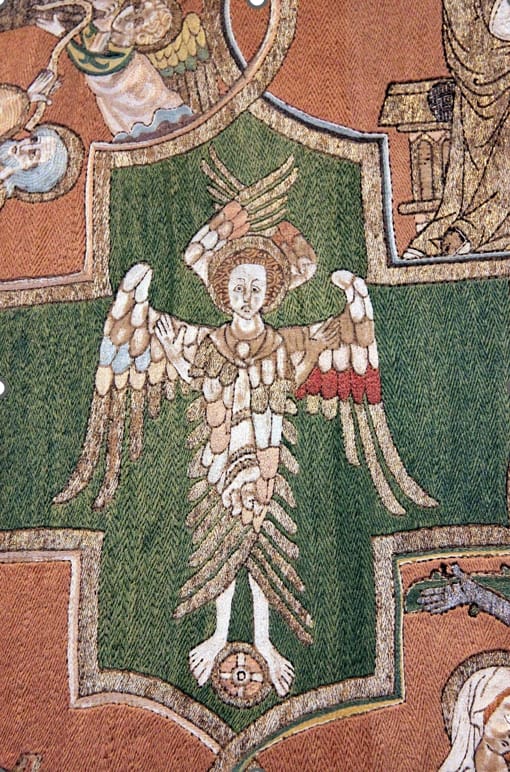
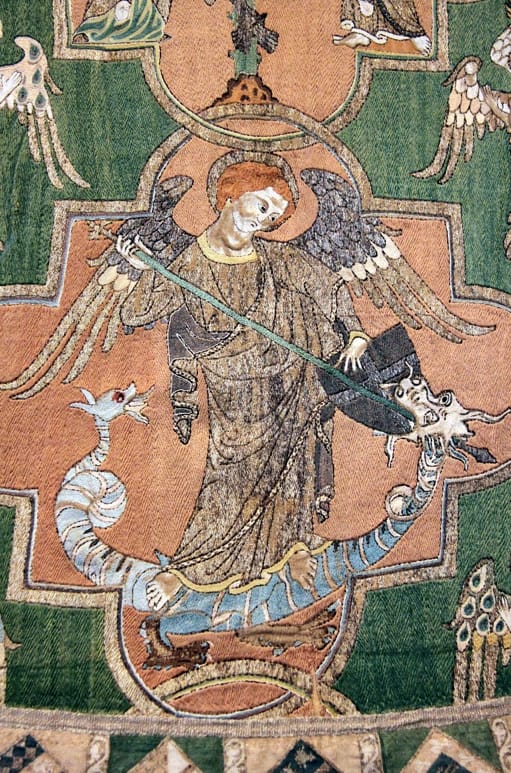
The Syon cope (Victoria & Albert Museum 83-1864) started life as a bell chasuble but was later cut down to become a cope (Figure 8–Figure 10). It is the only known piece of Opus Anglicanum where the entire background is filled with silk embroidery. The surviving scenes in the interlaced barbed quatrefoils are as follows: St Michael, Crucifixion, Coronation of the Virgin, St Philip, Noli me tangere, Funeral and Assumption of the Virgin with Thomas the Apostle receiving the girdle, death of the Virgin, doubting Thomas, St Simon, St Bartholomew, St Peter, St Paul, St Thomas, St Andrew, St James and two unidentified kneeling figures. The spaces between the scenes are filled with angels. The embroidery is executed in underside couching with silver gilt and silver threads on linen. Chevron patterns are used on the golden frame of the barbed quatrefoils and for the silken background. The Syon cope was made around AD 1310-1320 in England.
The Jesse cope (Victoria & Albert Museum 175-1889) was remade into an antependium and a chasuble. It is now once more reconstructed in its original shape, but many parts are missing. The iconography shows Jesus’ genealogy, known as the Tree of Jesse. The goldwork embroidery in underside couching is executed with silver gilt and silver thread on red silk twill reinforced with linen.
When you look closely at the use of silk versus gold for the clothing of each figure, there seems to be some sort of order. Jesus is the only figure with clothing worked entirely in gold. Mary, King Solomon, and King David, positioned in the middle vertically, have voluminous golden mantles reaching over their feet. You could argue that these are the most important ancestors of Jesus. When the cope was worn, these figures were prominently displayed on the back of the wearer.
Looking closely at the top figures (either side of the Virgin with Child), we see a rhythm. On the left is King Abia, with a short golden mantle, followed by Prophet Abraham, who has no gold at all. On the right, it is the other way around: no silk at all for King Roboam and a short golden mantle for the Prophet Zorobabel. This means that when the cope was worn, a silken person was paired with someone wearing a short golden mantle. We can thus predict that the missing person on the left wore a short golden mantle, and the missing person on the right was entirely embroidered in silk.
A similar rhythm is probably going on in the middle row of figures. To the left of King Solomon, Prophet Jacob wears a long golden undergarment, followed by Prophet Eliakim in a short golden mantle. We see the same pattern to King Solomon’s right: Prophet Moses is wearing a long golden undergarment, and Prophet Jeremiah is wearing a short golden mantle. It is likely that the missing figures on either side probably wore long golden undergarments. In the bottom row, we see Jesse embroidered only in silk. To his and King David’s left, we see Prophet Phares embroidered in silk, followed by an unidentified Prophet with a golden mantle. We see Prophet Isaiah in silk to the right, followed by Daniel with a golden mantle.
The fact that these patterns can be detected in the treatment of the figures underlines that these vestments were made in professional workshops. The piece was extensively planned before the stitching commenced. The cope was made between AD 1310 and 1325 in England.
The Pienza cope is kept at the Museo Diocesano in Pienza, Italy. This all-over ornamented cope shows scenes from several stories in three different rows. These three rows are separated from each other by two rows with the more miniature portraits of saints. The top row shows five larger scenes: Death, Coronation, and Assumption of the Virgin. The next row is filled with more miniature portraits of the ancestors of Mary and Jesus (Tree of Jesse). The next row shows nine larger scenes from the life of the Virgin. The next row is filled with the more miniature portraits of the 12 Apostles. The bottom row of 13 large scenes tells the stories of the martyriums of St Margaret the Virgin and St Catherine of Alexandria.
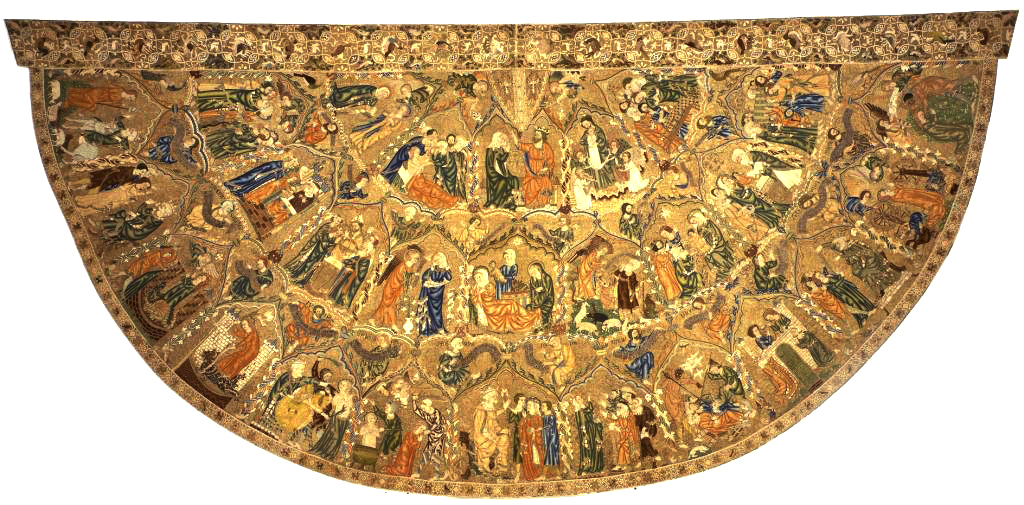
The larger scenes are all framed with Gothic arches. The scenes are mainly worked in silk on golden underside couched backgrounds. The golden backgrounds show floral motives, which are created by changing the direction in which the metal threads are couched. The silver-gilt and silver threads are worked on linen. The cope was made in England around AD 1330-1340.
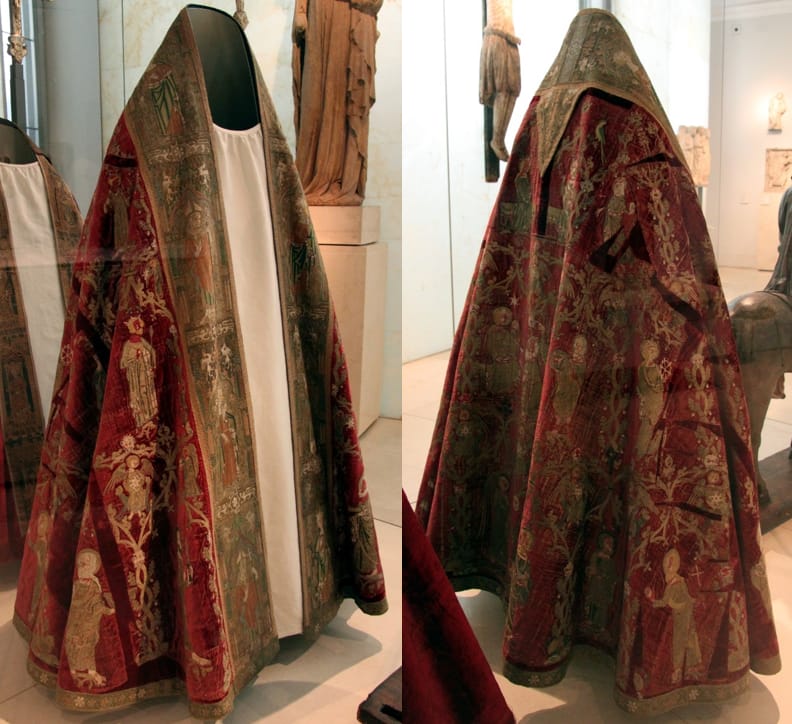
The Butler-Bowdon cope (Figure 11 & Figure 12) is on permanent display at the Victoria & Albert Museum (T.36-1955). Although remodelled at some point, the cope retained its original orphrey and small cope hood. In the central column on the back, we see from the top the Coronation of the Virgin, Adoration of the Magi and the Annunciation. These scenes are flanked on each side by three rows of saints (the bottom row consists of the 12 Apostles). A row of angels separates each row. Gothic arches frame the scenes and the saints. The figures are nearly entirely stitched with gold, and silk is only sparingly used. Silver gilt and silver threads are used for underside couching on silk on velvet reinforced with linen.
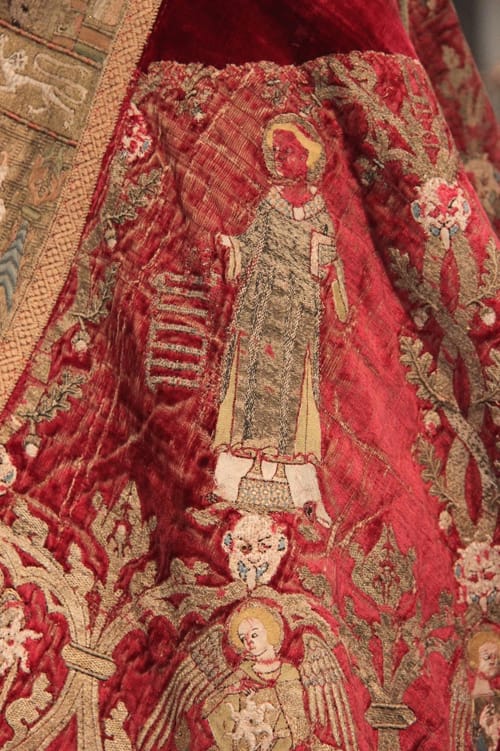
The orphreys show a king alternated with a bishop in such a way that when the cope was worn, a king faced a bishop. The figures are mainly worked in silks and placed on a golden background. The golden background is in underside couching and shows a pattern of eagles on chevrons, clover on chevrons and fleur-de-lys on chevrons. The figures are placed beneath ornate Gothic arches. The Butler-Bowdon cope was made around AD 1335-1345 in England.
This cope is held at the Museu Episcopal de Vic (MEV 1430; there’s a video at the bottom of the page!) and originally belonged to Bishop Ramon de Bellera (bishop of Vic AD 1352-1377). At some point during its life, it was turned into a lectern hanging, two dalmatics, a bookbinding for a missal and as embellishment for several other vestments. Its current reconstruction took place at the Abegg Stiftung in Switzerland in 2008 (Calonder and Woś-Jucker, 2008).
The cope shows in its central column on the back from the top: Coronation of the Virgin, the Nativity, and the Adoration of the Magi. On either side are three rows of saints separated by rows of angels. The figures and scenes are placed under Gothic arches. The majority of the embroidery is done in underside couching of silver gilt and silver thread on silk on red velvet reinforced with linen. The cope was made in London between AD 1350 and 1375.
Various other examples
The British Museum (1884,0606.6) holds part of an antependium. The two remaining scenes depict the Calling of the Apostles and the Betrayal by Judas. Each scene is placed beneath a Gothic arch. The underside couching is executed in silver gilt thread on linen in a floral pattern. The piece was made in England around AD 1320-1330.
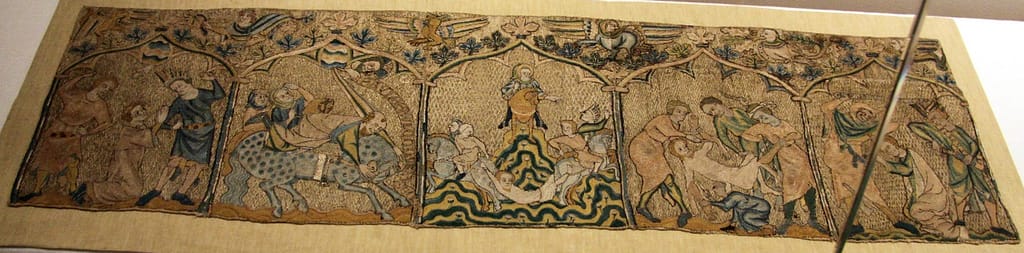
Another possible antependium fragment (Figure 13 & Figure 14) is dispersed over two museums: Museum Mayer van den Bergh (MMB.09050) and Musees Royaux d’Art et de Histoire (Tx 1086, Tx 1345). The scenes on MMB.09050 depict from left to right the martyrium of St Stephen, the Conversion of St Paul, the martyrium of St Hippolytus, the martyrium of St Bartholomew and the martyrium of St James. Each scene is placed under a Gothic arch in front of a golden background. Various underside-couched diaper patterns with metal threads on linen are present. The piece was made in England around AD 1340-1350.
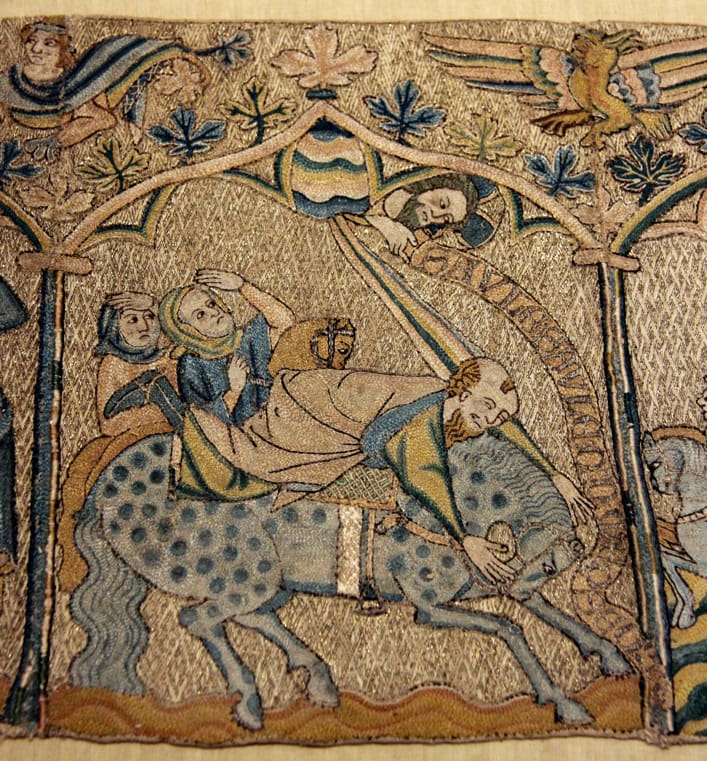
with the Conversion of St Paul.
The Victoria & Albert Museum (T.26-1936) holds a burse (a flat pouch for the linen corporal used in the eucharist). On one side, it shows the Crucifixion with Mary and St John, and on the other side, the Coronation of the Virgin. The underside couching is executed in silver gilt thread on linen, showing a complex pattern of quatrefoils with lions. The piece was made in England around AD 1320-1330.
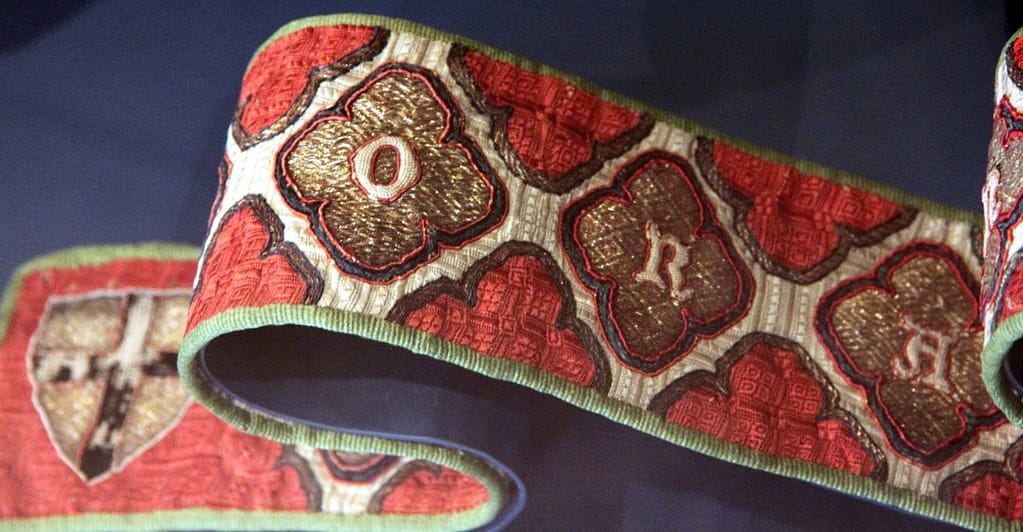
Also in the Victoria & Albert Museum (T.70-1923) is an interesting fragment (Figure 15) of which Hourihane (2016) argues that it was once part of a funeral pall (the cloth placed over a coffin during the funeral service). The design consists of 32 quatrefoils with in each a letter (made with knotted stitches) of the inscription “in hora mortis seccurre nobis domine” (Help us, Lord, in the hour of our death). The embroidered inscription on the linen lining on the back states “domna iohanna beverlai monaca me fecit“ (Sister Johanna of Beverly made me). The embroidery is executed with silver gilt thread in normal surface couching (this is seen on other, albeit later, funeral palls too). The gold fillings of the quatrefoils show many different diaper patterns. The piece was made between AD 1300-1349.

Musée Cluny (Cl. 20367 a-g) holds the fragments of a horse trapper[1] (Figure 16 & Figure 17) which at some point in its life was re-made into several vestments and kept at Altenberg Abbey in Germany. The horse trapper was probably made for Edward III (AD 1312-1377) when he visited the imperial diet at Koblenz, Germany, in AD 1338. As the horse trapper only depicts the lions of the coat of arms of England, it must pre-date Edward’s decision to quarter his coat of arms with that of France in AD 1340. Furthermore, the human figures in courtly dress inhabiting the foliage background are similar in style to some marginalia in the Luttrell Psalter (British Library MS 42130, f. 171V). This supports a date between AD 1320 and 1340.

As with the fragment of the funeral pall described above, the horse trapper is embroidered in normal surface couching. The silver gilt and silver threads are couched onto a layer of silk on velvet. The use of rock crystal for the eyes and imitation jewels of rock crystal and seed pearls make this embroidery fit for a king. Pearls were originally used on many embroideries, as indicated by the white padding and white threads that had originally fastened them.

A particularly fine example of an orphrey (Figure 18) with a golden background in underside couching forming several diaper patterns can be found in Musée Cluny (Cl. 22821). It is stitched on linen with silver gilt thread. The design shows the Presentation at the Temple. It was made in England AD 1340-1350.
The above-listed examples are more or less complete. But they are not the only pieces of Opus Anglicanum that have survived from this period. There are many loose panels and orphreys for which the original function is sometimes uncertain or unknown, as well as further, more or less complete pieces. Here are the ones from the online museum catalogues for you to explore: T.337-1921, T.56-1913, T.72-1922, 1919,0305.1, HC.T.X.xxxx.21.(E), 827&a-1903, T.1-1940, T.2-1940, 8128 to B-1863, 836-1902, 837-1902, 838-1902, 839-1902, 840-1902, T.765-1995, 28 to S-1892, 614-1898, T.5-1988, 17.190.186, 17.77, 1884.0606.6, 1982432, 176&A-1889 & T.14&A-1937, 614-1898, 1949.503, 828-1903, 829-1903, T.5-1988, T.5A-1988, 817-1901, 29.2, T.256-1967, T.141-1974, T343-1921, 89660, 1932.238a, 1932.238b and MEV 374.
[1] A fancy dress for a horse. You can find a contemporary depiction in the ‘Traité de la forme et devis comme on peut faire les tournois’ written by Duke René d’Anjou (AD 1409-1480): folio 45v and folio 45r.