Historical Examples Lesson 2
When we look at Figure 1 and Figure 2, we see that not many English embroideries survive from before the (2nd half) of the 12th century. As expected, more pieces have survived as we move closer to the present day. When we look specifically at the way the metal threads were couched onto the fabric[1], we see that underside couching was probably not practised in England before the 11th century. Equally, from the 14th century onwards, normal surface couching started to gain in popularity again. However, as embroidery is also often dated on technological grounds, it might be that the cut-off-point between underside couching and surface couching in the late medieval period was not so harsh. It is likely that scholars, in the absence of more refined methods, assign a later date too rashly for a surface-couched piece.
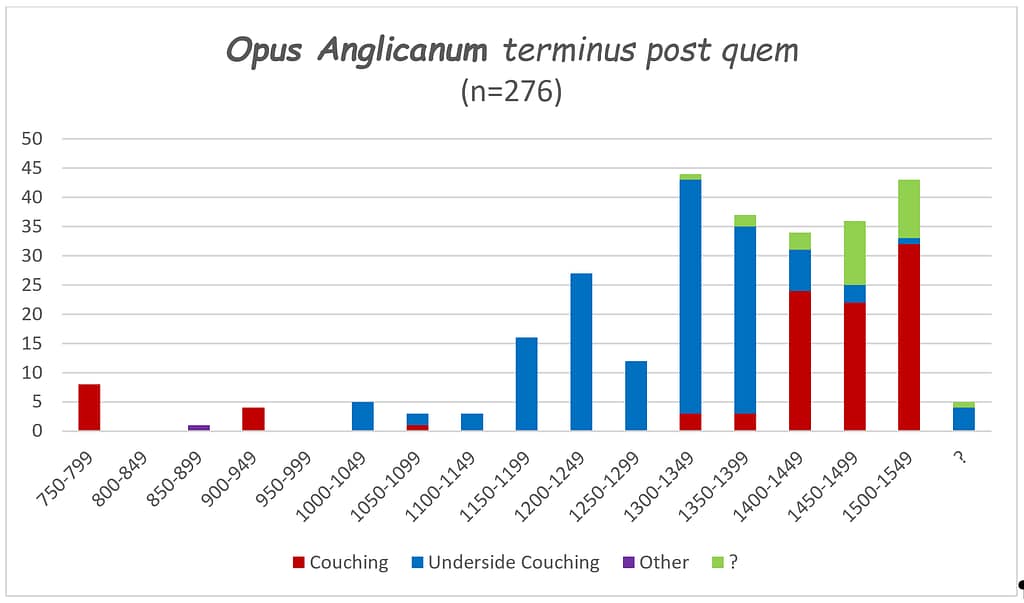
of “England” or “England?” in my database according to the embroidery technique used.
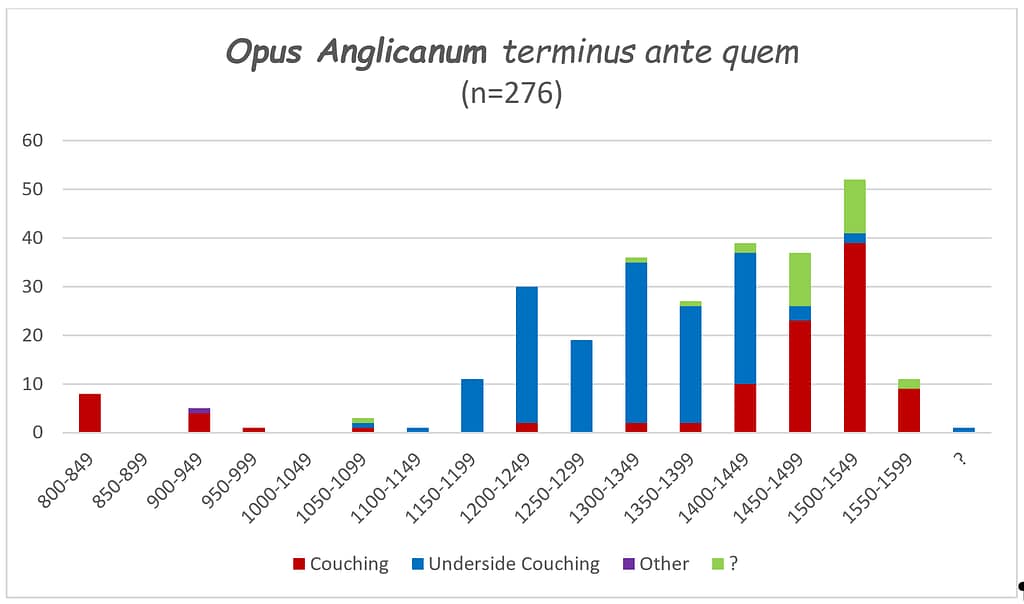
of “England” or “England?” in my database according to the embroidery technique used.
[1] There is one piece that probably shows a kind of a loop stitch using metal thread. As the piece stems from a cremation burial and is carbonised, identification is tentative (Lester-Makin 2019).