
In the coming blog posts, we will look at medieval goldwork embroidery produced in Venice, Italy. We are going to start with a beautifully embroidered mitre kept in the Germanisches National Museum in Nuremberg, Germany. The mitre (KG 709) was purchased by the museum from an antiques dealer in Cologne in 1890. Unfortunately, nothing is known about its provenance. However, a closer inspection of who is depicted on the mitre does hint at its original client.

Due to the way it is displayed, the mitre can only be studied on the back. The two prominent figures on the mitre proper are Saint Lawrence on the left and Anthony of Padua. The five medallions along the bottom show (from the left): Saint Agnes, Mary Magdalene, Louis of Toulouse, Catherine of Alexandria, and Clare of Assisi. The four medallions above (from the top) show: Saint Michael, Saint Lawrence (again!), Francis of Assisi and Saint Stephen. The lappets show (on the left and from the top) the sun with a face, John the Baptist (again!), two birds, Catherine of Alexandria (again!) and a deer. On the right (from the top): the moon with a face, Saint Anthony, a deer, Mary Magdalene (again!) and two birds.
On the front, the leading figures are Mary and Gabriel in the Annunciation. The medallions on the front depict: Luke the Evangelist, Mark the Evangelist, Saint John, Anthony of Padua (again!), Saint Peter, Saint Paul, Christ, Mary and John the Baptist. By the way, all figures can be identified thanks to their embroidered initials. Together with the embroidered figures’ style, the initials reveal a strong Byzantine influence. Venice was once ruled by the Byzantine Empire and later traded extensively with it.
Quite a few of the depicted figures are linked to the Order of Friars Minor (Franciscans). There’s Francis and Clara themselves, as well as Anthony of Padua and Louis of Toulouse. Anthony of Padua is depicted twice, once as a full-figure on the back and once as a medallion on the front. And then there are the sun and the moon, both personified with a face. They remind me of the famous Canticle of the Sun, composed by Francis of Assisi. The mitre was thus likely made for the Friars Minor. And the inclusion of Louis of Toulouse, canonised in AD 1317, indicates that the goldwork embroidery was made after AD 1317 – probably somewhere around AD 1325.
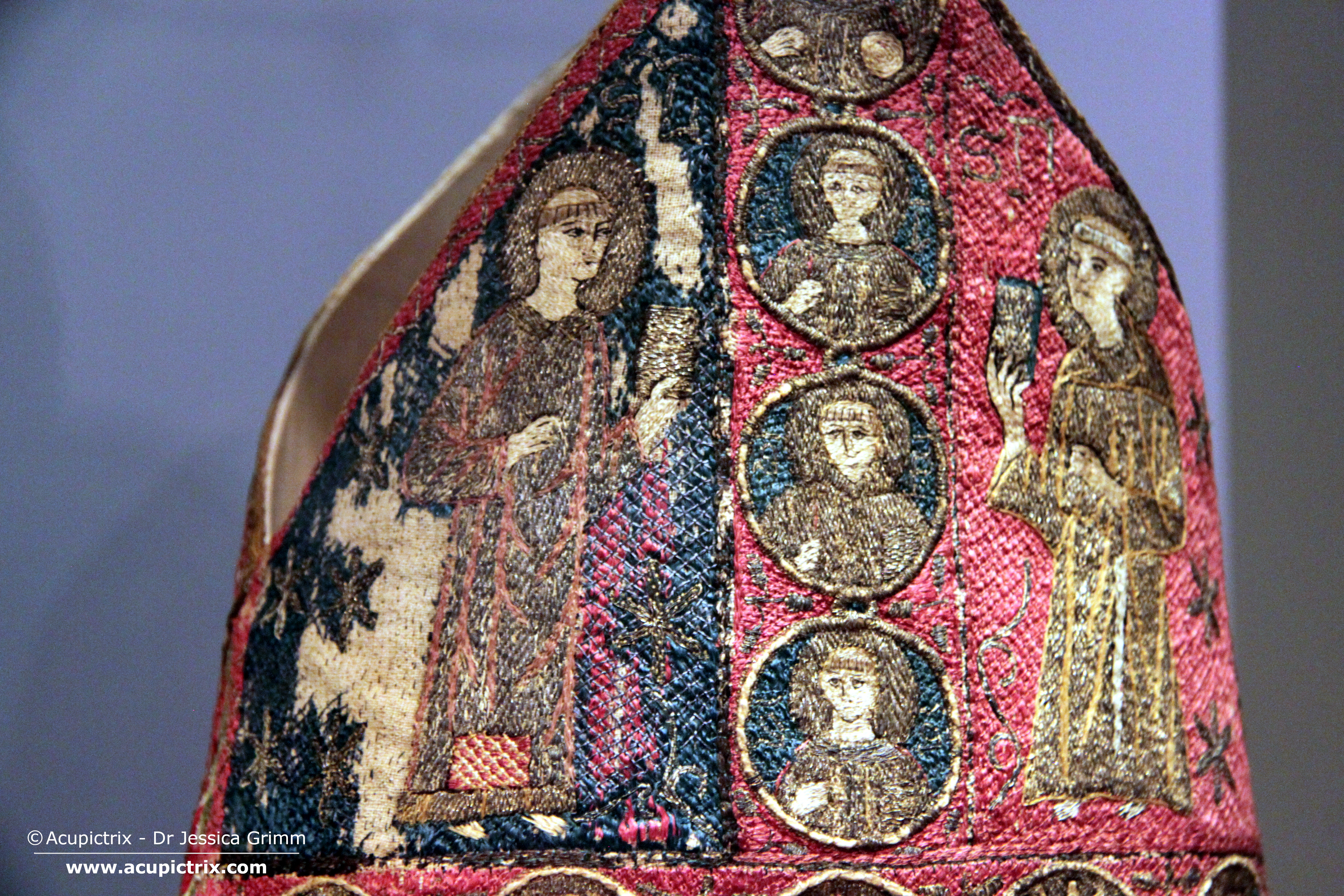
The goldwork embroidery on the mitre shows some interesting techniques. The figures’ garments are entirely filled with couched gold and silver threads. The metal threads are couched in pairs with cream-coloured silk, often in a bricking pattern. However, Saint Lawrence in the picture above has slanted lines as the couching pattern. The metal threads follow the flow of the garments. I am uncertain whether the folds were first accentuated with coloured silks, and the areas were then filled in with metal, or if the silk is stitched on top of the metal (I think the latter).
The edges of the medallions consist of string padding covered with pairs of gold thread gimped couched over it. All metal-thread embroidery is done with a passing thread with a silken core.

There are no slips. All embroidery is executed directly on natural-coloured linen with a warp count of 46-51. No weft count mentioned. The background of the goldwork embroidery consists of laid silk couched down with a trellis in the same colour, mainly. This makes for a lovely texture! And it saves on materials. Some of the metal thread decorations (foliage and stars) are worked on top of the silk.
The faces, feet and hands are worked in directional split stitch with the facial features stitched on top. Although not as finely worked as the directional split stitch in Opus anglicanum, there are some similarities. Not in the least in the treatment of the grey hair with dark streaks as seen in the figure of Saint Anthony in the picture above.
Parchment was used to stiffen the mitre. The original parchment was an upcycled piece of a 13th-century manuscript. When the mitre was widened for a person with a bigger head in the 15th century, an invoice from a monastery in Northern Italy was used. It is lovely to know that a, by then, already older piece of goldwork embroidery, was still being valued and altered for further use.
Literature
Blöcher, H., 2012. Die Mitren des hohen Mittelalters. Abegg Stiftung, Riggisberg.