
Late last year, I visited the Domschatz of Fritzlar. This small museum displays several embroidered medieval textiles, which you can photograph as long as you don’t use flash. The textiles are extremely well-lit and very close to the display case’s glass. This means that you can examine them very well! Today, we will discuss one of the embroidered chasubles on display featuring the Virgo inter Virgines iconography. It was made in Central Germany in the late 15th century. Depending on the definition, this can comprise parts of Hesse, Franconia, the south of Lower Saxony, Saxony, Thuringia, and Saxony-Anhalt. As Fritzlar falls within this area, this is thus more or less a local production.

Unfortunately, our poor chasuble sits right behind the seam between two glass sheets. The chasuble’s iconography of the Virgo inter Virgines is an all-female affair (bar Baby Jesus). The central depiction shows Mary with baby Jesus standing on the moon crescent with rays of light behind them. To Mary’s left, the bust of Catherine of Alexandria with sword and wheel. To the right, Saint Barbara with a chalice. Above, on the clouds (i.e. in heaven), sits the bust of Saint Ursula with an arrow. Below this central orphrey panel are two more orphrey panels, each with two female saints. The top one shows Dorothea of Caesarea with a basket and Margaret the Virgin with her pet dragon. Below that is a cut orphrey panel with Saint Apollonia (thongs) and Mary Magdalene (ointment pot). All the women wear crowns and have a nimbus to identify them as saintly virgins.
This concept of the Virgo inter Virgines (the virgin amongst the virgins) originates in Cologne and surrounding Westphalia, Germany. It is seen in various art forms between 1400 and 1530. Although it was popular with a wide range of audiences, it was explicitly aimed at religious women in convents. We will examine other examples in next week’s blog post.
The chasuble also has a corresponding embroidered column on the front. Unfortunately, I have not yet been able to see it.

Although the embroidery looks a lot cruder than the refined or nué pieces from the Low Countries, it is actually quite high-quality. Many techniques are being used for both goldwork and silk embroidery. For instance, the curly hair of Baby Jesus is made by overtwisting silk and couching it down. The silk embroidery in the faces is mostly vertical shaded brick stitching for the flesh, with finely added detailed stitching for the facial features. These are not an official type of stitch. The embroiderer painted with needle and thread to add the eyes, nose and mouth.
The folds in the garments have been padded with string padding. The gold threads have been couched over these. Thick silken stitches accentuate these folds further. The rays of light behind Mary have also been padded heavily. But that’s not all!
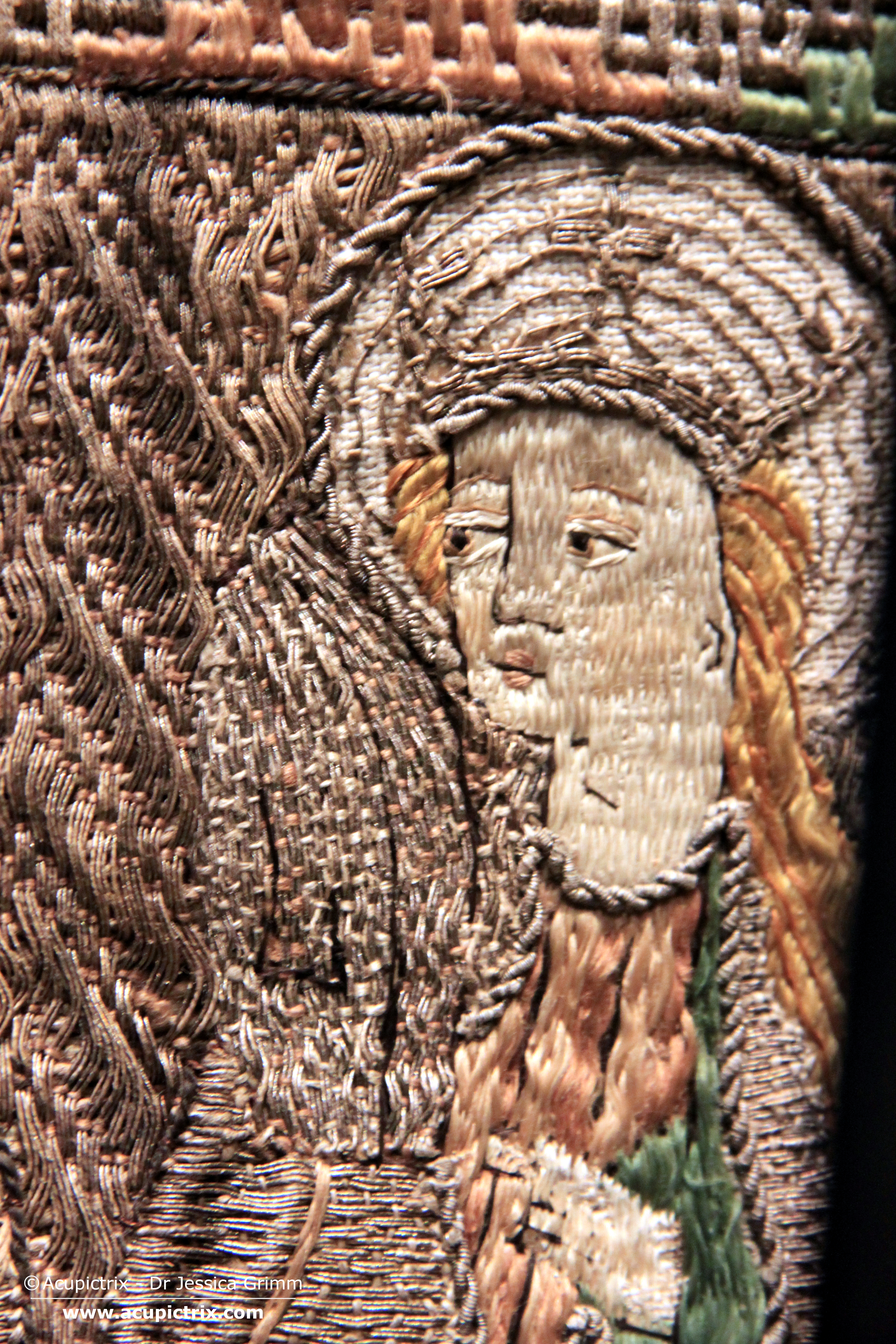
Above, you see a detail of Saint Barbara with her tower. If you look closely, just to the left of her nimbus, you can see the string padding beneath the diaper pattern in the background. The double chevron pattern is created by couching over horizontally laid string padding.
And we see something else that seems to be characteristic of some German embroideries: a thick textile thread wrapped in a thin metal thread. This metal thread is thinner than that used for the rest of the goldwork embroidery. Two of these ‘gold gimp’ threads are then twisted together and couched down along the edge of the neck opening of the garment and along the edge of the nimbus. I am wondering how they made this thread. Did they apply some glue to the thick textile core before wrapping it tightly with the thin metal thread? I am also thinking that this metal thread is a membrane gold rather than a passing thread. It must be relatively ‘soft’ to accommodate such tight, uniform coiling around the textile core. I have the suspicion that a passing thread would be too stiff or would show marked bends. Any thoughts?
Literature
Weed, S.E., 2002. The Virgo inter virgines: Art and the devotion to virgin saints in the Low Countries and Germany, 1400–1530. Dissertation, University of Pennsylvania.